
Bill Siwicki

Its CEO says healthcare organizations must "mobilize" their electronic health record systems, using AI-enabled platforms to get tangible value from all the data they've been collecting for two decades.

Remote Patient Monitoring
Rural Americans are nearly three times more likely to develop chronic kidney disease than those in urban areas. Dr. Sharica Brookins has proven that, with telehealth and RPM, 100% virtual kidney care is not only possible, but essential.

The four-hospital Florida health system's enterprise implementation was daunting, as any health IT leader knows. But getting outside, at-the-elbow help made for a smoother, safer and more controlled transition. The CMIO describes the big switch.

Success Stories & ROI
The three-hospital healthcare alliance's "Lines and Drains" EHR analytics project achieved 100% compliance in documentation across all locations, up from 20%. And the time to compile reports dropped from 50 hours to under four.

Success Stories & ROI
For Main Street Medical, the technology has streamlined prescription refills, improved patient experience and operational efficiency, boosted patient satisfaction and reduced staff burnout.
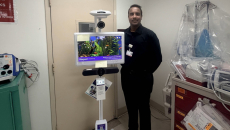
Virtual sitting supports continuous patient safety when bedside observation is needed. The 51-hospital health system narrowed its choices down to two very different models. The telemedicine chief offers a deep dive into this competition.
AI & ML Intelligence
So says Ryan M. Cameron, Children's Nebraska's newly minted chief information and innovation officer. He says provider organizations should pursue a small set of agentic AI projects – not as pilots for innovation's sake, but as fixes for concrete problems.

Success Stories & ROI
After careful research, the hospital changed its practices – and was able to eliminate nearly 500 metric tons of carbon dioxide emissions last year alone. A pediatric anesthesiologist describes how the HIMSS EMRAM Stage 7 facility achieved this feat.

Success Stories & ROI
The hospital's previously manual program – which offers more pay to employees who volunteer for high-need shifts – has seen its error rate decrease by 72% and its shift fulfillment rate soar from 40% to 70%.
Memorial Sloan Kettering's enterprise architecture chief offers practical advice for getting ahold of this fast-growing challenge before it overwhelms storage and cost-management strategies.