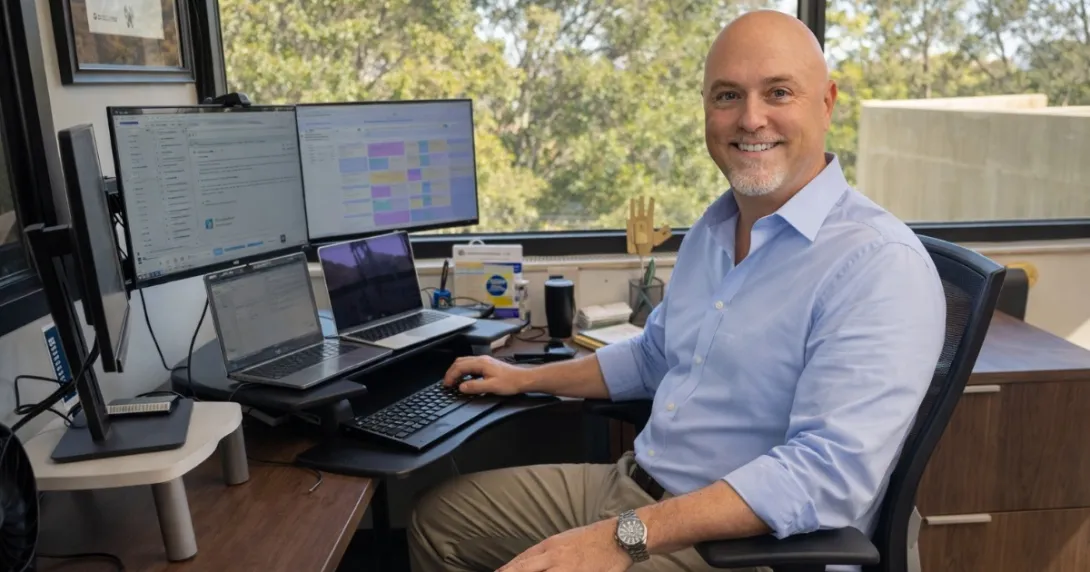
Dr. Brian Boggs, CMIO of Health First
Photo: Health First
Health First, a not-for-profit, four-hospital health system based in Brevard County on Florida's Space Coast, was preparing a large and diverse clinician population to transition simultaneously from multiple legacy systems and locally adapted processes to a unified enterprise record. In other words, a system-wide new EHR go-live.
THE CHALLENGE
Across its four hospitals, medical group and outpatient divisions, physicians had become accustomed to longstanding local workflows, variable documentation styles, and customized processes that differed dramatically by site and specialty.
That variability made it difficult to define a single standard that clinicians trusted – especially in a high-stakes cutover where even small workflow friction can impact patient flow, safety and clinician confidence.
At the same time, Health First needed to prepare a large clinician population – across inpatient, ambulatory and procedural settings – for a single enterprise cutover to the new EHR from Epic. The burden wasn't just training – it was building confidence and reducing uncertainty.
Physicians reasonably worry their ability to deliver safe, timely care will be disrupted by unfamiliar screens, new decision pathways or unexpected variations in documentation, said Dr. Brian Boggs, CMIO of Health First.
"For a large health system, the scale of that anxiety becomes its own operational risk," he explained. "We knew if we didn't proactively address those concerns, we'd see predictable downstream effects: slower care delivery, longer length of stay, documentation delays, and avoidable stress on nursing, physicians and support teams.
"Training alone – no matter how well executed – cannot fully mitigate those concerns," he continued. "Clinicians need real-time, experienced peers beside them during the transition to ensure they're supported the moment a question or barrier arises."
Finally, the go-live placed extraordinary demands on internal leadership.
"Even with highly capable internal teams, there are moments when an experienced outside perspective helps you separate signal from noise, pressure-test plans, and create practical guardrails for at-the-elbow support, command center escalation and stabilization," he said.
"We recognized early we needed a model that blended internal leadership with an external bench of highly experienced physician support to avoid the classic pitfalls of over-extension during a major system transformation," he added.
PROPOSAL
The proposal that resonated most strongly with Boggs and the team centered on mobilizing a substantial cohort of physician at-the-elbow support – clinicians with deep experience in the Epic EHR platform Health First was implementing, including emeritus-level advisors who had spent years leading similar transitions across the country.
This is why Health First decided to use the Epic Emeritus Program. As we've been reporting here recently, one valuable but perhaps underappreciated source for such EHR advisors is the Epic Emeritus CIO or CMIO program. With it, the company connects retired Epic executives and clinicians with healthcare organizations to provide strategic advisory services, fill interim leadership roles and support critical projects like go-lives and optimization.
"The idea was to build a physician-centric safety net: a highly trained, highly experienced group whose sole purpose was to stand beside our frontline clinicians in the moment of need," he explained. "The model emphasized pairing emeritus physicians – former CMIOs, physician informaticists and specialty leaders – with local clinical champions to combine external pattern recognition with internal institutional knowledge.
"These advisors brought experience from dozens of prior go-lives – allowing them to identify issues before they became systemic problems, calibrate workflows that often surprise clinicians on day one, and coach our internal teams to avoid common go-live pitfalls," he continued. "They would help distinguish urgent safety/workflow issues from 'important but later' enhancements, so the organization didn't drown in tickets or lose focus during the first weeks."
Operationally, the proposal was designed to create a multiplier effect.
"Emeritus physicians would form the core, providing strategic and real-time guidance, while additional physician support teams from partnering organizations would expand the footprint to ensure broad coverage across all go-live locations," Boggs noted.
"This structure ensured not just rapid issue resolution, but also clinician-to-clinician credibility – a critical component of maintaining trust and safety in the earliest days of a major EHR transition," he added.
MEETING THE CHALLENGE
Health First executed a physician support model of significant scale: More than 50 at-the-elbow physicians were deployed across the facilities, including emeritus-level advisors, former CMIOs, physician informaticists and physicians with extensive go-live experience from multiple partnering organizations.
"These individuals were strategically assigned across inpatient units, emergency departments, procedural environments and ambulatory practices to ensure no clinician was ever far from knowledgeable peer support," Boggs recalled.
"The emeritus physicians played a uniquely important role," he continued. "Their years of experience guiding other organizations through similar transitions meant they understood both the predictable pain points and the unexpected disruptions that clinicians experience in the first hours and days of a go-live."
They worked closely with internal clinical leadership, operational readiness teams and command center structure, helping refine escalation pathways, adjust support staffing hour-by-hour, and provide practical coaching to both frontline clinicians and local leaders.
"Logistically, we met with bedside medical staff leaders as a group daily to discuss illuminated issues, distribute solutions and consolidate progress," he said. "Our model used layered physician support. Emeritus advisors focused on high-complexity problem-solving and real-time pattern recognition.
"Experienced CMIOs and physician builders from multiple organizations worked directly with clinicians to resolve workflow issues at the bedside or immediately escalate high-acuity concerns," he continued. "Internal clinical champions provided context on local practice norms."
This combination – external expertise plus internal alignment – created a resilient structure that allowed staff to detect issues, address them quickly, and maintain calm operational flow during a period that can easily become chaotic, he added.
RESULTS
The clearest result was that the clinician support model functioned with greater reliability and consistency than staff would have achieved without an experienced "eyes-on-the-ground" advisor, Boggs reported.
"At-the-elbow support was not treated as an informal add-on – it was operationalized with defined workflows for intake, escalation and resolution," he explained. "Clinicians experienced faster answers in the moment, fewer dead ends, and a clearer sense that the organization was listening and acting.
"That reduced frustration, prevented workflow workarounds, and helped stabilize documentation, ordering and communication patterns far earlier than typically expected in a go-live of this scale," he continued. "This plan delivered the credibility that matters enormously during a major transition – confidence is an operational asset."
Operationally, the presence of emeritus and experienced at-the-elbow physicians enabled more structured and disciplined stabilization, he added. Instead of accumulating hundreds of undifferentiated issues, staff rapidly triaged concerns into safety-critical, throughput-critical and optimization-tier categories.
"Emeritus advisors helped ensure the organization did not overreact to every request equally or prematurely alter workflows without understanding downstream consequences," Boggs noted. "That allowed us to maintain steady improvement while avoiding unnecessary operational variability.
"Finally, the program strengthened leadership alignment and communication," he continued. "Clinicians received consistent messaging, reliable support and clear expectations. Internal leaders benefited from external pattern recognition that kept our decision making grounded and efficient."
The net effect was a smoother, safer and more controlled transition – an outcome that would have been far more difficult without the scale and expertise of the physician at-the-elbow program and the emeritus advisors whose experience proved invaluable, he concluded.
Follow Bill's health IT coverage on LinkedIn: Bill Siwicki
Email him: bsiwicki@himss.org
Healthcare IT News is a HIMSS Media publication.
WATCH NOW: How to surmount inconsistent, duplicate records


