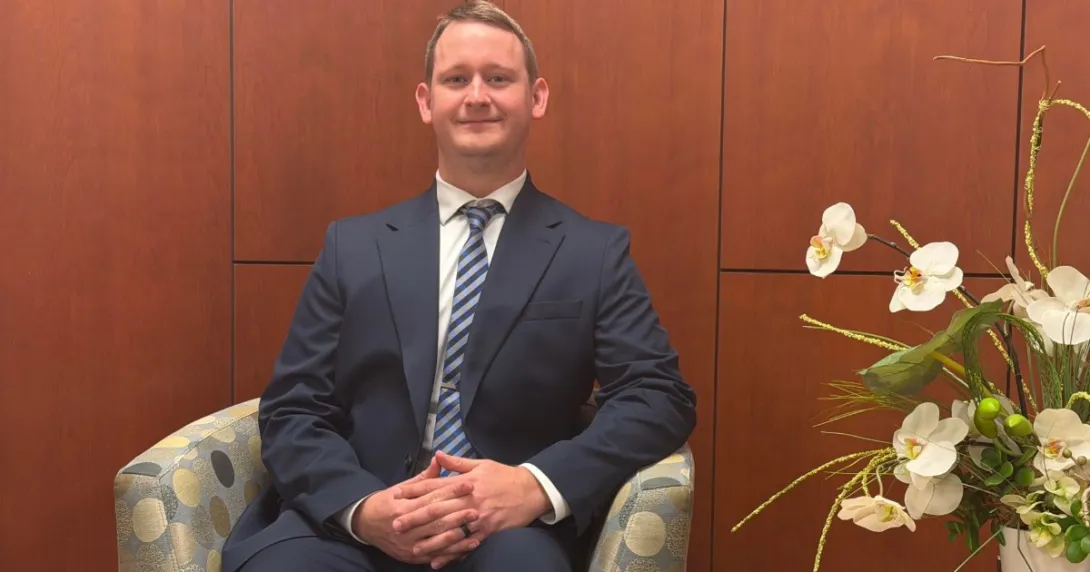
Kyle Kesinger, director of business operations at Springfield Memorial Hospital, an affiliate of Memorial Health
Photo: Springfield Memorial Hospital
Springfield Memorial Hospital is an affiliate of Memorial Health, a five-hospital health system serving Central Illinois. The hospital faced a growing challenge with the declining effectiveness of its bonus shift program, which offered additional pay to employees who volunteered to cover high-need shifts.
THE CHALLENGE
Bonus amounts were determined by the urgency of the staffing need. However, over time, the same limited group of employees consistently filled these shifts. This group began to show clear signs of fatigue, and fulfillment rates steadily declined.
Compounding the issue was a process that was both labor-intensive and highly prone to error, said Kyle Kesinger, director of business operations at Springfield Memorial Hospital.
"Initially, high-need shifts were identified manually on paper, with colleagues signing up for shifts that were often outside their intended roles," he explained. "These sign-ups were later entered into the staffing system through a cumbersome process that made verification difficult and frequently resulted in transcription errors.
"As a result, leadership lacked confidence in the accuracy of real-time staffing data," he continued. "During this period, whenever new high-need shifts were announced, lines of 30 or more colleagues would form as staff rushed to sign up."
In an effort to improve visibility, the program was later moved to the organization's internal social media platform. While this expanded the program's reach, the platform proved ill-suited for shift management. Many colleagues opted out due to the complexity and inconvenience of the process, and data errors continued to occur.
Ultimately, maintaining the program required significant resources while delivering diminishing returns, he said.
PROPOSAL
Springfield Memorial turned to vendor LotusOne's Shifts, a mobile app and platform designed to support and streamline the bonus shift program across multiple stages of the aforementioned workflow.
"The platform simplified the creation and management of high-need shifts through prebuilt templates and bulk-add functionality, significantly reducing administrative effort," Kesinger explained. "By leveraging specialties and professions, the system ensured that only colleagues with the appropriate qualifications could view and claim available shifts.
"In addition, the vendor team worked closely with us to define role-mapping rules, allowing colleagues with specific job titles to safely and accurately accept shifts across multiple related roles," he added.
From the employee's perspective, the user interface made signing up for a shift effortless, often requiring no more than a swipe of a finger, he said.
"Advanced filters allowed users to quickly find shifts that matched their preferences, such as role, department or time," he noted. "Once accepted, shifts were immediately reflected in real-time reporting, providing leadership with an accurate and reliable view of staffing levels and enabling more informed, timely decisions."
MEETING THE CHALLENGE
Springfield Memorial began by developing the application to meet the staffing needs of 21 distinct units across the hospital. Each unit presented unique requirements, which IT staff mapped by comparing real-time staffing levels against established coverage standards to identify high-need shifts essential to maintaining safe and effective operations.
By layering employee profiles so individuals could view only the shifts for which they were qualified, the hospital established a scalable framework that was easy to expand, Kesinger said. This approach quickly extended to additional departments with similar staffing challenges.
"Managers for each participating unit were granted access to the Shifts platform, allowing them to see which shifts had been accepted in real time," he explained. "This visibility provided leaders with critical staffing insight, supported more informed decision-making, and restored confidence in the integrity and reliability of the bonus shift program.
"Colleagues also consistently praised the mobile application for its intuitive design," he continued. "Access credentials were created during orientation, making adoption seamless from day one. By limiting each user's view to only applicable shifts, the app significantly improved the user experience compared to earlier versions of the bonus shift program.
The familiar, streamlined sign-up process eliminated many of the frustrations previously associated with claiming bonus shifts, he added.
"Once accepted, shifts were immediately reflected in the colleague's profile, making it easy to track upcoming assignments," he said. "Together, these enhancements expanded the reach and effectiveness of the bonus program and directly contributed to improved fulfillment rates across all offered shifts."
RESULTS
There were two primary goals in implementing new technology for the bonus shift program. The first was to reduce the high error rates associated with previous manual processes. This initiative proved highly successful, with error rates decreasing by 72% when comparing periods before and after the implementation of the mobile app and platform, Kesinger reported.
"The second goal was to revitalize shift fulfillment," he said. "Prior to implementing Shifts, fulfillment rates had declined to nearly 40%. Today, fulfillment consistently exceeds 70%, ensuring all units are staffed appropriately to support safe and effective patient care.
"In addition to these improvements, the combination of new technology and updated workflows reduced the administrative time required to maintain the bonus program by approximately 12 hours per week," he concluded.
Follow Bill's health IT coverage on LinkedIn: Bill Siwicki
Email him: bsiwicki@himss.org
Healthcare IT News is a HIMSS Media publication.
WATCH NOW: How to surmount inconsistent, duplicate records


