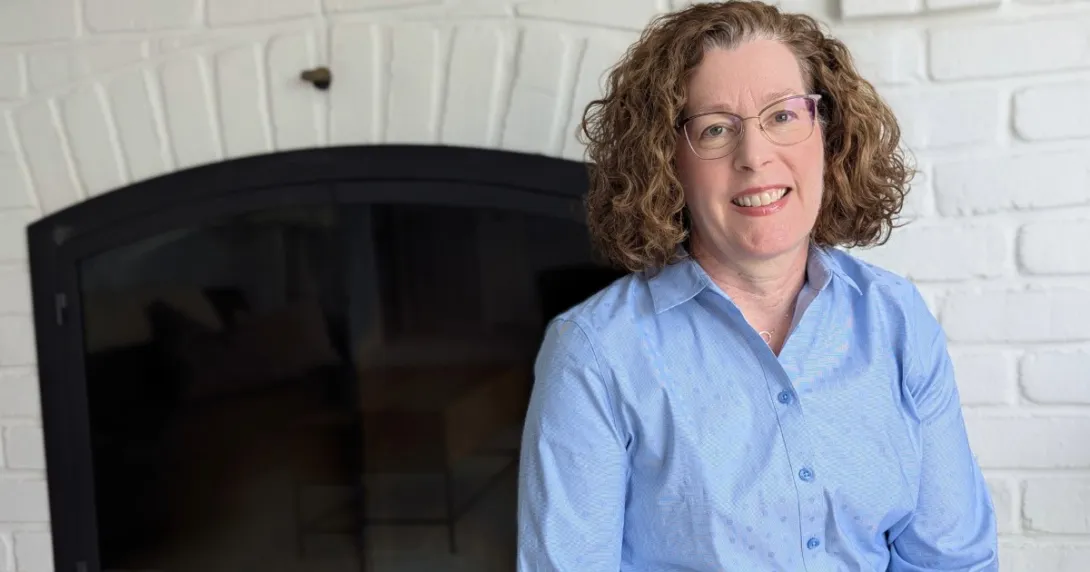
Dr. Peggy Allen, a pediatric anesthesiologist and the anesthesiology sustainability program director at Akron Children's Hospital
Photo: Dr. Peggy Allen
Dr. Peggy Allen is a pediatric anesthesiologist and the anesthesiology sustainability program director at Akron Children's Hospital. The hospital has reached Stage 7 on the HIMSS Electronic Medical Record Adoption Model, or EMRAM.
Part of that achievement was a successful effort to reduce gases harmful to the environment that stem from anesthesia. And the hospital's anesthesiology team used technology to do so.
Akron Children's Hospital posed an innovation challenge to all departments in 2021: How can the organization reduce its carbon footprint?
Allen and Tabby Cline, CRNA, one of the nurse anesthetists, had some conversations, did some research and learned the hospital's waste anesthesia gases were a significant contributor to the organization's greenhouse gas emissions. Indeed, 5-10% of the hospital's greenhouse gas emissions came exclusively from the waste anesthesia gases.
Healthcare IT News sat down with Allen to get the whole scoop on her and her colleagues' work to help the environment using technology.
Q. What was the nitrous oxide challenge you faced before turning to the technology you used?
A. The two most prominent anesthesia gasses we use at Akron Children's Hospital – and probably the most commonly used across the country and maybe even globally – are sevoflurane and nitrous oxide.
Nitrous oxide is about 300 times worse than carbon dioxide for the atmosphere. And it lingers in the atmosphere for more than 100 years. Sevoflurane lingers for more than a year and is about 100 times worse than carbon dioxide. They certainly have an environmental impact. Our goal was not to eliminate them, but to minimize how much we're using.
An interesting thing about anesthesia is the brain doesn't care how many liters of these gases it sees. It cares about what percent it sees. So, if you have 50% of something flowing at two liters versus 50% flowing at 10 liters, the brain doesn't care. It sees the 50%, and that's the effect.
We did a lot of research and educated ourselves and all of our colleagues in the department about using low-flow anesthesia, where you simply reduce the flows, you maintain the percent of anesthesia, and you certainly maintain the patient under anesthesia adequately, but you just reduce the flows.
We really wanted to reduce our nitrous oxide use because of its profound effect on the environment. As an institution we historically were very heavy users of nitrous oxide, and we saw this as an opportunity to really make an impact on the environment.
Once you learn about it, it's impressive. It's not historically a part of anesthesia education. It is becoming part of anesthesia education as we are learning more about it as a profession. But when I trained 20-plus years ago, there was essentially no conversation about this. The waste anesthesia gases come out of the back of the anesthesia machine, are vented out the roof of the hospital, and off they go.
Q. What technology did you use to address this challenge? What was the proposal this technology offered to resolve the challenge? How is it supposed to alleviate it?
A. I look at technology on multiple different levels. We had some low basic technology things. For example, anesthetics are part of the electronic health record; an electronic anesthesia record within Epic.
So, you can adjust the EHR to your institution's practices. One thing we implemented was simply an electronic low-flow reminder that popped up at the beginning of every anesthetic case, probably about the first 10 minutes of each anesthetic case. Just a simple visual reminder to consider low-flow anesthesia.
That was a simple one. And after we implemented that, we saw about a 5% reduction in our nitrous oxide use right there alone, just by one simple little technological reminder. Our anesthesia machines also have a visual reminder on them to reduce our flows of anesthesia. It's color-coded, and it has a little bar graph, and it also has text that tells you whether you are using optimal flows of gas.
They call it efficient flow of gas – too little or too much. The machine interprets what you've dialed in, the patient's characteristics, and then how much gas you flow, and if you're giving too much gas to the patient.
We also put in little laminated cards on every anesthetic machine to encourage people to use low-flow for induction of anesthesia, which means the beginning of anesthesia when you're getting a patient off to sleep.
So, those are some low-fidelity technologies we used. But then the biggest one we used, I would say, the most involved one was getting our data from Epic. Since we have an electronic health record, we said, "Let's use it." The challenge with this project was to determine: How much gas are we really using?
We know anecdotally, this provider uses a lot, and this provider already does low-flow, but how much are we all using? So, Epic allowed us to capture that answer, capture that data. And we got four months of baseline data before we even announced the project to try to reduce our flows.
We had some great baseline data for four months, starting in December of 2021 through the spring of 2022. To know how much gas we were using overall. Then we have data, and we continue to collect every minute of anesthesia at every single location since that time.
That data now is in Epic. Epic is a great electronic health record for most things, but it can be a little cumbersome to use. So, we had a third member of our team, one of our Epic analysts who was fantastic, gather all that data and crank it out into a report for us once a month. So, about the end of the first week of the month, I would get last month's data.
I had a great report, basically an Excel spreadsheet with our data for how much each individual uses in terms of the different gases, how much they use compared to their colleagues. So, say you did 5% of the anesthesia minutes, but you use 10% of the gas flows, you're an outlier there. And it also had a couple of nice graphs. It was great data to have. I could not have done this study without the work of our Epic analyst.
But the challenge was, the data wasn't terribly timely. I'm getting the data on the seventh or eighth of the month for the previous month. It's great, but it's just not real-time data. So, it allows you to look at things in a bigger picture, and you can see trends over time with that data.
But it also required the skills of our Epic analyst. So, there were other opportunities that came afterward.
Q. So how did your waste gas journey continue?
A. Well the aforementioned effort we called Project WAGER, for Waste Anesthesia Gas Emission Reduction program. That was all in-house. We did education with our colleagues. We sent out emails, we shared the data. A lot of carrots. No sticks, just carrots in terms of encouraging behavior change in practice.
After we did that for about a year, we were invited to join an international pediatric anesthesia consortium, initially nine hospitals headed up by Seattle Children's and Denver Children's, but it includes other children's hospitals around the country, and some colleagues in Canada and Australia. This was called Project Spruce.
In our first effort, our in-house project, we had reduced our nitrous use by 40% through all those efforts, which was really, we thought, fantastic. But when we joined Project Spruce, the goal was in the first year to reduce your waste anesthesia gas or your greenhouse gas emissions by 50%.
And I thought, "Great, we've already done 40%." And they said, "No, no – it's 50% from that point." I thought that was a really tall ask, but we did it. So, it was amazing that we were able to achieve that 50% extra reduction in the first year.
We joined Spruce in September 2023. And that first year, we hit the 50% target, as did every other member of the consortium, which was fantastic. And we've continued to make strides since then. But one key for Project Spruce that made all the difference is a platform called AdaptX. It's a software platform that takes all the Epic data and downloads it every night. So, the anesthetics I do today get downloaded tomorrow.
I can look today in AdaptX and see if I did something different yesterday – did it make a difference in terms of my gas emissions or did it make a difference in a whole host of different variables? AdaptX lets you look at data from so many variables. It was designed by a brilliant anesthesiologist out of Seattle Children's who was looking to optimize waste anesthesia gas and other things in anesthesia.
So it looks at so many variables in the whole perioperative period, whether it's anesthesia time for induction at the beginning of the case or emergence at the end of the case, the total operative time, the length of stay patients are in the recovery room, or did the patient need nausea medicines or pain medicines in the recovery room.
There are so many variables in the perioperative period that this software gathers, and then I can use it to answer any clinical question I have. The question with Project Spruce is trying to reduce our waste anesthesia gas.
So, it gave us our CO2 equivalence, which is the unit of measure in this field to look at your emissions, gave us our CO2 equivalence, and I could look at it by anesthesiologist, which of us were a little heavy-handed, which of us were more efficient.
Or by a certified registered nurse anesthetist, we could look at it by surgical service. Were we using more gas in our ENT cases, or were we using more gas in our orthopedic cases? Was there something about our practice where there was an opportunity to make improvements in what we do? So, this software was just amazing.
And I have to say, it's super user-friendly. Everyone in the department has access to it. Anyone can log in and pose their questions. It's literally a few clicks away, and it comes up with beautiful tables I can present in a PowerPoint talk, which I do. Every month I give our department report, and I show a couple of slides from AdaptX.
Where's our progress? How are we all doing? So that piece of technology was light years ahead of the Epic data we had. Don't get me wrong, Epic was great. And Epic data is what feeds into AdaptX. But the AdaptX platform is remarkable in terms of what it allows us to do and how easy it is. I didn't have to wait for my Epic analyst to do the report once a month. I could do it on my time or any of my colleagues could do it, which was great.
Q. What are some of the hard results you've achieved from your efforts?
A. In terms of hard results, there are three items representing what we have achieved through this entire nearly four-year process. Throughout the course of this time, we have reduced our total fresh gas flows.
So, for anesthesia, that means both our oxygen, our air and our nitrous oxide – all three of the carrier gasses, by 50%. A 50% reduction in nearly four years is remarkable. But it's also important to note how much less time we did in the OR.
During that time period, we have increased our minutes of anesthesia by 20%. So, our relative flow is actually greater than a 50% reduction per case. I am really proud of my colleagues in terms of implementing their low-flow anesthesia techniques.
In terms of actual nitrous oxide use, as I mentioned before, we were fairly heavy-handed with our nitrous oxide use before we started this program, and we reduced our nitrous oxide use by more than 85% in that same period.
Per minute of anesthesia, we are using 12% of what we used before we started this. So really remarkable change. And with that change, if you measure it in terms of metric tons of carbon dioxide, if we had never changed our practice and we continued it through to the volume we did of cases in 2025, we would have emitted an extra 498 metric tons of carbon dioxide last year.
But we have saved that in 2025 by the practice changes my colleagues have made – truly remarkable change in practice.
Follow Bill's health IT coverage on LinkedIn: Bill Siwicki
Email him: bsiwicki@himss.org
Healthcare IT News is a HIMSS Media publication.
WATCH NOW: How to surmount inconsistent, duplicate records