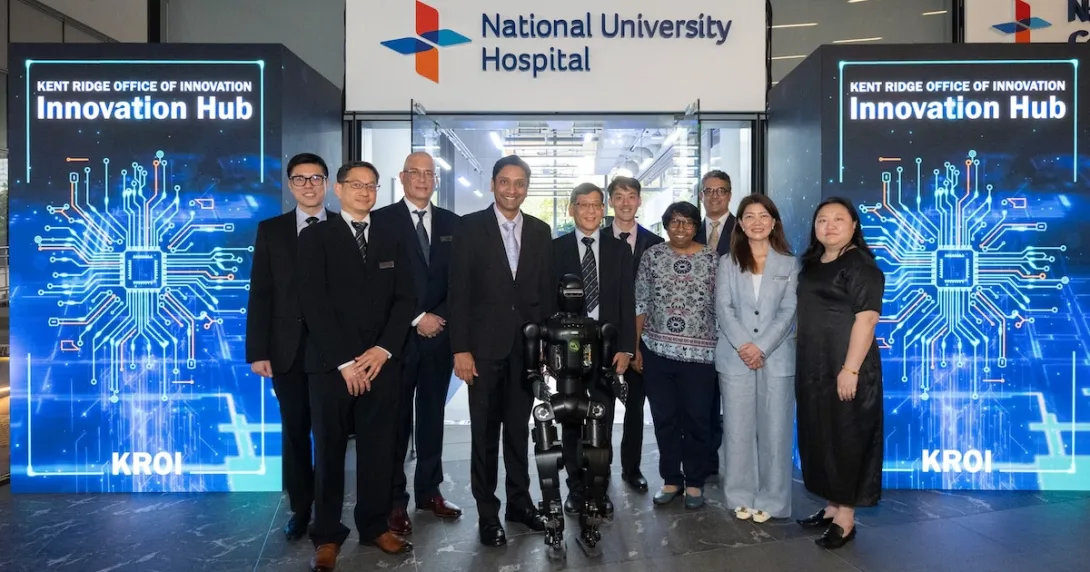
Photo courtesy of the National University Hospital
The National University Hospital in Singapore has launched an innovation hub that serves as both an incubator and a real-world sandbox for testing, validating, and scaling AI and digital health solutions within live clinical settings.
The launch of the NUH Innovation Hub comes as Singapore's healthcare system faces increasing challenges of an ageing population, rising care complexity, and persistent workforce shortages.
Developed under the NUH Kent Ridge Office of Innovation (KROI), the hub brings together clinicians, startups, academia, and industry partners to co-develop and validate solutions within NUH's actual care environment through a structured pathway from ideation to deployment, with emphasis on clinical relevance, workflow integration, and scalability.
As an incubator, the hub supports the development and refinement of digital solutions, including those internally developed innovations led by the KROI. Among these are MedBot, a virtual pharmacy assistant that enabled savings of about 28 man-hours monthly, and the ED Summarizer, which has cut clinicians' documentation time by at least half.
On the sandbox side, the hub provides a real-world validation site for startups and technology partners, working with the Infocomm Media Development Authority through its Open Innovation Platform to identify and pilot solutions for identified clinical and operational challenges.
Moreover, the hub supports staff training to build capability and drive the uptake of in-house AI tools. According to NUH, more than 3,400 staff have already completed innovation-related training programmes.
The hub is also supported by a range of research and industry partnerships, including a collaboration with Elsevier to study how clinicians use AI-powered tools for medical information. It is partnering with the National University of Singapore (NUS) College of Design and Engineering to jointly strengthen innovation capabilities and train talents. In addition, the hub is working with the Digital Advanced Technology Accelerator at the NUS Yong Loo Lin School of Medicine to explore the possibility of organising a hackathon with startups.
In addition, the hub will house the Singapore office of the Singapore-Shanghai Medical Innovation Centre, NUH's joint initiative with Ruijin Hospital, to support such innovations as CAR T-cell therapy and 3D-printed orthopaedics.
Healthcare IT News caught up with Sandy Ho, assistant COO (Plans and Strategy) at NUH, and CMIO Dr Ling Zheng Jye, to understand how the hub operates as a real-world incubator and sandbox. She discussed its structured validation pathway, governance approach for AI deployments, key barriers NUH faces in scaling innovations beyond pilot, and the hub's priority areas over the near term.
Q. Can you walk us through how the NUH Innovation Hub operates as a sandbox, from onboarding startups to validating and deciding which solutions move toward deployment?
A. The NUH Innovation Hub operates as a real‑world innovation sandbox that deliberately links frontline clinical and operational needs with external innovators, including local startups, SMEs, and research partners. Solutions typically enter the hub's Innovation Maturity Path, called IMPEL, through clearly articulated problem statements identified by NUH clinical or operational teams, or through partnerships aligned with NUH's strategic priorities.
Once onboarded, solutions are tested within NUH's live care environment under a structured "trial‑of‑trial" model. This allows innovators to validate their solutions against real workflows while receiving direct feedback from clinicians and operational users. Importantly, experimentation does not sit outside institutional controls; trials are conducted using NUH's existing legal, clinical, and data governance mechanisms to ensure accountability from the outset.
Decisions to progress beyond the pilot phase are based on demonstrated clinical relevance, operational feasibility, and alignment with NUH's care and workforce priorities. This ensures the sandbox functions as a pathway toward adoption, rather than a collection of proofs-of-concept that may not be fully aligned.
IMPEL: Ideate – Model – Prototype – Evaluate – Launch
Q. How are solutions in the sandbox integrated with NUH's clinical systems and workflows, and what governance structures are in place to ensure safety and alignment with Singapore's health data and AI frameworks?
A. Integration within the innovation hub is guided by a clear principle: innovation must support safe care delivery and fit within existing clinical and operational workflows. Solutions are assessed in close collaboration with clinical leaders, operational teams, and corporate functions to determine whether they can be meaningfully embedded into day‑to‑day practice.
From a governance standpoint, all sandbox activities operate within NUH's established institutional frameworks. Legal agreements and standard non‑disclosure arrangements are used to manage vendor relationships, while data protection considerations are addressed through Data Protection Impact Assessments.
For AI‑enabled solutions, oversight is provided through National University Health System-level (NUHS) AI governance structures, including the NUHS AI Governance Committee and its associated review checkpoints. These frameworks ensure alignment with Singapore's health data protection requirements and responsible AI principles, even at early pilot stages.
Clinical and digital safety oversight is further reinforced through review by the Chief Medical Informatics Office, ensuring alignment with organisational strategy and patient safety expectations. This ensures that innovation, whether developed internally or with startups and SMEs, meets safety, regulatory and ethical expectations, while remaining scalable and sustainable within a public healthcare setting.
Q. What are the main barriers NUH has encountered in scaling AI and digital health solutions beyond pilot, and are there plans to deploy successful innovations across the wider National University Health System?
A. One of the main challenges NUH has encountered in scaling AI and digital health solutions lies in bridging the gap between technical success and sustainable operational adoption. Demonstrating point performance alone is insufficient; solutions must earn clinical trust, integrate into workflows, and be supported by capability building and change management. MedBot is a good example where tool-supported medication counselling was co-designed with pharmacists from the very beginning, resulting in high levels of acceptance.
Another barrier is the need for early consideration of scale. Experience has shown that pilots designed without a clear path to procurement, integration, and system‑level governance often struggle to move beyond experimentation. As a result, NUH increasingly emphasises early alignment with institutional and system partners when validating innovations. For example, with speech-to-text, we matched use cases ranging from long consults to admin meetings, and considered existing tools-at-scale and form factors (mobile device, laptop) in order to make our recommendations for digital note creation.
Through the innovation hub, NUH works closely with government agencies such as the IMDA to strengthen use cases and support startups in validating solutions that can be adopted at scale. Where solutions demonstrate clear value and robustness, NUH works with partners within the NUHS cluster to explore broader deployment, subject to system-level priorities and governance.
Q. Besides MedBot and the ED Summarizer, what priority projects are currently being piloted in areas like digital twins, genomics, or IoT, and what are the hub's key focus areas over the next two to three years?
A. The innovation hub supports a portfolio of emerging initiatives developed in partnership with startups, SMEs, research institutions, and national agencies. These include projects in areas such as robotics and automation, digital twins for healthcare planning and operations, and data‑driven decision support tools that leverage shared analytics platforms.
Over the next two to three years, the hub's focus will remain on applied innovation with tangible impact – particularly solutions that address workforce sustainability, operational efficiency, and patient experience. NUH will continue to deepen collaborations with system partners, SMEs, and agencies such as IMDA to ensure that promising technologies are not only piloted, but responsibly scaled within a public healthcare system.
_
Editor's note: The previous version of this article only attributed the responses to Sandy Ho. It has since been changed to add Dr Ling Zheng Jye. Their responses have been edited for brevity.