Photo courtesy of Tairex
A virtual hospital concept developed at China's Tsinghua University has entered early clinical deployment, with eight hospitals now testing an AI-assisted consultation service for outpatients.
The "real consultation room" mode of the Tairex Agent Hospital platform, introduced last year, has entered functional trials across more than a dozen clinical departments – mainly in internal medicine – after being integrated with hospitals' existing HIS systems, Tsinghua professor Liu Yang told Healthcare IT News.
"We will continue to optimise our system based on feedback from patients, doctors, and hospital users, and gradually expand its application scope [while] complying with policies, regulations, and ethical requirements," added Prof Yang, who co-leads the virtual hospital project. He did not specify which hospitals were involved in the trial.
There is a plan to add multilingual support beyond English and Chinese, Prof Yang mentioned.
THE LARGER CONTEXT
This comes as Tairex, a spinoff from Tsinghua's Institute for AI Industry Research (AIR) that developed the virtual hospital concept, recently launched a separate virtual consultation room mode for doctors and medical students to practice skills with AI-generated patients.
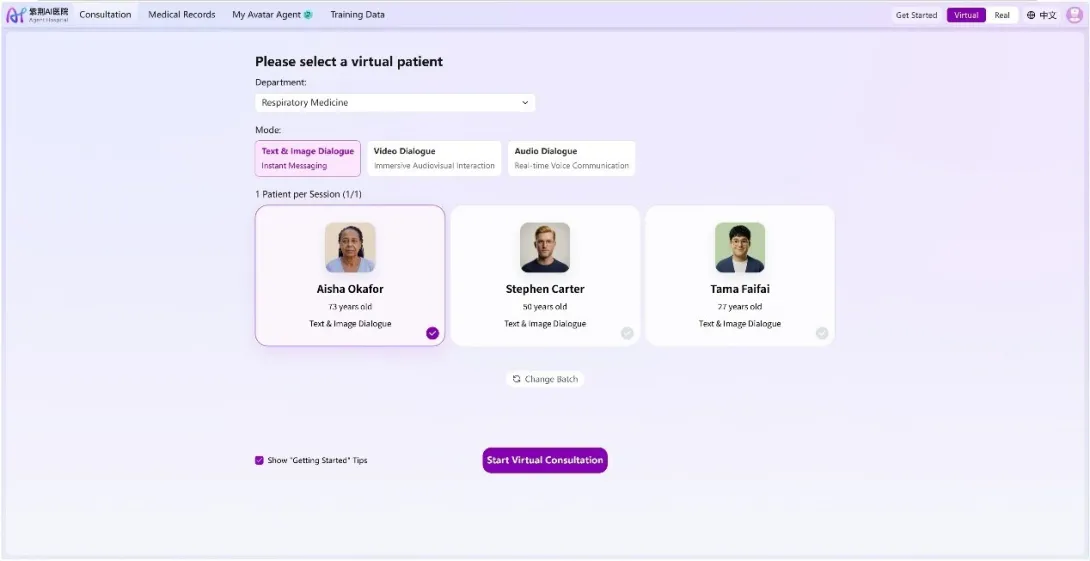
"When a doctor or medical student enters the virtual consultation room, they select one of 26 clinical departments that match their professional field. The system will then randomly recommend several AI patient agents from that department. The user may select one AI patient agent to receive and treat, followed by clinical procedures such as consultation, ordering examinations and tests, making a diagnosis, and issuing treatment recommendations," Prof Yang said, explaining the process.
He said the virtual mode simulates real-world scenarios, including AI-generated patients automatically returning synthesised examination and test reports to doctors.
"Upon completion of diagnosis and treatment, the user can view the distribution of decision-making opinions from other doctors on the same AI patient agent, enabling mutual learning and reference."
A digital avatar of a doctor then provides decision-making suggestions while final decisions rest with the human doctor.
"In the online virtual consultation room, medical students and junior doctors can practice and improve their clinical capabilities, while senior doctors can establish exemplary diagnosis and treatment cases and build their own avatar agents," Prof Yang emphasised.
Tairex is now focused on optimising the doctor avatar feature, which it expects will "continuously improve various medical capabilities," including medical consultation, suggesting examinations and test orders, offering diagnostic recommendations, proposing treatment plans, writing medical records, and conducting automatic follow-ups. The feature reportedly supports diagnosis across more than 1,000 disease types.
Meanwhile, Tairex recently raised nearly RMB 100 million ($14.6 million) in a funding round involving venture capital firms including Link-X Capital, InnoAngel Fund, and Shangshi Capital.
There are also plans to add multilingual support for this new virtual mode. Limited public beta access is available through partner channels.