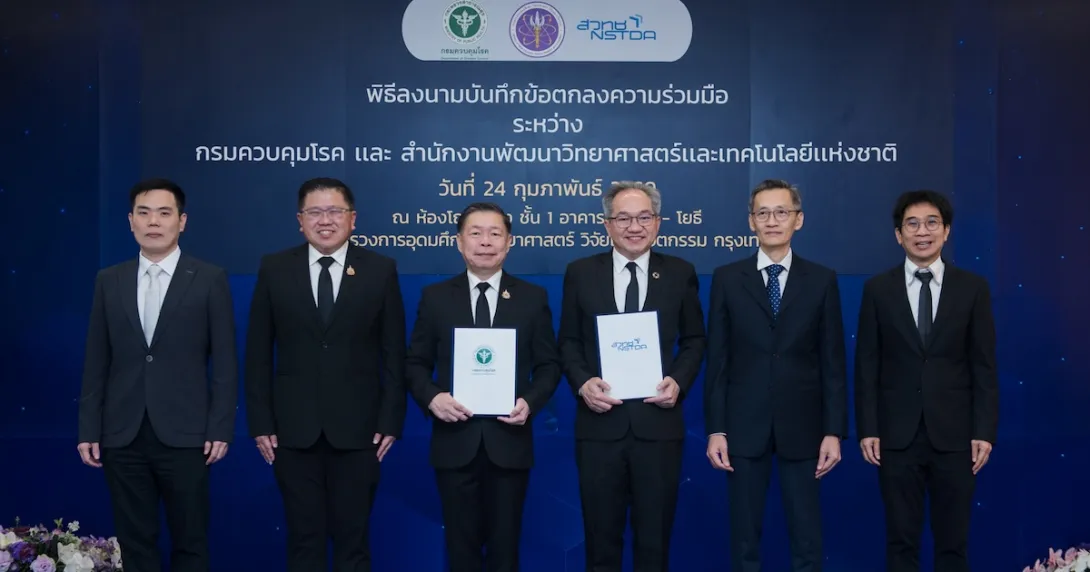
Photo courtesy of the Ministry of Higher Education, Science, Research and Innovation
Thailand is moving to digitally consolidate its national disease surveillance system after the Department of Disease Control signed a memorandum of understanding with the National Science and Technology Development Agency to integrate research, data platforms, and digital tools into a more proactive public health monitoring framework.
WHAT IT'S ABOUT
Based on a media release, the MoU covers the development of big data systems, intelligent surveillance systems, as well as the enhancement of personnel capabilities in both ministries in responding to future health crises. It will also create mechanisms to translate scientific research into practical public health applications and develop an innovation ecosystem supporting disease prevention and control.
The collaboration ultimately aims to create "the most accurate and modern disease surveillance system in the region," which will also serve as a key model for intergovernmental cooperation.
WHY IT MATTERS
The DDC and NSTDA will work to strengthen Thailand's ability to detect, prevent, and respond to emerging and re-emerging diseases as well as the complex impacts of climate change, while supporting the development of digital disease control information systems across the country.
"Collaborating with NSTDA is a crucial mechanism to shift from a reactive to a proactive approach. We will use digital technology and empirical research as the basis for policy decision-making to develop the most effective disease surveillance, prevention, and control system," Dr Montien Kanasawasdi, director-general of the DDC, was quoted as explaining their MoU.
The partnership is also expected to build a national network of researchers and public health experts to address systemic health challenges and support more sustainable disease prevention strategies.
The initiative builds on earlier partnerships between the two agencies and will expand the application of technologies "more directly relevant to communities," according to NSTDA director Dr Chookiat Limpichamnong.
THE LARGER TREND
The DDC and NSTDA previously worked on several R&D projects in public health, including the TanRabad mobile application, which enables real-time mosquito larva surveillance and dengue risk alerts.
They have also created digital infrastructure for disease monitoring and data management, such as the BigStream big data platform, the DDC-Care health monitoring system for infectious disease surveillance, and INTERVAC, the digital vaccine certificate platform deployed during the COVID-19 pandemic.
Other efforts include the IAAM Zero Trust identity verification and access control system, NCD Public BP community screening system for hypertension and diabetes, and the upcoming expanded deployment of the citizen-reporting platform, Traffy Fondue, to enable public health monitoring at the community level.
Meanwhile, the Ministry of Public Health (MPH) has recently approved a series of measures to accelerate national digital health integration, including plans to consolidate fragmented public health information systems and support the country's universal healthcare programme.
The measures also aim to link health service data across systems operated by the MPH, the Bangkok Metropolitan Administration, and the Ministry of Labour and propose a Digital Health Act to establish a national framework for health data exchange and emerging technologies such as AI and telemedicine.