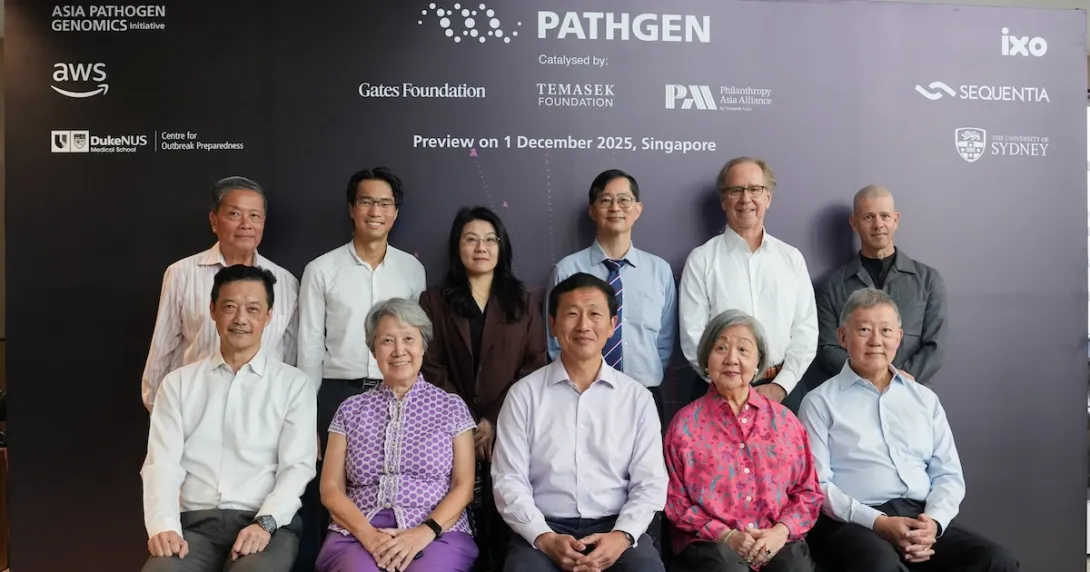
Photo courtesy of Duke-NUS Medical School
The Asia Pathogen Genomics Initiative (Asia PGI), led by the Duke-NUS Medical School Centre for Outbreak Preparedness, is preparing to pilot a new AI-based disease outbreak intelligence platform.
Called PathGen, it is described as an "AI-powered sense-making and decision-making support platform" for public health sector practitioners, clinicians, and decision makers.
WHAT IT'S ABOUT
Duke-NUS says PathGen can "help detect emerging disease threats earlier, assess risks faster, and coordinate responses within and across borders" without compromising data sovereignty.
It further explained that the federated, sovereign-by-design platform shares only the analytics, with the underlying raw data unmoved and remaining under the control of its respective country or owner.
The platform provides actionable intelligence that, according to Duke-NUS, can guide decisions on, for instance, when to adjust treatment protocols, where to deploy vaccines, and how to allocate resources prior to outbreaks. Its insights are powered by AI foundation models, leveraging diverse data sources, including pathogen genomics, clinical information, population data, climate, and mosquito habitat patterns.
PathGen is developed in collaboration with Amazon Web Services (AWS), IXO, Spain-based Sequentia Biotech, and the Sydney Infectious Diseases Institute at the University of Sydney, Australia. The project has received funding from the Gates Foundation, Temasek Foundation, and Philanthropy Asia Alliance.
A proof-of-concept was recently previewed in public with Singapore's Health Minister Ong Ye Kung.
Based in Singapore, Asia PGI convenes over 50 government and academic partners across 15 countries to advance pathogen genomics sequencing for the early detection, control, and elimination of infectious diseases in the region.
WHY IT MATTERS
Duke-NUS emphasised the need to advance genomic surveillance to address more frequent and complex disease outbreaks across populations driven by rapid population growth, unprecedented mobility, climate disruptions, and antimicrobial resistance. It noted that existing disease surveillance systems are limited by a lack of data interoperability, lesser availability of contextual data, data sovereignty barriers, and policy constraints.
PathGen is said to fill critical gaps in Asia's disease surveillance by enabling shared intelligence, powered by AI, without compromising data sovereignty.
"By sharing only essential insights, countries can respond faster to outbreaks while strengthening trust and sovereignty," said Paul Pronyk, professor and director of the Duke-NUS Centre for Outbreak Preparedness.
Asia PGI is preparing to launch PathGen "over the next 18 months," with pilots slated for early 2026 and a staged rollout through 2027.
THE LARGER TREND
SingHealth developed a disease outbreak surveillance system based on digital twin technology in response to the 2020 global pandemic. Last year, its application was expanded to resource optimisation and healthcare facilities planning.
Beyond Singapore, a $6 million national initiative in Australia was launched in October to align hospital electronic medical records with global standards so data can be securely used for large-scale research, including rapid pandemic response.
Another Australian project, the Unified Phenotype Foundation Model, is being developed, which can analyse multimodal patient data at scale to help doctors catch diseases early and improve prognoses.
In India, meanwhile, the Ministry of Science and Technology is working to sequence 10 million genomes, contributing to the creation of a comprehensive database representing India's genetic diversity and bringing about innovations in areas such as mRNA-based vaccines, protein manufacturing, and genetic disorder treatments. The Phenome India National Biobank, which aims to collect data for a longitudinal study tracking health trajectories unique to the Indian population, was also unveiled in July.
ON THE RECORD
Dr Lee Fook Kay, head of pandemic preparedness at Temasek Foundation, stressed that the future of health security and preparedness is a "shared intelligence system that protects sovereignty, cuts response time, and stops outbreaks before they become crises."