Photo: Regency Specialist Hospital/LinkedIn
A private hospital in Johor, Malaysia, has fashioned a smart ward concept from leading hospitals in Taiwan into a system that allows its nurses to respond faster to urgent, life-threatening findings and spend more time with patients.
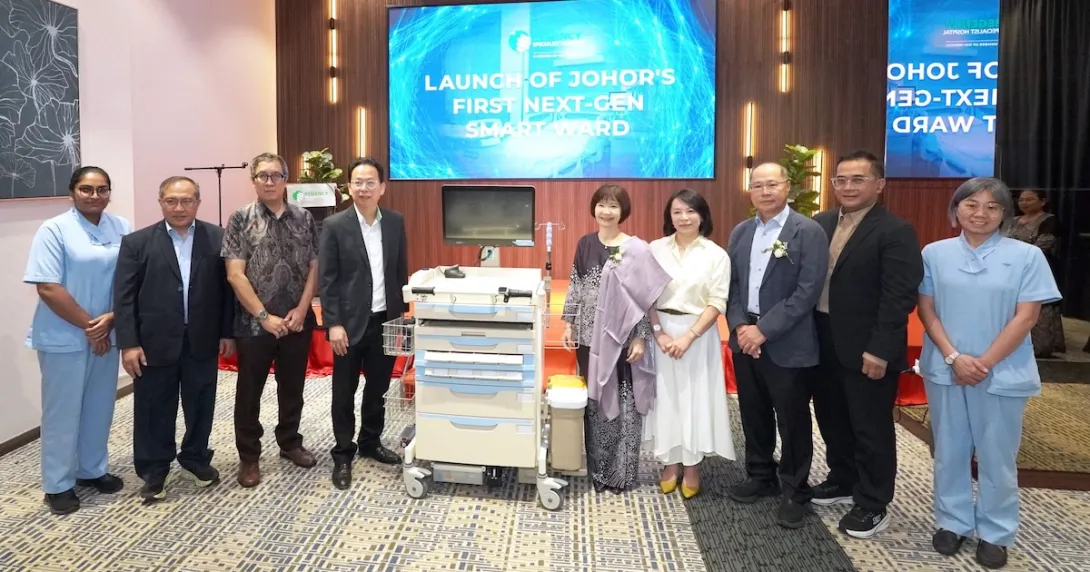
The 200-bed Regency Specialist Hospital, part of HMI Medical, which has been operating across Malaysia, Singapore, and Indonesia, unveiled what could be Johor state's first hospital smart ward in October.
A key piece to its smart hospital transition, the Next-Generation Smart Ward features automation and near real-time monitoring that improve nursing efficiency and patient and staff experiences.
THE PROBLEM
Over the years, Regency observed that much of nursing time was spent on repetitive tasks. This, according to CEO Serena Yong, "reduce[s] opportunities for direct patient interaction and can delay critical information, often leaving patients and families waiting anxiously for updates."
PROPOSAL
In an interview with Healthcare IT News, Yong said that the hospital decided to set up a smart ward to "[direct] unavoidable busyness towards purposeful activities that enhance patient safety and create measurable value for both patients and healthcare providers."
Building on its parent company HMI Medical's 2024 memorandum of understanding with Taiwan-based Chang Gung Memorial Hospital, Linkou (CGMH), Regency sought a collaboration with CGMH, its operator, Chang Gung Medical Foundation, and the Lanseed Medical Group to build a smart ward, with Origin Integrated Studios as its integration partner.
In recent years, CGMH received multiple HIMSS digital maturity model validations that recognised its smart ward and other innovations. Dr Kun-ju Lin, deputy information security chief at CGMH, discussed the hospital's smart hospital development at the HIMSS25 APAC conference in July.
MEETING THE CHALLENGE
The smart ward at Regency features a centralised dashboard, bedside terminals, e-paper display, automated vital signs and body measurement, mobile nurse application, and smart nursing carts, which all provide real-time access to patient data and streamline workflows.
"Drawing on design experience from Taiwan and working closely with local teams, the project adapted solutions to the Malaysian context," Yong said. Localising the Taiwanese smart ward framework was the hospital's biggest challenge and a key area of learning.
"Every design decision was guided by the principle of using technology to enhance empathy, not diminish it," the hospital CEO emphasised.
Another major challenge was ensuring every nurse felt confident and competent in using the new system.
"To address this, daily training sessions of 2-3 hours each were conducted in small groups, allowing nurses to participate while maintaining clinical duties. Upon implementation, smart ward training became part of the orientation programme for all new nurses, supported by bedside hands-on training once deployed to the ward," Yong explained.
"For existing nurses, annual refresher courses are held to reinforce competency and sustain engagement," she added.
RESULTS
Regency took a phased approach in establishing the smart ward, starting with a pilot to test and refine the system before scaling. Following its official go-live earlier in April, the hospital noted how the system lets nurses do away with much manual documentation and respond faster to urgent cases.
The smart ward eliminated 67% of manual data entry. Near real-time alerts from an early warning score and location tracking improved nursing teams' response times. They respond to critical laboratory findings faster by 16% as well.
Additionally, centralised dashboards and timely access to patient data helped enhance collaboration among multidisciplinary teams, according to Regency.
For patients, the hospital observed, self-service tools provided through bedside terminals allowed them to actively participate in their care.
Citing findings from a month-long patient satisfaction survey and interviews in September, Yong said patients found it easier to request nursing assistance and appreciated the bedside terminal’s multilingual interface – available in English, Bahasa Melayu, and Mandarin – which improved accessibility. Patients also reported that the feature helped them better understand their medications, make requests, and learn more about their condition and overall health through educational resources.
The hospital also noted improvement in overall patient safety through automated alerts for fall risks, critical lab results, and stat medication alerts. Satisfaction rates also shot up as nurses spend more time with patients.
"Looking ahead, Regency plans to expand monitoring indicators to include patient satisfaction, clinical accuracy, and staff well-being. Data captured from the system will guide evidence-based improvements under the Smart Ward Nursing Committee, ensuring that innovation continues to deliver meaningful clinical and human outcomes," shared Yong.
TAKEAWAYS
Yong emphasised that beyond technology, a "rethinking" of care delivery, where empathy, efficiency, and human-centred values converge," defines a smart ward implementation.
"Each purposeful intervention strengthens patient trust, reassures families, and enhances professional pride among caregivers. These outcomes were made possible through collaborative design and context-sensitive implementation," she said.
Based on their experience, the hospital CEO said the key enablers of smart ward implementation – and broader smart hospital transformation – for regional hospitals lie in three areas: collaboration, contextual adaptation, and commitment to continuous learning.
"Together, these allow healthcare institutions to harness technology not just for efficiency, but for safer, smarter, and more patient-centred care across the region."