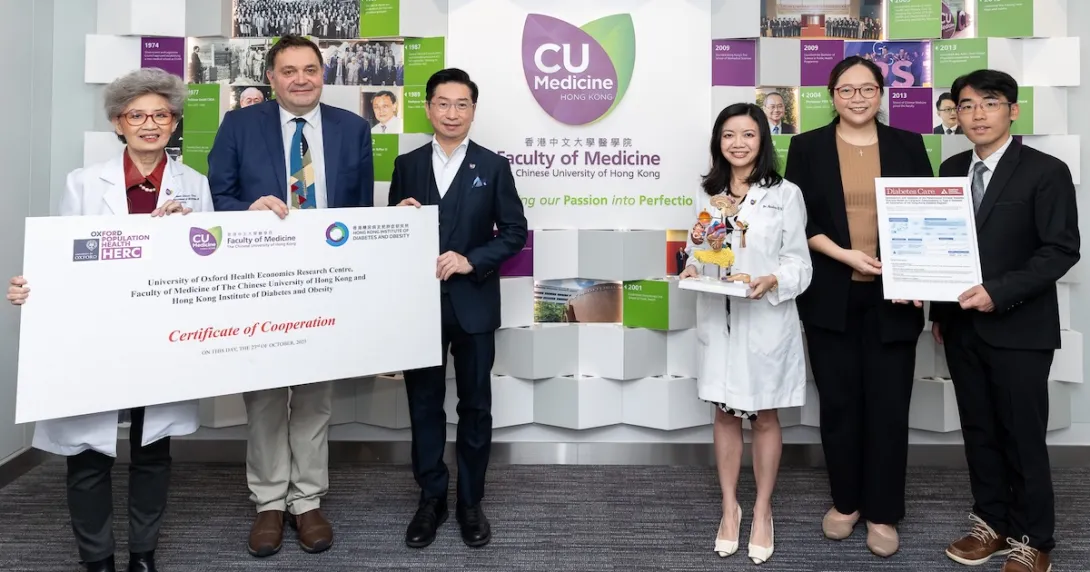
Photo courtesy of the Chinese University of Hong Kong
The Chinese University of Hong Kong is preparing to extend its diabetes-focused risk prediction model into an Asia-wide chronic disease analytics platform, initially leveraging one of Asia’s largest troves of longitudinal EMR data to support future clinical trials, interventions, and health policy planning.
It builds on the Chinese Diabetes Outcomes Model (CDOM), a mathematical model for assessing the lifetime risks and economic impact of diabetes that was recently validated using Hong Kong's territory-wide EMR data.
CUHK Faculty of Medicine (CU Medicine) professor Juliana Chan Chung-ngor, senior investigator of the CDOM project, told Healthcare IT News that the research team plans to transform the predictive model into a "definitive" diabetes risk modelling tool tailored to Asian populations while expanding it to cover "a broader range of chronic conditions."
"As new drugs and interventions are developing in the pipeline, we aim to align CDOM's capabilities with emerging trends in chronic disease management," she said.
"Its capabilities extend beyond the evaluation of conventional treatments to include drug interventions, digital health solutions, diagnostic tools, and program interventions," added Prof Chan, who also directs the Hong Kong Institute of Diabetes and Obesity.
THE LARGER CONTEXT
CDOM was developed using training data from more than 21,000 type 2 diabetes (T2D) patients stored in the Hospital Authority (HA) EMR-linked Hong Kong Diabetes Register (HKDR), collected between 2002 and 2019.
The Chinese-specific mathematical model is based on the University of Oxford’s research methodology, which applies regression-based risk equations and survival analysis techniques to predict year-on-year changes in risk factors and diabetes complications for individual patients.
It underwent dual validation funded by the Hong Kong government to assess its ability to predict outcomes in T2D patients and to evaluate the cost-effectiveness of new and existing diabetes interventions. In addition to the HKDR training dataset, the model was validated using an independent cohort of 176,210 patients, drawn from a larger HA EMR dataset containing records of more than four million individuals who have had a blood glucose measurement since 2000. This dataset includes longitudinal admissions, labs, prescriptions, diagnoses, and mortality.
The predictions were found to be "highly consistent" with actual observed outcomes, indicating potential for informing diabetes policy and resource optimisation.
Health economist and CU Medicine assistant professor Juliana Lui Nga-man also confirmed CDOM's potential to "underpin insurance and reimbursement models in Hong Kong and mainland China." Its ability to analyse patient-level data and identify high-risk subgroups, she said, enhances its relevance for guiding evidence-based investments in diabetes care.
Additionally, CDOM's modelling outputs may also support clinical trials. "The Asian profiles of CDOM will help industry design [clinical] trials targeting patients who will benefit most to maximise impact and return [on] investment," Asst Prof Lui said.
"By providing precise cost-effectiveness analyses and insights into targeted strategies, CDOM can assist clinicians, healthcare providers and payors in making informed treatment decisions. This will ultimately improve patient outcomes, optimise resource utilisation, and advance diabetes care in public settings," Prof Chan added.
For now, CDOM predicts the lifetime risks of 10 major complications in T2D patients using routine clinical measurements, such as age, weight, lipids, HbA1c, and kidney function. These complications include ischemic stroke, haemorrhagic stroke, ischemic heart disease, heart failure, peripheral vascular disease, lower limb amputation, end-stage kidney disease, severe hypoglycaemia, any cancer, and premature death.
"We are currently performing further data analyses to identify predictors for cancer," shared Prof Chan.
"Future versions of CDOM could potentially incorporate genomics, lifestyle factors, and data from wearables," she added.
Following the dual validation study, CUHK and Oxford launched a four-day course on Cost-Effectiveness Analysis and Health Economic Evaluation in Asia to train clinicians and policymakers to interpret and appraise CDOM and other health technology assessment models.
While preparing a patent filing, the CU Medicine research team has secured "several" government research grants to apply CDOM in evaluating the cost-effectiveness of conventional and novel interventions for diabetes and its related complications, including chronic kidney disease and cardiovascular disease. Although primarily used for patient-level analyses, CDOM can also be applied flexibly to subgroup evaluations, Asst Prof Lui said, helping identify high-risk subgroups who may benefit most.
The team is also seeking opportunities for hospital and data partnerships across Asia to further validate the diabetes model.
_
The responses of Profs Chan and Lui have been edited for brevity and clarity.