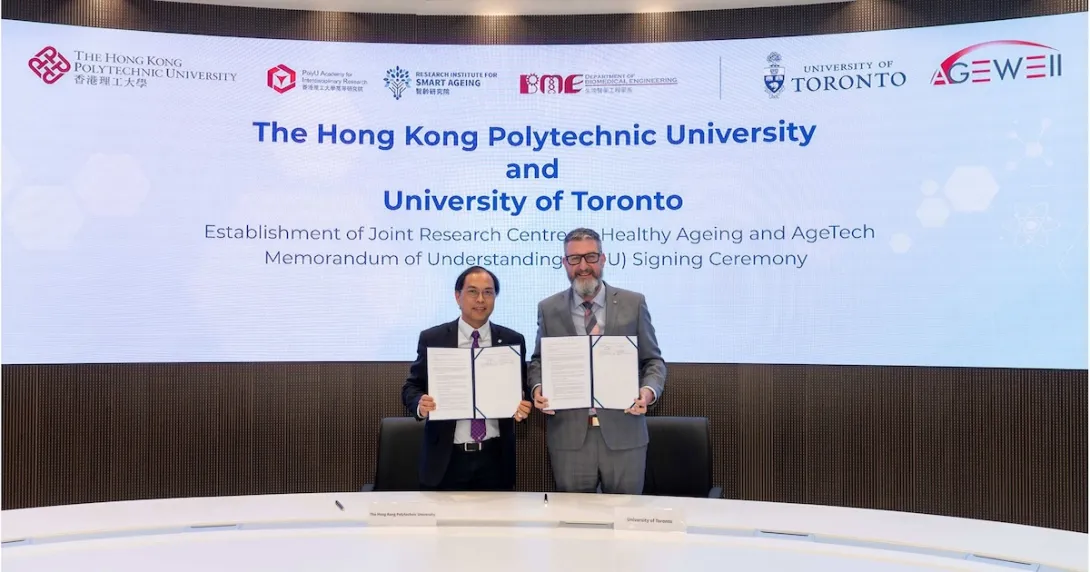
Photo courtesy of Hong Kong Polytechnic University
The Hong Kong Polytechnic University and the University of Toronto in Canada are planning to establish a joint research centre to accelerate the deployment of ageing technologies beyond pilot projects by testing and validating solutions across care settings in Hong Kong and Canada.
Despite significant investment and ecosystem support in Hong Kong, including government funding programmes and innovation platforms promoting gerontechnology, agetech solutions remain confined to pilot deployments and have yet to achieve sustained, system-wide adoption.
Under a memorandum of understanding signed by the two universities last month, researchers will explore setting up the Joint Research Centre on Healthy Ageing and AgeTech to support collaborative R&D, clinical evaluation, and international exchange programmes while promoting technologies designed to support ageing in place, particularly for Cantonese-speaking seniors.
Healthcare IT News spoke with PolyU professor Zheng Yongping and UT professor Alex Mihailidis, who shared that the centre aims to address persistent barriers in gerontechnology adoption, including the lack of large-scale clinical validation and the difficulty of translating prototypes into procurement-ready technologies.
They added that the initiative will create cross-border pilot programmes in hospitals, long-term care homes, and community housing environments in both cities, with initial deployments expected within one to two years and broader international scaling targeted within three to four years.
Q. Can you describe the current state of development and real-world adoption of gerontechnology in Hong Kong? Where do you see the most critical gaps in agetech development and adoption, and how will the proposed joint centre directly address these structural weaknesses?
Prof Zheng: Hong Kong has been very active in the development and adoption of gerontechnology, or agetech. Local universities have rolled out different R&D programmes for providing innovative agetech devices and solutions. For example, PolyU established the Research Institute for Smart Ageing (RISA) in 2021 to promote the development of advanced technologies for smart ageing. RISA facilitates interdisciplinary research on the mechanisms of ageing and ageing-related diseases, and the adoption of smart and innovative solutions for ageing-related concerns and issues. With a donation from the Hong Kong Jockey Club Charitable Fund, in 2018, PolyU also set up the Jockey Club Smart Ageing Hub (The Hub), which aims to bridge the gap between the technology available and real-world needs in the field, as well as acting as a platform for agetech promotion, connection, education, application, and innovation. In order to help ensure it meets real-world demands, the Hub actively involves users in its design and development work.
The HKSAR government also actively supports the development of agetech. In terms of R&D, the Hong Kong Science and Technology Park has specific incubation and supporting themes for agetech startups, with the aim of building a local agetech ecosystem. The government has also co-hosted the annual Gerontech and Innovation Expo cum Summit with the Hong Kong Council of Social Service that showcases various gerontechnology and solutions, while also promoting business opportunities and enhancing public awareness. In addition, the government has supported the Gerontechnology Platform project to establish a testing protocol and platform for facilitating the adoption of technologies, particularly innovative agetech, in real-world settings such as elderly caring facilities. To promote the use of agetech in the community, the government has set aside funding of up to HK$2 billion (over $250 million) to support elderly service units in the purchase of agetech products.
Despite these resources, programmes, and other support, Hong Kong still has a long way to go in popularising the adoption of agetech and in achieving the long-term goal of ageing in place. Not many agetech products have been widely adopted and/or developed in Hong Kong. With the recent technological advancements in AI, robotics, and sensing technologies, there are tremendous opportunities for the introduction of more effective, user-friendly, easily accessible, and mass-production-ready technologies. Meanwhile, an effective pathway for worldwide application of agetech also needs to be further explored, outlining how agetech products can be made suitable for different geographical regions and cultures during the design and fabrication stage. At present, catering for segmented market demands is both a big challenge and key success factor for the agetech industry, given that it is difficult for business sustainability to be achieved without mass production.
Prof Mihailidis: Hong Kong has built one of the most comprehensive agetech ecosystems globally, with strong investment across research, incubation, procurement, and community deployment. Government funding programmes have enabled long-term care providers to procure technologies, while demonstration platforms, rental services, and innovation hubs have increased workforce familiarity and community awareness. This has resulted in meaningful early adoption, particularly in institutional care and pilot community settings.
However, several structural gaps remain that are common internationally. First, many technologies remain at the pilot or demonstration stage and do not transition into sustained, system-wide deployment. Second, there is often limited clinical validation across multiple care systems, which is increasingly required for procurement, reimbursement, and regulatory approval. Third, many solutions are developed for a specific local context and face barriers when scaling internationally due to differences in language, culture, housing environments, and care delivery models. Finally, there remains a need to more deeply integrate emerging technologies such as AI, robotics, and advanced sensing into routine care workflows in ways that are clinically validated, scalable, and acceptable to users and providers.
The Joint Research Centre on Healthy Ageing and AgeTech to be established by PolyU and UT (The Joint Centre) directly addresses these gaps by linking Hong Kong's strong engineering, prototyping, and government-supported deployment ecosystem with Canada's internationally recognised strengths in clinical research, AI-enabled healthcare, rehabilitation technology, and health system integration. UT and its affiliated hospitals and care organisations provide large-scale real-world validation environments, enabling technologies to be rigorously evaluated across hospitals, long-term care homes, and community-based ageing in place settings. This dual-site model will accelerate the transition from prototype to validated, procurement-ready, and internationally scalable solutions.
Q. What concrete translational mechanisms will the joint centre put in place to accelerate age-tech deployment, for example, regulatory sandboxes, hospital or community care pilots, industry co-development, or public housing testbeds? What adoption timelines are you realistically targeting for first deployments?
Prof Mihailidis: First of all, we plan to implement several concrete translational pathways to accelerate deployment. These include joint pilot studies conducted in hospitals, long-term care homes, and community housing environments in both Hong Kong and Toronto, allowing technologies to be tested and refined across two different healthcare and social care systems. Public housing and ageing in place environments will serve as real-world testbeds, enabling evaluation under everyday living conditions.
The Joint Centre will also seek to promote industrial co-development through partnerships with startups, multinational companies, and local innovation ecosystems in both regions. This will enable technologies to move more efficiently from research into manufacturable and commercially viable products. In addition, we will support joint clinical validation studies, data-driven evaluation using AI and advanced analytics, and integration with care providers to ensure technologies fit within existing workflows.
Initial pilot deployments are expected within the first one to two years of the centre's operation, building on existing technologies that are already at advanced prototype stages. Broader scaling and international deployment are expected over a three-to-four-year horizon as clinical evidence, regulatory alignment, and industry partnerships mature.
Q. What are some existing smart ageing and rehabilitation technology projects PolyU researchers have worked/been working on, and which of these are expected to be prioritised/supported under the joint centre? How will this latest partnership with UT help scale these projects beyond Hong Kong into global markets or care models?
Prof Zheng: PolyU researchers have developed a wide range of technologies, spanning rehabilitation robotics, smart home monitoring systems, assistive mobility, and AI-enabled tools to support independent living and caregiving. Many of these have been successfully piloted within Hong Kong care facilities and community programmes.
Through the partnership with UT, these technologies will gain access to additional clinical validation environments, including major academic hospitals, rehabilitation centres, and community care programmes in Canada. Canada also provides access to different housing models, care pathways, and regulatory frameworks, which are essential for demonstrating international applicability. UT's strong connections to global research networks, industry partners, and startup ecosystems will further support the commercialisation and deployment of PolyU technologies beyond Hong Kong. At the same time, technologies developed in Canada will benefit from Hong Kong's highly dense urban environment, coordinated government programmes, and rapid deployment infrastructure, creating a bidirectional pathway for global translation.
At this stage, we are still working on operational details and are not ready to release further information. However, one of our objectives is to extend our successful collaboration outcomes to global markets. The achievements and experiences of this Joint Centre project will be shared on different occasions, such as at international conferences and seminars.
Q. How will the Joint Centre approach culturally and linguistically adaptive design (given that it emphasises solutions for Cantonese-speaking seniors), and what opportunities exist to clinically validate and compare ageing in place technologies across Hong Kong and Toronto's differing care systems?
Prof Zheng: During the years of collaboration between the Hong Kong and Toronto team members, we have observed the tremendous effort, time, and resources needed for an agetech product or solution developed in our region to be adopted in another region. Toronto has a large group of elderly Cantonese-speaking people with lifestyles similar to those of many elderly Hong Kong people. This makes it more feasible to develop agetech items that can easily be used by these two groups of seniors, thus opening up the possibility for us to overcome one of our major challenges: geographical difference. With these achievements and experiences, we can explore further how to tackle the more complex cultural and language differences involved in developing agetech solutions.
Prof Mihailidis: The Joint Centre provides a unique opportunity to design and validate technologies across culturally and linguistically diverse populations. Toronto has not only one of the largest Cantonese-speaking older adult populations outside of Asia, but also highly multicultural communities. This allows technologies designed for Cantonese-speaking older adults in Hong Kong to be directly tested and refined within Canadian care settings, while also being expanded to English-speaking and other linguistic groups.
By conducting parallel clinical and community deployments in both Hong Kong and Toronto, the centre will be able to compare adoption, usability, and clinical outcomes across different healthcare systems and cultural contexts. This will facilitate the development of agetech solutions that are adaptable, globally relevant, and scalable without requiring extensive redesign for each new market.
_
Responses of Profs Zheng and Mihailidis have been edited for brevity and clarity.