Photo courtesy of the National University Health System
Following a global partnership, Singapore's National University Health System is set to expand 5G connectivity across the cluster to hasten its development of extended reality, robotics, and other emerging technologies.
In late February, the healthcare cluster signed a strategic agreement with GSMA Foundry, the collaboration hub of the global mobile communications advocacy organisation GSMA, for 5G integration.
Based on a media release, this involves integrating 5G private networks with digital twin, XR, IoT devices, and ambient AI.
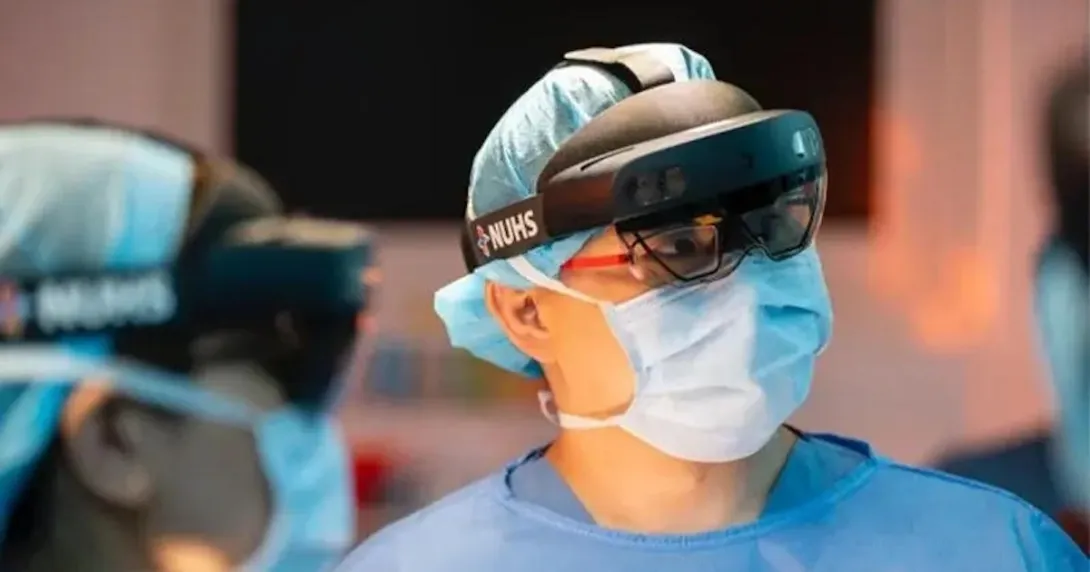
Their initial focus is to accelerate the development of 5G-enabled remote surgical assistance, XR training and simulation, robotic systems, and intelligent facilities management.
The partnership comes as NUHS doubles down on tech innovation, particularly AI development, which has been partly enabled by 5G private networks. Singtel Singapore has set up 5G standalone network for NUHS, which is enabling remote surgical support, immersive XR training, intelligent robotics, and hospital-at-home models. Alongside 5G, NUHS increased its supercomputing capacity, later allowing it to develop its own large language model.
Other health systems across Asia, particularly India, South Korea, and Thailand, have increasingly established 5G connectivity to support their digital transformation.
Healthcare IT News caught up with Dr Gao Yujia, assistant Group CTO and adjunct associate professor at the NUHS, who discussed what makes private 5G mission-critical in hospital operations and the practical challenges of scaling connected health infrastructure across sites.
Q. Advanced connectivity models like private 5G and network slicing require capital investment, spectrum coordination, and close telco partnerships. From a health system perspective, how do you justify the economics? What governance, cybersecurity, and workforce capabilities must be in place before scaling connected health models, say, from flagship sites like those in Singapore, to other health systems across Asia?
A. The economics will depend on the mandate of the healthcare institute, as well as the stage at which they invest. Pioneers and first movers will always incur a higher economic cost, as new technology is always expensive at the beginning. Hence, this is usually reserved for tertiary healthcare institutes that have a mandate to innovate and strategic funding to do so. The balance between CAPEX and OPEX funding will also affect the ability of a healthcare institute to deploy an advanced network in its facility. ROI will also need to be calibrated by looking at non-financial or indirect ROI, such as patient and staff satisfaction, reductions in patient complications and hospital length of stay, increased utilisation of operating theatre, etc.
Different countries have different governance and cybersecurity regulations; hence, it is difficult to apply a blanket policy across all. Healthcare institutions will need to work with their local regulators in order to deploy their network at scale.
Q. From NUHS's experience, at what point does connectivity, particularly private 5G, shift from being an IT upgrade to becoming a mission-critical clinical infrastructure? What specific operational or clinical constraints were you trying to overcome that traditional hospital networks could not support?
A. It becomes mission-critical when hospital systems (clinical or non-clinical) depend on this network for BAU [business-as-usual] utilisation. This includes running production-level AI and other capabilities on the network, which the hospital uses as standard. The initial constraint when NUH first trialled 5G was bandwidth and connection speed. However, with increased understanding of the power of a software-defined network, such as 5G and beyond, we appreciate that the network, in the future, will form the very fabric of an intelligent hospital, not just a pipeline for data transmission.
Q. Beyond remote surgical assistance and XR training, what does NUHS's next phase of connected health look like over the next three to five years? What implementation challenges remain?
A. The next phase will involve expanding 5G/6G network beyond NUH into other hospitals, including Alexandra Hospital, Ng Teng Fong General Hospital, and NUHS Polyclinics. Expansion will also involve out-of-hospital use cases such as connected ambulances and the NUHS Hospital @ Home programme, where patients are monitored remotely at home. The initial priorities will be to use advanced networks for hospital management, such as intelligent digital twins, and progressively move to incorporate and productionise clinical applications following validation studies. Challenges include cost, integration with the national database for patients, and integration of existing applications and data silos.