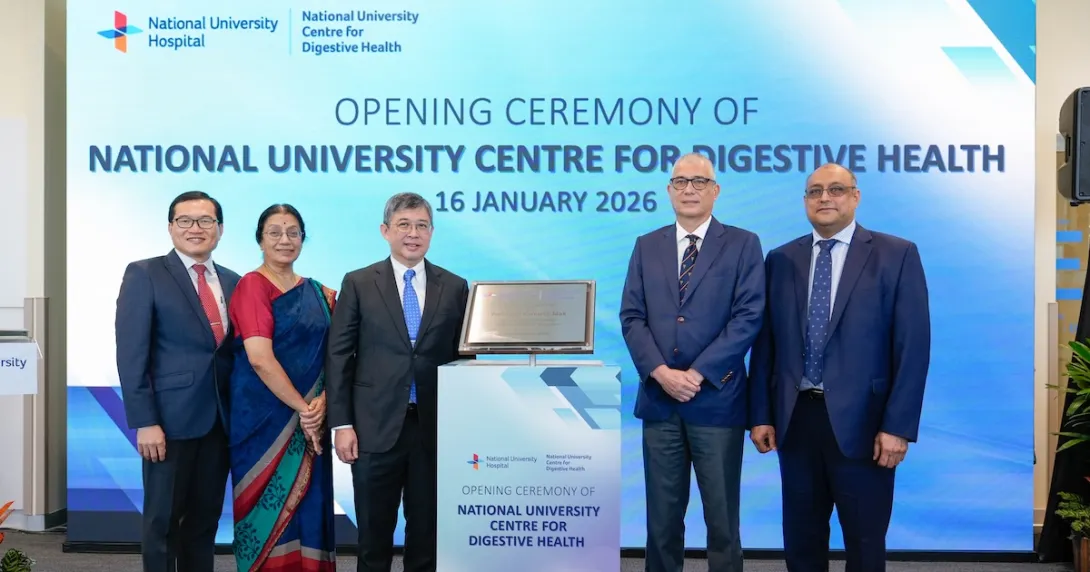
The National University Hospital in Singapore has officially opened the National University Centre for Digestive Health, its one-stop centre for digestive health services.
Since its concept launch in 2024, the NUCD has consolidated the hospital's various digestive health services to provide streamlined, same-day access to specialists in upper gastrointestinal, hepatobiliary and pancreatic, and colorectal care. It now also serves as a referral hub for complex cases from other hospitals within the National University Health System, including Ng Teng Fong General Hospital and Alexandra Hospital.
WHY IT MATTERS
"Previously, patients often moved through separate clinic and diagnostics queues in a step-by-step way—clinic first, then wait for tests, then come back for review, sometimes with additional referrals in between," NUCD director and NUH adjunct associate professor Lee Guan Huei told Healthcare IT News.
He explained that the cause of the bottleneck then was not expertise, but fragmentation – multiple handoffs, sequential scheduling, and endoscopy capacity being the rate-limiting step.
"NUCD consolidates the pathway so patients get faster clarity and fewer unnecessary loops," he said.
For clinicians, the streamlined process at NUCD resulted in more integrated triage, reduced test duplications, and more standardised procedures.
"With a consolidated centre, referrals can be reviewed through a common framework, and patients can be channelled more directly to the correct pathway (general gastrointestinal, hepatology/liver, inflammatory bowel disease/IBD, functional disorders, or surgical assessment) without unnecessary intermediate steps. Clinicians spend less time redirecting cases and more time making decisions that advance care," A/Prof Lee said.
Tests, he shared, are now ordered with the downstream decision in mind. "For example, if a patient has alarm symptoms, the pathway ensures the right definitive test is prioritised rather than repeated clinic visits without closure."
"If a patient is being evaluated for chronic liver disease risk, investigations can be grouped and sequenced more logically, reducing repeat bloods or backtracking. In IBD, monitoring and escalation can be protocol-driven, reducing ad-hoc variation and unnecessary repeat testing," added A/Prof Lee.
Moreover, the NUCD director said the consolidation of services has enabled standard pre-procedure work-up, more consistent bowel preparation processes, clearer post-procedure instructions, and structured follow-up. "Over time, this reduces cancellations, repeat procedures due to inadequate preparation, and variability in post-procedure planning. Clinicians feel the benefit as this leads to fewer avoidable complications and a cleaner end-to-end process."
THE LARGER CONTEXT
The NUCD runs high-impact programmes, including a chronic liver disease screening programme with the National University Polyclinics and GP clinics, which has screened over 12,000 high-risk patients to date.
The centre has raised its adenoma detection rate (ADR) for colorectal cancer, well above the 25% guideline set by the American Society for Gastrointestinal Endoscopy, to 42.4%, utilising AI-enabled and image-enhanced colonoscopy, an automated ADR calculation system, and a dashboard displaying critical quality indicators for endoscopists. Colorectal cancer, a known silent killer, is the second most common cancer and the second leading cause of cancer-related deaths in Singapore.
The IBD Centre of Excellence, a cornerstone of NUCD, is delivering advanced care across all ages, featuring innovations such as home administration of intravenous biologics, point-of-care intestinal ultrasound, and a translational precision medicine programme.
"Our goal is simple: to detect problems early, treat them well, and help our patients live healthier lives," A/Prof Lee said in a statement during the centre's inauguration on 16 January.