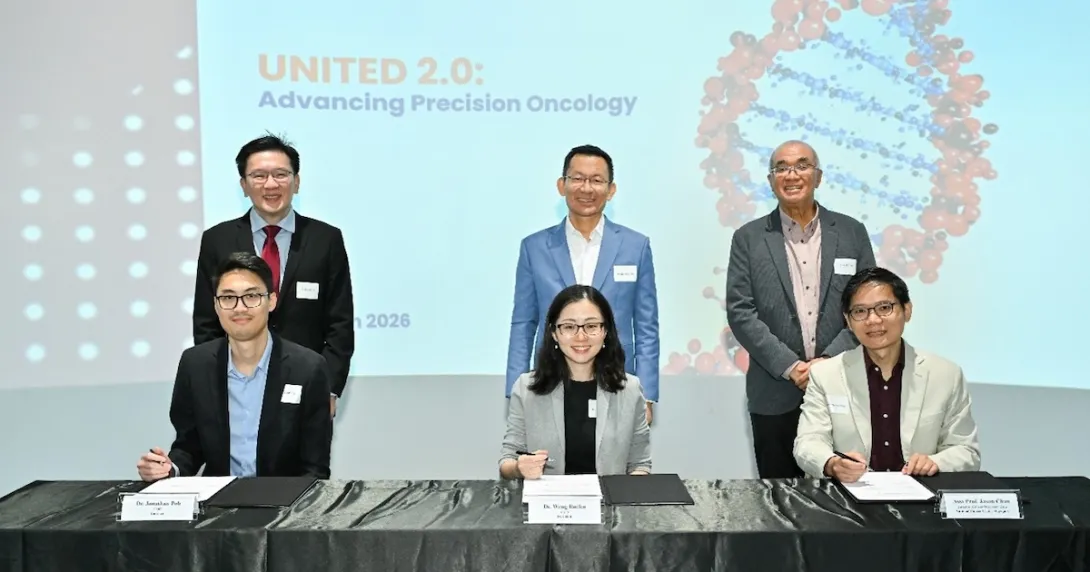
Photo courtesy of National Cancer Centre Singapore
Singapore's leading national tertiary cancer centre, National Cancer Centre Singapore, has announced a new S$6 million ($4.7 million) collaboration to develop an AI-powered cancer test that uses advanced genomic sequencing to provide clinicians a more complete view of tumours and guide treatment decisions.
It partnered with precision oncology company Lucence and the Diagnostics Development Hub (DxD Hub) of the Agency for Science, Technology and Research, Singapore (A*STAR) for the UNITED 2.0 project.
It builds on the previous UNITED 1.0 project that developed the cancer tissue test called UNITED 600. The assay analyses tumour and tissue samples for 572 genes and 71 RNA fusions using DNA and RNA signals.
Based on a media release, the new project will adopt a dual Whole Exome Sequencing and Whole Transcriptome Sequencing approach, looking beyond selected genes to provide "a more complete picture of the cancer." The team will also use AI for "more efficient analysis and reporting of [a] large amount of genomic data generated."
WHY IT MATTERS
The NCCS explained that a more detailed tumour profiling – including the identification of complex mutations and fusions – helps clinicians identify genetic alterations that can be targeted with precision treatments.
"UNITED 2.0 moves us from a 'snapshot' to a high-definition map of a patient's cancer," said Dr Tan Min-Han, founding CEO and medical director of Lucence.
"By integrating AI with comprehensive DNA and RNA sequencing, we are turning massive amounts of complex data into clear, actionable answers that will help clinicians choose better treatments faster," he added.
According to NCCS, the upgraded clinical-grade cancer profiling test will analyse a broad range of cancers, including breast, lung, colon, bladder, central nervous system tumours, and lymphoma.
The three-year collaboration also plans to develop tools to monitor a patient's status after treatment, including Minimal Residual Disease (MRD) testing to detect early signs of cancer recurrence.
"We hope that this will help clinicians successfully treat patients with rare cancers or those who have exhausted standard treatment options in the future," shared Dr Jason Chan, NCCS assistant professor and director of the Cancer Discovery Hub.
Alongside the announcement of this new research collaboration, Lucence and DxD Hub also signed a memorandum of understanding with Brain Tumour Society Singapore to establish a framework that will "keep the patient's perspective at the heart of cancer research."
THE LARGER CONTEXT
Over the years, the NCCS has worked on AI projects to augment cancer care and research. In 2022, it partnered with GE Healthcare to develop AI-powered solutions in data analytics and clinical workflows supporting cancer care. In October last year, it received a $3.5 million gift from the Verdant Foundation to support its cancer drug discovery facility, which has been utilising advanced AI techniques to identify and develop novel cancer therapies.
Meanwhile, the Singaporean government is preparing to expand its national genetic testing programme to cover more hereditary cancers and kidney-related genetic diseases.