Data Warehousing

By year's end, staff expect to see a reduction in time spent on manual tasks and a reduction in duplicative research data generation leading to an overall reduction in ongoing operational costs.
Digital health organizations can future-proof themselves to ensure longevity and relevance years into the future. Dr. Guido Giunti, adjunct professor of digital health at the University of Oulu in Finland, explains how.

Marwan Abdulaziz Janahi, senior VP of Dubai Science Park, explains how the UAE has spent 10 years building robust IT infrastructure and security measures as it plans to eventually leverage genomics data for precision medicine.

A new private WMware cloud aims to address healthcare's data proliferation while Sanford Health taps Infor for modernization and Qventus launches perioperative artificial intelligence to enhance OR efficiencies.

This has already been a record setting year for cybersecurity, in all the wrong ways. Errol Weiss, chief security officer of Health-ISAC, discusses the cyber risks he's most concerned about and makes the case for cross-sector information sharing.

Healthcare organizations interact with massive amounts of data, from protected health information (PHI) to sensitive financial information. This data is at risk of exposure through human error, internal leaks, or attacks by hackers.
There's a direct link between achieving EMRAM Stage 6 or 7 and higher quality and safety results, explains Anne Snowdon, HIMSS Chief Scientific Research Officer after examining Leapfrog data from 2,000 U.S. hospitals.
SPONSORED
 |
04:10 pm |
August 14, 2024
|
04:10 pm |
August 14, 2024
|
04:10 pm |
August 14, 2024
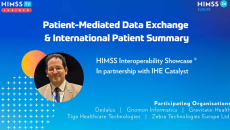
A demonstration at the HIMSS24 Europe Interoperability Showcase highlighted how the eHealthPass app and the International Patient Summary can help traveling Europeans quickly share their medical records to access needed care.

Healthcare organizations will need to go through a three-step process to achieve post-quantum safety: Discover, observe and transform, says Scott Crowder, vice president of IBM's quantum-safe adoption team.
Sam Amory, managing director for Dedalus AMEA, says more patients should be open to sharing their healthcare data so they can better understand their own health.