 | December 8, 2025
| 9:00 AM
| December 8, 2025
| 9:00 AM
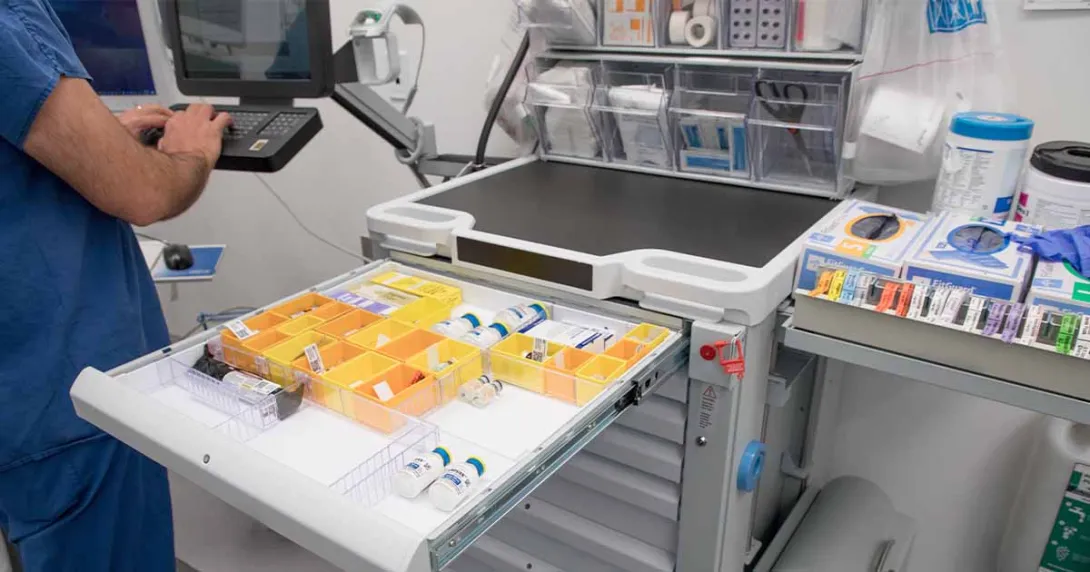
Photo: Fresenius Kabi
In 2013, the United States Congress passed the Drug Supply Chain Security Act (DSCSA), a federal law mandating national standards to ensure the secure and traceable distribution of prescription drugs across the pharmaceutical supply chain.1 While enforcement of this law was delayed for more than a decade, Bahar Aliakbarian, interim director at Michigan State University’s Axia Institute, said that pharmaceutical companies have been searching for the most effective ways to trace drugs as they travel from the manufacturer to the patient.
“The DSCSA does not suggest that organizations use any particular technology. It was thought that barcodes, which had been used for a long time, could be effective,” she said. “But, as we talked to more pharma supply chain loss and counterfeit prevention solution providers, we started to brainstorm what else could be added to traditional barcodes to make drugs more traceable. Radio frequency identification (RFID) tags came up.”2
To test whether RFID could support traceability across the pharmaceutical supply chain, while meeting DSCSA requirements, the Axia Institute conducted a pilot study. Aliakbarian said the researchers opted to use the GS1 standard, a specific encoding scheme that ensures RFID tags can be read by any solution deployed by the myriad pharmaceutical stakeholders. Jonathan Gregory, director, global standards, GS1 US, said the use of GS1 Standards means that they all can access key information about each drug.3
“[Stakeholders] don’t have to access a cloud subscription to get core critical information like the serial number, the National Drug Code (NDC), the batch or lot number and expiration date,” he explained. “Using the GS1 Standards allows anyone in the supply chain to access it — enabling interoperability across different systems.”
Pilot results
In phase one of the pilot study, the Axia research team used ultra-high frequency (UHF) passive RFID tags, commonly known as RAIN tags, from three different manufacturers attached to both boxes of solid tablets and those filled with liquid vials. They then scanned the items after creating two totes of product, one with a greater number of tablets in plastic bottles and the other with more glass vials to evaluate the tags’ readability rate.
“This was just a lab-scale study, but we confirmed that the minimal readability rate was something between 96% and 98%,” she said. “It provided proof of concept that RFID can work, even with tags that were not specifically designed to be used on pharmaceuticals.”
The group hypothesized that products with tag designs optimized for drug products would increase the readability rate. In phase two, they put drugs with RAIN RFID tags into both a simulated supply chain and a real-world pilot at a pharmaceutical distribution center. With these enhanced tags in place, the researchers were able to achieve 100% traceability, even with different types of packaging and pharmaceutical solutions, and multiple read points, demonstrating that users can quickly and accurately scan items across the supply chain ecosystem.
“The biggest takeaway from the pilot is that RFID works well even in very complicated environments to bring high levels of traceability — and it works better than barcodes,” said Aliakbarian. “But we also saw that we need to use common standards like GS1 to make sure all these different systems can talk to one another to make traceability happen.”
Accurate and efficient tracing
The Axia Institute pilot study is the first real-world demonstration that RFID can support end-to-end traceability across the pharmaceutical supply chain in an accurate and efficient way, meeting DSCSA requirements.
“You don’t have to have the drug in the line of sight; you don’t need to physically see or physically open a box to scan it and know what’s inside. That’s important when you are talking about pallets of unopened boxes moving across the supply chain,” Aliakbarian explained.
Gregory agreed, saying that many pharmaceutical products are made of highly sensitive material, or are of high value, so the ability to scan and read important information at a distance is paramount. The results show that pharmaceutical solutions that leverage RAIN RFID tags and GS1 encoding standards provide a smarter way of tracing pharmaceutical products, he noted.
“You can see where different drugs are in the supply chain. You can use systems to find only the tags that have expired or that have a particular batch lot value. Even if you have one thousand tagged items in front of you and only one is expired, you can send a signal out and find that one product. It offers a huge time savings,” Gregory said. “As this pilot shows, RFID is incredibly efficient and allows access to critical data to the people who need it when they need it.”
References
- GS1 US. 2024. What is the Drug Supply Chain Security Act (DSCSA)? https://www.supplychain.gs1us.org/standards-and-regulations/drug-supply-chain-security-act.
- GS1 US. 2024. What is RFID technology, and how does it work? https://www.supplychain.gs1us.org/rfid.
- GS1 US. GS1 Standards: The global language of business. https://www.gs1us.org/industries-and-insights/standards