 | December 23, 2025
| 6:00 AM
| December 23, 2025
| 6:00 AM
Photo: Fresenius Kabi
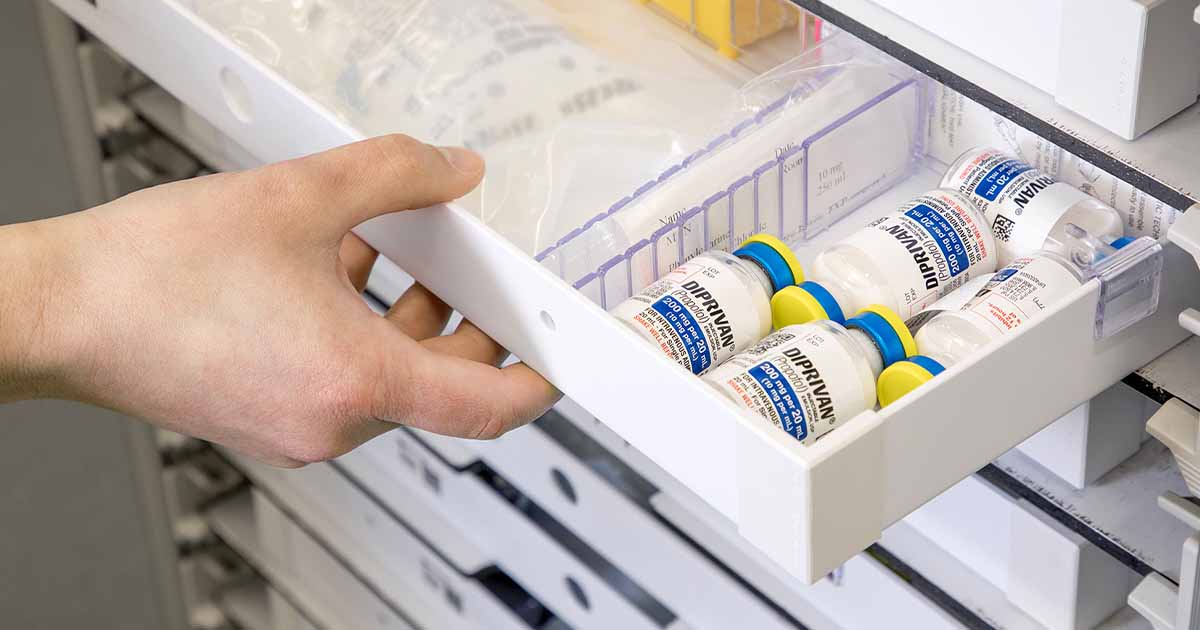
Today’s medication supply chain relies heavily on barcodes for tracking and authentication, and these are applied not only at the unit of sale — such as a box of medications — but also at the unit-of-use level, on individual syringes, vials or blister packs. However, the FDA does not require lot numbers, serial numbers or expiration dates to be encoded in the barcodes on these unit-of-use items. This limitation makes automatic capture of these critical attributes difficult across the supply chain, reducing the ability to maintain granular visibility for inventory management. RFID technology addresses this gap by enabling these attributes to be encoded directly into the tag, providing richer data for tracking location, quantity and status — capabilities that advanced standards like GS1 RFID aim to deliver.
David Berkowitz, Senior Clinical Product Manager, Point of Care at Omnicell, notes: “Managing medication inventory in hospitals can benefit from increased digital visibility. Current serialization practices typically stop at the unit of sale. Because nursing units stock and administer medications at the unit-of-use level, the lack of unique identifiers for these doses makes it difficult to track location, quantity, provenance, and status in real time.”
Thus, once medications get to automated dispensing systems, the pharmacy loses the ability to automatically count and track those individual items. That lack of digital visibility and traceability could put patients at risk. Yet, when pharmaceutical manufacturers place a radio frequency identification (RFID) tag on each unit of use, healthcare organizations can automatically see what drugs have been recalled or expired before they reach the patient.
Unit-of-use RFID tags with integrated sensors could also allow the pharmacy to better manage the “cold chain,” ensuring that drugs requiring strict temperature control have not gone out of that range during transport or storage. It also has the benefit of giving pharmacists up-to-date inventory, helping them avoid potential stockouts.
“RFID allows you to track a single dose of the drug from where it was made and then at key points along the supply chain to see whether it is real, safe and available where it’s needed,” Berkowitz said.
A standard that works for everyone
The good news is that healthcare organizations are moving toward such serialization thanks to greater adoption of GS1 standards. GS1 is a common global framework that allows different solutions, regardless of which company offers them, to identify, capture and share important drug information like the national drug code (NDC), lot number, expiration date, serial number and more. Aaron Sundman, Business Development, CCL eAgile, said GS1 standards are imperative to support strong interoperability among the various systems the pharmacy supply chain relies upon to get drugs from manufacturers to patients.
“Interoperability is just a long word that means an RFID tag can work for everyone and every system … and when there is a single standard, like GS1, we know that any system can read the RFID tag and so people can get the information they need,” he pointed out.
When manufacturers provide RFID tagging on individual doses, it expands traceability and digital visibility, added Berkowitz. Today’s absence of an industry-wide RFID coding standard creates logistical and operational challenges for hospitals. The use of GS1 standards, however, will remove such barriers, no matter what kind of medication management, inventory or electronic medical record (EMR) solutions are being used.
“Pharmacists and hospitals just want their tags to work and for it to be easy no matter what system they are using. GS1 supports that,” Berkowitz said.
Greater efficiencies, greater safety made possible with manufacturer-enabled RFID
GS1-standardized RFID can help pharmacies and provider organizations gain greater efficiencies, saving valuable hours that pharmacists and pharmacy techs must now use to manually input data or search for recalled or expired drugs. When manufacturers encode essential data directly to the RFID tag, including the NDC, lot number, expiration date and serial number, vendors that provide medication management systems can easily read critical drug information without having to seek out the data through external registries, databases or cloud-based interfaces. Doing so increases both process complexity and costs — while also increasing the risk of inaccurate data. It’s yet another reason why manufacturer-enabled RFID tags will make medication management across provider organizations not only safer but faster and more cost-effective, said Sundman.
“When the RFID tag is on the dose itself, placed there by the manufacturer, the one who actually made the drug, you can trust the data,” he said. “And it makes auto-identification really easy. You can validate every dose within a few seconds. You can check every single expiration date and every single lot number in a population of hundreds and know those drugs have not expired or been recalled.”
Berkowitz said that there are not many solutions out there that can improve outcomes in such a wide variety of use cases — but manufacturer-enabled RFID tags on single doses, supported by GS1 standards, can. “This is just a smarter barcode that can solve a lot of problems,” he added. “RFID tags have broad applicability to the goals of increasing stakeholder visibility within the pharmacy supply chain and improving patient care.”