White Papers

For healthcare organizations, EHR downtime is no longer a rare disruption, but a recurring enterprise operating condition with measurable effects on operations and care.

Drawing on real-world hospital experience, this session reframes administrative burden as a clinical operations challenge with direct financial implications.

With 2026 requirements now in effect—and 2027 API deadlines fast approaching—the real challenge isn’t just implementing APIs—it’s transforming how data flows across your organization to improve efficiency, reduce friction, and deliver better member and provider experiences.

Regulatory mandates are reshaping healthcare—but leading payers aren’t treating CMS-0057-F as a compliance burden. They’re using it to modernize operations, reduce provider abrasion, and unlock long-term ROI.

Healthcare leaders are under increasing pressure to unify fragmented data and turn it into meaningful clinical, operational, and financial impact. Yet siloed systems and data complexity continue to stand in the way.
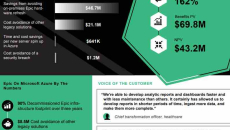
Explore the cost savings, operational efficiencies, and innovation gains that healthcare organizations experience by running Epic on Microsoft Azure—a secure, scalable cloud platform built for mission-critical workloads.
Healthcare organizations are increasingly under attack from cybercriminals, and most healthcare IT teams are stretched to the limit, managing complex infrastructure with limited resources.
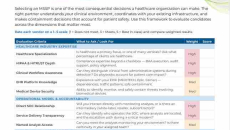
Your security provider relationship is a matter of patient safety, and the right partner will be willing to coordinate with your existing infrastructure and answer questions about topics such as visibility and incident response.

The Best in KLAS 2026, Software and Services Report, delivers an objective, data-driven analysis of the healthcare technology solutions earning the highest performance ratings from providers nationwide.
Forward-thinking healthcare technology companies are embedding Ambient Clinical Intelligence (ACI) across clinical workflows to reduce administrative burden, accelerate revenue cycles, and improve workflow efficiency. However, developing these models in-house requires organizations to divert engineering teams into complex AI builds.