Government & Policy
About 15,000 children and family members across the country in need of healthcare will benefit from a partnership under which 15 of the Children's Health Fund's mobile medical clinics will be equipped with the latest health IT from the Verizon Foundation. The initiative kicked off in Miami on July 25.
Averill discusses the surprising resistance to ICD-10, widespread misperceptions, how another delay could enter the legislative discourse, and reasons that physicians are not dying to their hands on the coming code set's more granular data.
In a report, released July 25, the American Hospital Association calls for "redirecting" the existing requirements for digital clinical quality measures. As it stands, the process raises costs and effort for providers, AHA said, without leading to accurate data.
Following last week's call from Sen. Orrin Hatch, R-Utah, to pause the meaningful use program and determine whether "the bar is too low," a federal hearing Wednesday included testimony from providers and a tech vendor who recommended expanding the timeline because the next phase is overly-prescriptive and threatens to hinder hospitals.
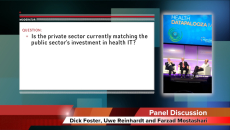
In this clip from Health Datapalooza IV, panelists Farzad Mostashari, Dick Foster and Uwe Reinhardt discuss whether or not the private sector is beginning to match government investment in health IT.
With an eagle-eyed watch on the implementation of a new Medicaid claims system in 2015, Montana's CIO Ron Baldwin says he wants the state's recently redesigned health and human services IT systems to last several decades. Which is why he is plotting the project similarly to how an urban planner might.
The Mass. Medical Society hopes a law conditioning physician licensure on meaningful use demonstration will be flexibly enforced — and that other IT requirements for payment reforms won't overwhelm smaller practices.
Richard Averill of 3M Health Information Systems counters the jokes about macaws, lampposts, and subsequent encounters by explaining that even the seemingly senseless codes exist for a reason.
Efforts to analyze identifiable and HIPAA de-identified data for public and population health will rely on ad hoc data warehouse techniques for the time being, unless other standardization is advanced.
A new generation of Medicare beneficiaries, longer lifespans and the wide availability of personal technology are creating new challenges and opportunities for home care.