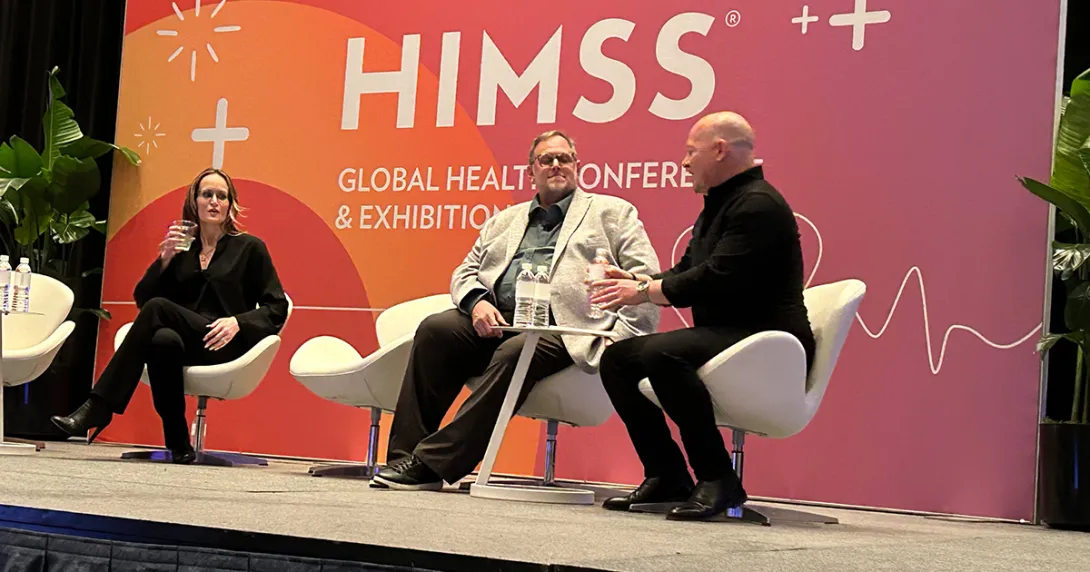
(L-R) Laura Edell, Scott Perryman and Brian Spisak at HIMSS26 on Monday
Photo: HIMSS Media
LAS VEGAS – Scott Perryman, interim CEO of Three Crosses Regional Hospital, a 46-bed acute care hospital serving Las Cruces, New Mexico, was asked on Monday what he thought the biggest misconception might be about innovation in rural or small community hospital settings.
"It's probably more of a social misconception," said Perryman, speaking at the HIMSS26 AI in Healthcare Forum here. "But I think it's that rural communities are exclusively almost uniformly poor, and lack expertise or capability. I find that to be a complete misstatement of fact."
Perryman, who is also a senior partner at Csuite Growth Advisors, and has extensive experience in executive roles at small and rural hospitals, said, "There are actually many, many communities we've worked in that are very unique, special places that have unique needs and unique capabilities – and a community workforce that is incredibly loyal to that community."
These workforces have the appetite and readiness to put automation to work to improve care delivery. And they'll be crucial, if given the tools, to helping their hospitals meet the pressing demands that are facing small providers – in some ways, all providers – in the coming years.
When it comes to scaling AI in under-resourced community and critical access hospitals, "there are pockets of real special, incredible capability," said Perryman. "I think people miss that. And I think it's a part of the solution for how we're going to leverage some of this technology."
Perryman was joined in his panel discussion Monday by Laura Edell, chief innovation and technology officer at Csuite Growth Advisors (who also served as a data scientist at Microsoft and worked on an early version of Siri at Apple), and Brian Spisak, a senior partner at Csuite and director of AI at Harvard's National Preparedness Leadership Initiative.
The goal of the conversation was to explore ways that healthcare organizations can implement advanced technologies like AI, even without the monetary or workforce resources of larger institutions – to help ensure that a particular provider's geographic location isn't determinative of the quality of care they deliver.
"Innovation is not great until it is actually meaningful and practical," Edell said, echoing a mandate from Steve Jobs that tech products should be intuitive and useful above all.
And while the past several years have shown what a meaningful and practical effect AI-enabled technologies can have for health systems in well-resourced communities, too many small hospitals are still not able to take advantage.
"Rural to me represents that underserved community, the digital inequities that I really want to help address," she said.
Spisak said he's been exploring AI innovation in Cambridge focused on bringing technologies to the small and rural providers who could benefit from them most.
He described a "flywheel of access that comes from understanding what the needs are, finding where the innovation hubs are, bringing the innovation in the people and the clinicians into those places, and constantly feeding that up – and then feeding that back up to potentially the larger systems.
"That's what we're trying to do, more and more is connect those dots," he said. "How do we do this in these rural, small community settings?"
Perryman said it might be useful to think of resource-constrained community hospitals as something of a preview of what might be coming for many hospitals and health systems – in all areas of the U.S. – as financial and human capital challenges continue to impact care delivery.
"Rural communities have dealt with this shortage and this challenge, that everyone else is going to deal with sooner – it just happens to be in the first place, the pressure point," he said. "It's a challenge for everyone in the future, as resources become scarcer, and there's a larger demand for healthcare, particularly in the areas of primary care and chronic care management."
The Rural Health Transformation (RHT) Program, the $50 billion initiative for healthcare digital projects (funded by the same Congress that enacted sweeping Medicaid reimbursement cuts in the same "Big Beautiful Bill") could help some hospitals make good on their innovation potential.
"If you need some really interesting reading, look at some of the summaries that have been created" by states applying for the CMS funding," said Perryman. It's a mishmash of very different types of solutions.
"If you look at what the states are doing with that $50 billion over the next five years, it's really interesting what emerges – which is, trying to address access, local workforce challenges and then chronic care management."
With its emphasis on boil-the-ocean transformation efforts, he wonders whether the RHT Program might be a bit of a "misalignment of financial incentives [with] what communities actually need for well-being," he said.
In certain areas of the country, "you can almost pinpoint regions where two or three urban centers just pull off pretty much what needs to be pulled off from them to be involved in the community," said Perryman. "By and large, the core services that the community needs to get stripped out because to get involvement of larger weather resource organizations, they lose sight of the core of it."
That's an opportunity, he said, "where innovation and technology has such great potential."
In their applications for RHT funding, "there are a number of states that have begun to create hubs" and tackle some of these issues in a regional way, he said.
"Historically, I think people looked at rural health communities as kind of like a point solution, an asset-by-asset need. But this is an area that lends itself to be able to look at the population. For instance, there's 11 counties between Austin, Houston and San Antonio – that's 550,000 people. I think you can achieve scale with that."
Mike Miliard is executive editor of Healthcare IT News.
Email the writer: mmiliard@himss.org
Healthcare IT News is a HIMSS publication.


