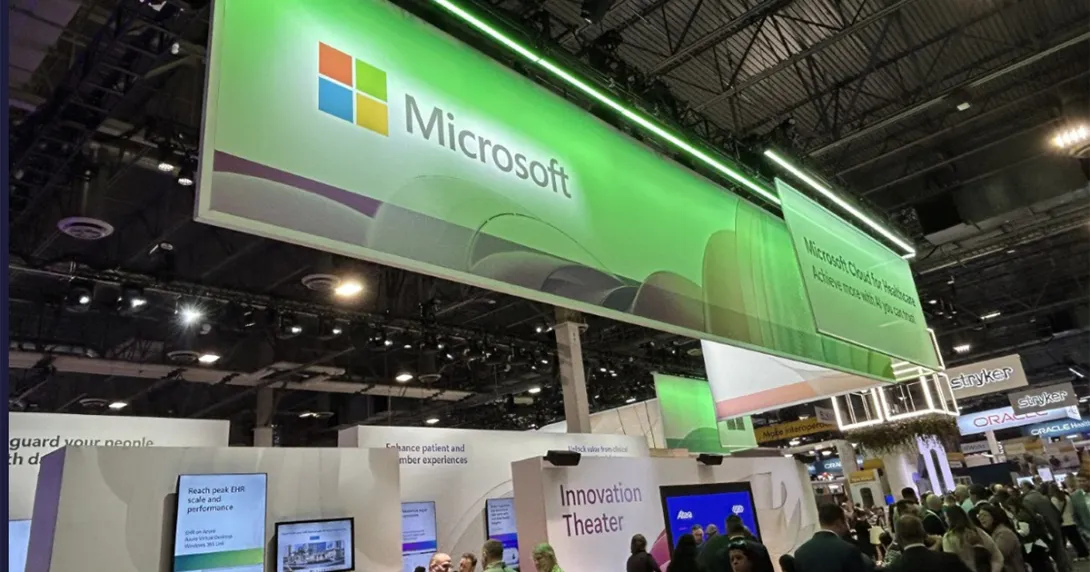
Microsoft wants visitors to its HIMSS26 booth (#2812) to see how freshly rolled out integrations in Dragon Copilot – its public preview coincides with the conference next week in Las Vegas – enable clinicians and revenue cycle management teams to spend less time navigating systems and more time focused on patient care.
That means more artificial intelligence insights are available to clinical and revenue cycle management teams at their fingertips, directly within existing workflows, says Kenn Harper, general manager of Dragon Product at Microsoft.
"Wherever your cursor is, Dragon Copilot is there, ready to do something on your behalf," Harper told Healthcare IT News on Wednesday, ahead of the company's announcement about the new and expanded AI capabilities.
On Thursday, Microsoft noted in a blog that the unified AI features can simplify charting, notes, flowsheets and reporting to reduce rework and cognitive burdens.
As part of its ongoing focus to enhance clinical productivity, Microsoft developed the new third-party interface using Dragon Copilot with health tech companies Canary Speech, Humata Health, Optum and Regard.
The integrations available in Microsoft Marketplace for Dragon Copilot users, who number more than 100,000 users, will make it possible for healthcare organizations to acquire, deploy and scale, Harper said.
"It's been a really fun journey to see just how pervasive this has become in healthcare," he said. "It's running at scale, and it really has changed how clinicians are working throughout the course of the day and how they're interacting with patients."
At the conference exhibition, numerous Dragon Copilot workflow enhancements will be on display, such as integrations with Canary's biomarker technology, which analyzes a patient's voice for anxiety and depression while in an exam room, and Humata's prior authorization tools for doctors.
"Canary was the first to use our ecosystem," Harper noted.
By leveraging real-time patient-doctor conversations, Dragon Copilot can "serve up intelligence, guidance and evidence-based recommendations on what the provider should consider doing on behalf of the patient," he said.
At HIMSS26, Microsoft will also feature a Humata plug-in that ensures clinicians have payer guidelines to validate their recommendations and prompts them to complete required workflows.
Based on diagnoses, doctors can look at payer information for patients and "capture everything so that procedures get approved," Harper said.
Microsoft said it expects that there will be hundreds of clinical and rev cycle plug-ins available for Dragon Copilot.
"There really is a world of possibility of the types of extensions that are going to come into Dragon," Harper said. "Our role here is to make it open where anyone can plug in and provide the context and then allow them to bring their intervention into the Dragon workflow."
Along with the unified AI copilot widget, Microsoft is also launching more centralized insights served up through a Dragon dashboard available to customers using the Microsoft 365 Copilot, which can search third-party systems clinicians use daily, such as UpToDate and Elsevier, and software programs, such as Teams, Outlook and SharePoint.
Visitors to Microsoft's booth can expect to see the Dragon Copilot compressed widget, always afloat, available and ready to launch wherever a system cursor is – in any app, Harper said.
The shapeshifting Dragon Copilot widget can provide content and answer questions from outside applications within existing workflows through typed or voice prompts.
"You don't have to switch applications and switch different interfaces from Dragon," Harper explained. "Ask a question, and we will go to multiple sources and bring you back the results in a summarized way to help best answer that question, all done in Dragon in your existing workflow."
It works across all electronic health records, just like Dragon Medical One.
"This is what historically we've done with DMO – with dictation at the cursor, where you talk and then we insert text into wherever your cursor is," he said. "It's leveraging that same intelligence, but we're supercharging it with Copilot, where we now can allow you to basically speak a natural language."
Dragon's healthcare-grade AI models rely on the Provider Document Summarization Quality Instrument (PDSQI9) industry standard to evaluate content and ensure accuracy, Microsoft noted.
New persona-specific note types, automated referral letters and after-visit summaries, summaries of prior radiology reports, and proactive coding guidance in Dragon aim to reduce toggling between applications, freeing up the mental focus of care teams.
Sentara Health is integrating Regard's diagnosis and documentation technology plug-in for Dragon Copilot, said Dr. Joseph Evans, the organization's vice president and chief health information officer, in the company's announcement.
"By combining Dragon's ambient conversation capture with Regard's ability to surface key insights from data, we expect to help our clinicians identify comorbidities and relevant diagnoses in real time without adding steps to their workflow," he said. "Our goal is straightforward: strengthen the clinical picture, reduce documentation burden and support more informed decision-making at the point of care."
New copilot capabilities can also support specialties in new ways.
As a companion for PowerScribe One, Dragon Copilot can minimize repetitive tasks in radiology, Microsoft said.
It "gives me confidence that I can test and benefit from the latest AI advancements with minimal disruptions and distractions," said Dr. Sean Cleary, vice chair of informatics for imaging sciences at the University of Rochester Medical Center.
Of note, the integrated Dragon Copilot is available for U.S. med-surg nurses, with 10 organizations up and running, Harper said.
Those on the lookout for technologies that improve nursing workflows can ask for a demo at the Microsoft anchor exhibit just adjacent to the HIMSS Connect booth. It provides expanded support for all med-surg flowsheet templates and lines, drains, and airways additions and removals, Microsoft said.
Through a dedicated app available on mobile, web and desktop, nurses can also access medical data, query transcripts and patient details, and create care summaries without leaving workflows.
Mercy is one health system that has launched Dragon Copilot for nurses.
Nurses spend more time at patients' bedsides "with face-to-face interactions," Stephanie Whitaker, Mercy's chief nursing officer, said in the Microsoft announcement.
"I can say that without a doubt, using Dragon Copilot has significantly reduced the time that I'm focused and worrying about sitting down and getting my charting done behind the computer," added Mercy nurse Christine Dupire.
Dragon Copilot, available in the U.S., Canada, the United Kingdom, Ireland, France, Germany, Austria, Belgium and the Netherlands, currently captures clinical conversations in 58 languages.
Microsoft said it provides seamless migration from the Dragon Medical One ambient scribe available to many EHRs, like athenahealth's cloud-based system, and preserves existing commands, vocabularies, profiles, templates and auto texts.
Microsoft will be in Booth 2812 at HIMSS26.
Andrea Fox is senior editor of Healthcare IT News.
Email: afox@himss.org
Healthcare IT News is a HIMSS Media publication.


