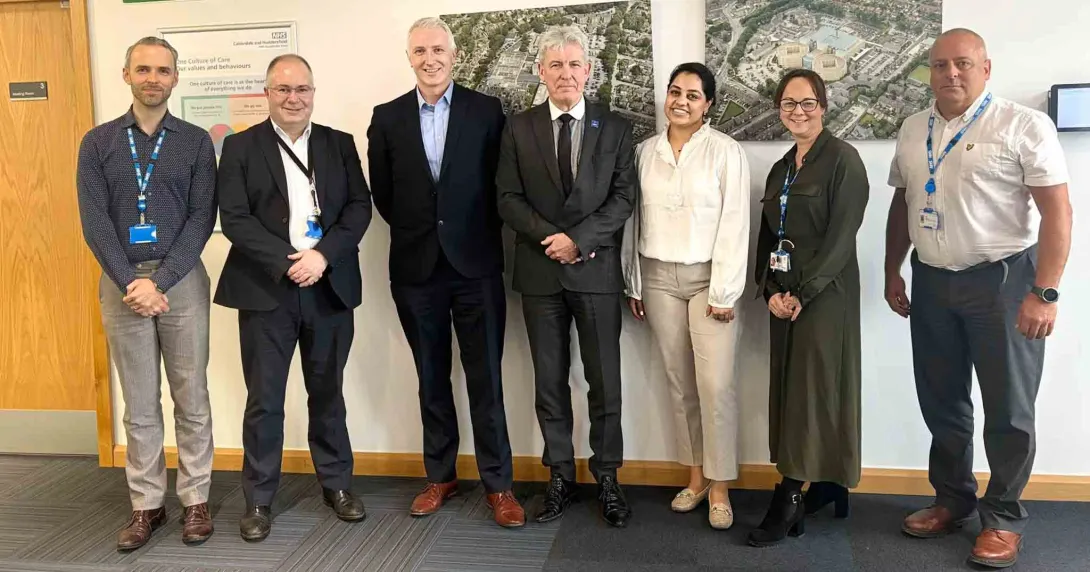
Calderdale and Huddersfield NHS Foundation Trust have earned Stage 6 on three HIMSS Maturity Models.
Photo: Calderdale and Huddersfield NHS Foundation Trust
When evaluating digital maturity, healthcare organisations generally fall into one of three groups: those with inaccurate self-assessments, those lacking clear visibility into their current performance and, most commonly, those unsure of where to begin.
HIMSS addresses these challenges through its internationally recognised Digital Transformation Maturity Models. These frameworks provide comprehensive evaluations across key areas such as clinical safety, cybersecurity, data quality, analytics, governance and IT infrastructure. Each model follows a scale from Stage 0 to Stage 7, in which Stage 0 reflects largely paper-based systems and Stage 7 represents a fully integrated, paperless environment supported by advanced analytics.
Currently, more than 50 hospitals across Europe and the Middle East have reached Stage 6 or 7 in at least one HIMSS Maturity Model. Among those assessed recently, Calderdale and Huddersfield NHS Foundation Trust stands out. Through years of consistent digital development and investment in analytics, the Trust achieved three Stage 6 certifications.
Where to begin
A decade ago, starting from a relatively low level of digital maturity, Calderdale and Huddersfield NHS Foundation Trust used HIMSS benchmarking to define its direction. The Trust's transformation began with an infrastructure upgrade, the implementation of an electronic patient record system and the introduction of a Trust-wide knowledge portal.
"Digital maturity cannot exist in isolated areas of an organisation; it must be embedded across the entire system," said Rob Birkett, the Trust's chief digital and information officer. "This requires alignment between clinical, operational and corporate functions so that digital capabilities are applied consistently and safely, rather than relying on localised solutions."
Meaningful transformation demands a long-term commitment, he added. "Digital transformation is not achieved through short-term projects. It requires sustained effort over many years – often five or more – guided by a clear strategic direction."
Securing organisational buy-in
Technology and strategy alone are not enough. Without engagement across the organisation, success is unlikely. At Calderdale and Huddersfield, staff engagement was strengthened through structured learning programmes aimed at building digital understanding and capability. This culture of shared ownership has been critical in supporting the Trust's digital ambitions and ensuring progress remains both impactful and sustainable.
Similarly, the assessment at King's College Hospital NHS Foundation Trust proved valuable as a morale-boosting exercise. "We work closely with clinical teams, and our clinical colleagues responded with genuine pride and enthusiasm when they heard about the achievement," said Senai Jimenez, head of ICT Programmes and Projects at King's College Hospital NHS Trust. King's completed its infrastructure assessment (INFRAM) and achieved Stage 6 certification.
Making the case for investment
Healthcare leaders, particularly in public systems, often struggle to build a compelling case for digital investment. Benchmarking plays a critical role here, providing a structured way to link digital maturity with measurable outcomes.
The Government of Jersey offers a strong example. By combining maturity model assessments with patient safety data and productivity estimates, it developed a "risk projection" to show how underinvestment would increase clinical risk and workforce pressure.
As Martin Carpenter, health CIO for the Government of Jersey, explained: "The HIMSS Care Continuity Maturity Model placed us at 0 out of 7, ranking last among 26 jurisdictions. By linking this to patient safety incidents, productivity loss and the needs of our ageing population, we showed that not investing would continue to compromise safety, efficiency and long-term sustainability. This allowed us to turn a technical upgrade into a human case for change."
By reframing a technical request into a human-centred case for change, the government secured a £32 million, four-year programme for system-level care coordination, enabling clinicians to access a whole-patient view and deliver the right interventions at the right time.
A strategic, long-term approach
Validation should not be seen merely as a recognition; it is a strategic asset. It links investment to measurable impact, guides future development and builds confidence across the organisation.
For Calderdale and Huddersfield, recent validation has shaped its next five-year digital strategy. The Trust is now focusing on intelligent automation, safe integration of AI, and enhancing patient empowerment – such as improving scheduling systems to offer greater choice and a better patient experience. By sharing its progress with partners, the Trust aims to contribute to wider systemwide digital advancement.
Hospitals that have achieved Stage 6 and 7 digital maturity will be featured at HIMSS Europe 2026 in Copenhagen in May, where they will share their experiences and strategies with the broader healthcare community. See the HIMSS Europe programme for more details.