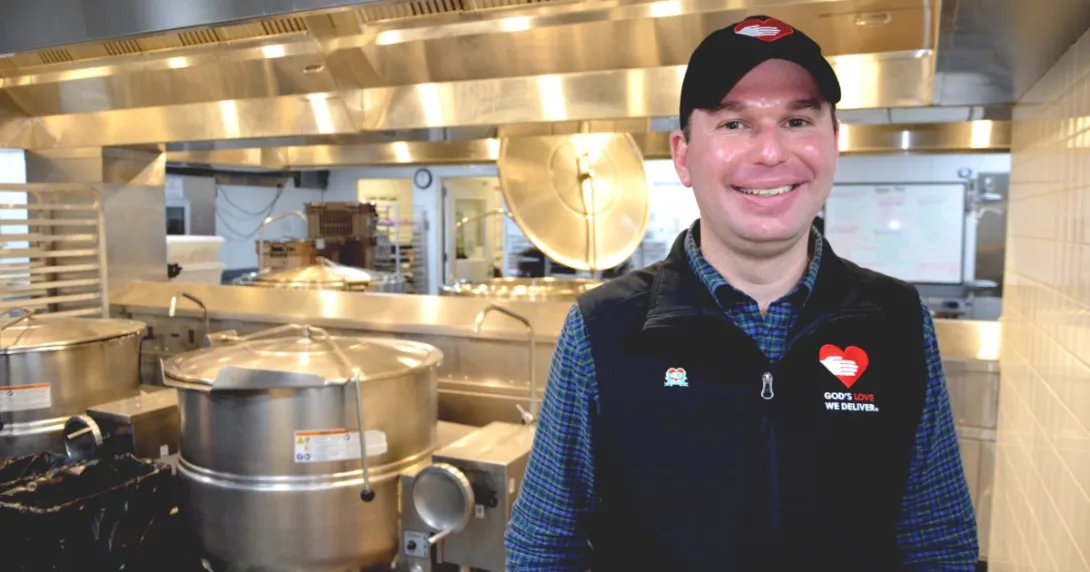
Eric Rochman, chief strategy and growth officer at New York City-based God's Love We Deliver
Photo: God's Love We Deliver
A longstanding challenge community-based organizations have faced is the ability to receive electronic referrals for services through a common platform that connects healthcare and social services organizations – enabling interactions between individuals in need of services and the organizations on the ground providing them.
THE CHALLENGE
As a community-based nonsectarian organization, God's Love We Deliver has experienced this challenge firsthand over its 40-year history of providing medically tailored, home-delivered meals to clients affected by life-altering chronic illnesses.
Varying referral methods – referral forms mailed, emailed or faxed – complicated the organization's ability to manage referrals for individuals who needed services and the ease with which it could communicate with referral partners about the status of the services for clients.
"Additionally, while existing referral processes were available for healthcare providers to connect individuals to the social services they need, there was no coordinated way to connect that referral through the delivery of services to the actual payment for the rendered service," said Eric Rochman, chief strategy and growth officer at New York City-based God's Love We Deliver.
"While healthcare providers across the continuum of care, from hospitals to physicians, have historically had platforms to support the submission of claims to receive payment for services, similar platforms have not existed for community-based organizations," he continued. "This has created a burden for organizations like God's Love in working with healthcare institutions for which we have agreements in place to provide reimbursable services."
Community-based organizations have historically been left out of the integrated healthcare service delivery model until more recently, with the acknowledgement of the importance of health-related social needs, he added.
"This in particular has come to light in the implementation of the New York State Health Equity Reform Program (NYHER), which developed a pathway for community-based organizations to receive referrals and payment for services traditionally not payable through Medicaid," Rochman noted. "With this change, identifying opportunities to allow for CBOs to receive reimbursement for the care and services they provide clients was necessary to ensure sustainability and success for us to support the communities we serve."
PROPOSAL
The proposed solution that existing referral platforms like Unite Us offered to resolve challenges with managing and submitting for payment of services was to integrate the referral and reimbursement process together to simplify the lifecycle of referral, service delivery and reimbursement for services rendered to achieve a true closed-loop process.
"The vendor we chose, Unite Us, identified the need for the individual submitting the referral to have visibility to see whether a client had received the services we were providing, while allowing us to render the service and communicate through the platform with the referrer to allow for coordination of service delivery and reimbursement," Rochman explained.
"The proposed system also provided a level of transparency to God's Love on the status of submissions for reimbursement and allowed us to work directly with the payer to resolve any issues related to the invoice, all within the referral record, allowing for easier coordination for the various organizations involved in the end-to-end process," he continued.
This alleviated the challenge of streamlining the coordination between the various entities – referrer, service provider and payer – to ensure the client received the services they needed and organizations like God's Love were reimbursed for the services they provided while providing visibility to everyone involved.
MEETING THE CHALLENGE
In implementing the platform, God's Love has been able to increase the accessibility and visibility of its services to a larger network of referral sources, increasing access to services to clients in need of the support provided – while also improving the ability to receive reimbursement for services from payer organizations funded through Medicaid.
"Starting with our program service team, we are able to more easily identify clients eligible for our services and communicate with referral partners working with clients to get them connected to our services," Rochman said. "Once the client is onboarded, we can notify the referrer that services have been initiated, creating a more effective closed-loop referral process that increases the coordination of services and care for clients.
"As services are delivered, our finance team is able to submit reimbursement for services within the referral record for clients, including submitting any additional details or documentation that was required for payment of services," he added.
As the payer provides reimbursement, the finance team can track the status of invoices for services and reconcile the payment for services rendered. In addition, if any issues arise with invoices submitted, the finance team can communicate directly with the payer to resolve issues and, if needed, resubmit for reimbursement of services.
"Using the platform has allowed us to collaborate with both external and internal stakeholders to increase the efficiency and visibility into a complicated process that previously was completed across various systems," Rochman explained.
"The platform does not currently integrate with our CRM or finance systems, yet we are working with Unite Us to explore opportunities for API integrations that would further automate the process and allow for improved data exchange between our systems," he said.
RESULTS
By implementing the referral and payments technology platform, God's Love has decreased the time it takes to intake a client into its program and start services, as well as the time between service delivery and billing – allowing the organization to receive reimbursement for services rendered more quickly.
"Before implementing the platform, we were billing for our services monthly across all our healthcare partner contracts," Rochman recalled. "Using the payments technology has decreased the timeframe needed from delivery of services to when we can submit for reimbursement, allowing us to bill weekly for our services, thereby accelerating the payment for our services."
ADVICE FOR OTHERS
As an important part of the healthcare continuum, community-based organizations are often an afterthought in how they are integrated into systems and technology that allow them to connect with clients and receive reimbursement for the services they provide, Rochman said.
"Historically, CBOs often do not have similar resources, both from a workforce and financial capacity, when compared to healthcare provider organizations – making it more challenging for CBOs to stand up new platforms or technology that enable coordinated care delivery in a reimbursable fashion," he continued.
"To ensure the success of using similar payment technology with CBOs, healthcare providers must engage with CBOs in the design and implementation of payment technology early in the process to minimize any potential operational burden that could result from a lack of understanding of their processes and the way in which they serve their clients," he added.
By engaging CBOs upfront when implementing payment technology, CBOs can become effective partners with healthcare provider organizations to streamline the referral to payment lifecycle, improving the coordination of care for clients in addressing health-related social needs while opening new reimbursable pathways for CBOs to best support the communities they serve, he concluded.
Follow Bill's health IT coverage on LinkedIn: Bill Siwicki
Email him: bsiwicki@himss.org
Healthcare IT News is a HIMSS Media publication.
WATCH NOW: Accurate provider directories are needed for patient access


