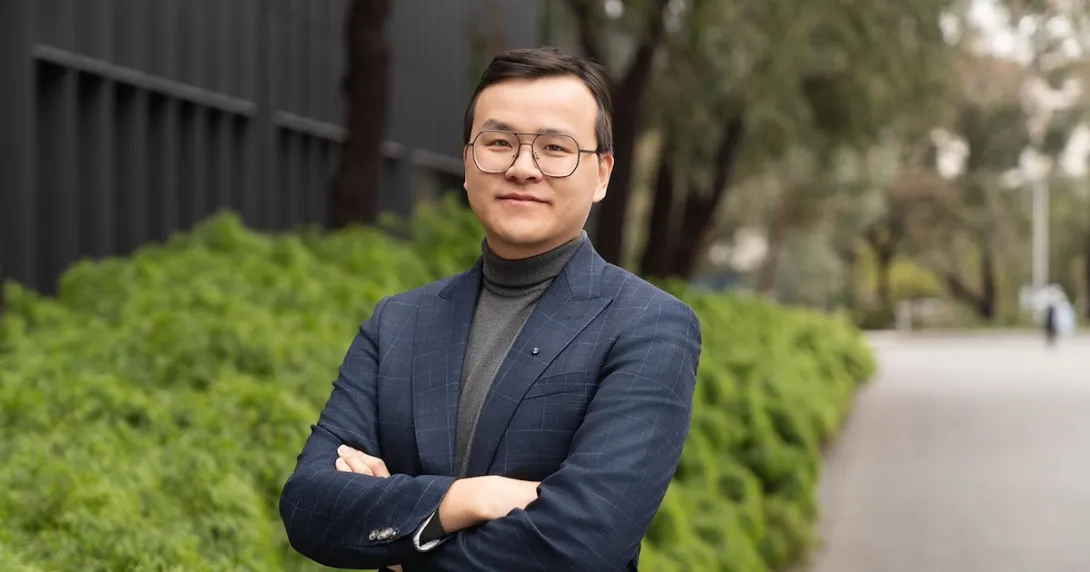
Monash University associate professor Zongyuan Ge
Photo: Monash University/LinkedIn
Monash University is developing an AI foundation model for healthcare, touted as the first of its kind in Australia, that can analyse multimodal patient data at scale.
Late last month, Zongyuan Ge, PhD, an associate professor at Monash University Faculty of Information Technology, was one of the recipients of the 2025 Viertel Senior Medical Research Fellowships. Offered by the Sylvia and Charles Viertel Charitable Foundation, the programme supports innovative medical research projects.
A/Prof Ge, who is also the first AI scientist to receive the medical research fellowship, is leading a team of researchers developing an AI system capable of linking imaging scans, clinical notes, and long-term patient records to help doctors catch diseases early, improve prognoses, and support personalised healthcare.
Healthcare IT News talked to A/Prof Ge to discuss more about his team's Unified Phenotype Foundation Model, exploring its multimodal design, secure data training environment, early pilot collaborations, and the training pathway being set up to equip clinicians with the AI skills needed for future deployment in Australian hospitals.
Q: To start, what is the Unified Phenotype Foundation Model (UPFM), and what gap in current medical AI does it aim to close? Many AI models today are designed for narrow, single-task applications. What makes the UPFM different, and what "unified" capability are you seeking to build for Australia's healthcare ecosystem?
A: Most current medical AI is very specialised. It might be excellent at analysing an eye scan or a skin lesion, but it can't see the connection between them. The gap is that medicine doesn't happen in a silo. A patient is a whole person, not just a single organ.
The Unified Phenotype Foundation Model (UPFM) is designed to close this exact gap.
Instead of looking at isolated data points, it learns the fundamental patterns of human health by integrating all of a patient's information over time. This includes everything from eye scans and skin images to brain signals, lab results, and electronic health records. The goal is to build a collaborative "teammate" for clinicians; an AI that sees the complete picture. This unified view will enable proactive healthcare, helping clinicians catch diseases earlier, predict risk more accurately, and truly personalise treatments for major conditions like cardiovascular disease, skin cancer, and epilepsy.
Q: Your team plans to integrate highly diverse patient data, such as radiology and pathology scans, clinical text, and long-term health records. What are the main technical or governance challenges in harmonising such varied data sources across Australia’s fragmented healthcare landscape? How will you address interoperability between hospital systems and ensure that data from both public and private providers can be represented fairly in the model?
A: This is one of the biggest technical challenges. You're teaching a model to find meaningful patterns between completely different types of information – a doctor's text note, the pixels of an eye scan, and the waveform of a brain signal. Our team's expertise is in designing an AI structure that can 'fuse' these different data streams into one coherent understanding.
On the governance and interoperability side, the key challenge is linking data from different systems (public and private) that don't naturally talk to each other. We're addressing this by building a highly secure and robust data pipeline. We will be training the model using large-scale, de-identified public datasets, data from our clinical partners, and high-quality medical education materials. A core part of the work is ensuring all this data is harmonised and represented fairly, so the model works for all Australians.
Q: How far along is the project at this stage? Have you already built a prototype or proof-of-concept version of the UPFM, and what early insights or validation results can you share?
A: We've successfully built and validated the 'blueprint' for this approach in a specific and very complex area: dermatology.
Our recent model, PanDerm, which is being published in Nature Medicine, was the first of its kind for skin conditions. We trained it on over two million images from 11 clinical sites, and it set a new standard across 28 different diagnostic tasks. Most importantly, in a clinical reader study, it improved clinicians' skin cancer diagnostic accuracy by 11% and was significantly better at detecting early-stage melanoma.
PanDerm's success gives us enormous confidence. It shows that this method of integrating diverse data works and has a real-world clinical impact. The UPFM is the next logical step, scaling this proven concept from one organ system to the entire human body.
Q: Your Fellowship comes with significant funding support. How do you plan to allocate the program's resources (for instance, toward compute infrastructure, data partnerships, or clinical collaborations) and what milestones are you targeting over the next three years?
A: A significant portion of the funding is dedicated to people. I strongly believe we need to train a new generation of 'clinician-scientists' – doctors who also have deep AI expertise. This Fellowship will support AI-PhDs for candidates who already have a medical degree, creating leaders who can bridge the gap between medicine and technology.
The rest is allocated across our three key pillars. First, building the model, which requires significant computing power, and we're heavily supported by Monash's MAVERIC supercomputing facility. Second, validating the model's predictions against real-world clinical outcomes. And third, implementing it, which is all about our data partnerships and clinical collaborations.
Over the next three years, our major milestones are to build the core UPFM, demonstrate its predictive power in our key disease areas, and begin our first human-AI collaboration studies to prove its value in the clinic.
Q: What are the initial clinical focus areas or disease domains for the model? Will the first deployments concentrate on early diagnosis, longitudinal risk prediction, or personalised treatment planning?
A: We're initially focusing on three high-burden areas where we have incredibly strong clinical data and partnerships:
- Cardiovascular diseases, like stroke and heart attack.
- Neurodegenerative diseases, including epilepsy and dementia.
- Skin diseases, particularly melanoma.
Our roadmap follows a logical clinical path. We'll start with early diagnosis and prognosis – predicting a patient's risk. From there, we'll use the model to discover new biomarkers, which are the hidden signals in the data that predict disease. The final step is moving into personalised treatment planning, which will be guided by new, prospective data as the project progresses.
Q: Do you plan to pilot the UPFM within a specific hospital network or research consortium? If so, who are your early collaborators, and what will success look like in those pilot settings?
A: Yes, this work is impossible without deep clinical collaboration. Our primary clinical research partner for data collection and our initial proof-of-concept studies will be The Alfred Network, including the Paula Fox Melanoma and Cancer Centre.
But our strength comes from a broad national and international network of experts. We have a strong clinical collaborator network, including Profs Victoria Mar, Peter Soyer, Monika Janda, and Harald Kittler; A/Prof Lisa Zhuoting Zhu; professor Mingguang He; Dr Zachary Tan; A/Prof Dominic Dwyer; Profs Patrick Kwan and Terence O'Brien; Prof Wojtek James Goscinski; Prof Christoph Hagemeyer; Prof Anton Y. Peleg; Prof Meng Law; and Prof James Whisstock.
This collaboration isn't just about accessing data; it's about having the world's best clinical minds at the table to ensure the AI we build solves real, practical problems for doctors and patients.
Q: Handling sensitive health data at this scale raises questions of consent and privacy. How is your team navigating patient data governance – from anonymisation protocols to data-sharing frameworks – to make large-scale training feasible while remaining compliant with Australian health data laws?
A: This is a non-negotiable priority for us, and we have a very robust system.
First, all patient data is rigorously de-identified before our research team can access it. Second, all this data is stored and processed within an incredibly secure digital vault environment called the Monash Secure eResearch Platform (SeRP).
This platform is managed under strict governance protocols and international standards for data security. It's effectively a closed-loop system: the data goes in, we build and train the model inside that secure environment, and no private data ever leaves. Only the anonymous, aggregated insights from the model are used. Patient privacy is the bedrock of this entire project.
Q: You've described the model as enabling "more equitable care." How will you measure and mitigate potential bias within datasets, especially across Australia's diverse populations and regional health contexts?
A: This is one of the most important questions in medical AI, and we're tackling it in three ways:
- Data collection: We are actively curating data from diverse regions across Australia, not just one or two major cities. This helps ensure our model is trained on a dataset that truly reflects the country's population.
- Model training: We are designing the model to pay special attention to underrepresented groups in the data. This prevents it from only learning from the 'majority' and failing on 'minority' patient groups.
- Fairness evaluation: We're not just measuring overall accuracy. We are building specific benchmarks to rigorously test the model's fairness and performance across different ages, genders, and ethnicities. If it doesn't work well for everyone, it doesn't work [at all].
Q: Looking ahead, how do you see the UPFM fitting into the broader digital health ecosystem? Could it one day connect with national platforms such as My Health Record or underpin future AI-enabled precision medicine initiatives across Australia?
A: That's exactly the vision. I see the UPFM as the 'engine' – it's the core intelligence that understands the deep, complex patterns of human health.
The next step is to build the dashboard for that engine. This would be a system that can safely plug this intelligence into real-world clinical workflows and systems, like hospital EMRs or potentially, yes, a platform like My Health Record.
But the most exciting part for me is discovery. By seeing connections that no human could possibly track across millions of data points, this model will become a 'discovery agent.' It will help us find novel biomarkers and fundamentally new ways to understand disease. This project is about establishing Australian leadership in medical AI, creating a trusted, collaborative tool for clinicians, and ultimately, improving healthcare for all Australians.