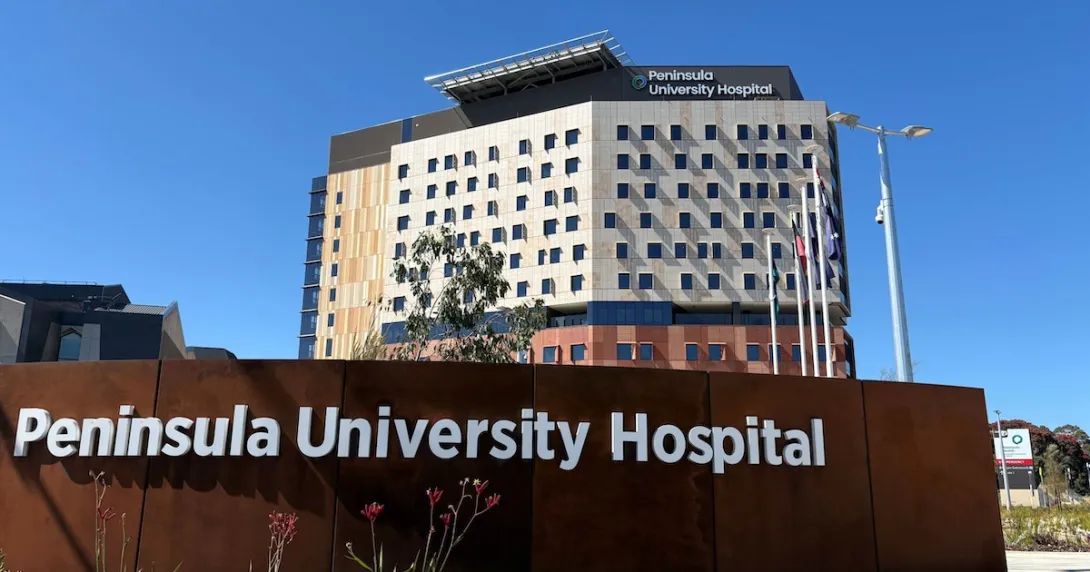
Photo courtesy of Peninsula University Hospital
Peninsula University Hospital, formerly Frankston Hospital, in Melbourne, has reopened with a new digital patient experience.
It has implemented digital patient check-in and queuing for outpatient appointments, with the solution provided by Five Faces.
HOW IT WORKS
A mobile patient app guides users before, during, and after their appointment. Based on a media release, this includes viewing and managing appointments, receiving information and resources, completing digital forms, using secure messaging, checking in, and completing surveys.
Paul Butler, executive director of Strategy, Capital and Digital at Bayside Health, Peninsula, told Healthcare IT News that the hospital also installed digital check-in and queuing on touchscreen kiosks found within outpatient areas, while outpatient information boards provide real-time updates on appointment progress.
The solution, which integrates with the hospital's PAS and radiology system, also shows live patient status updates and enables coordination across services, Butler said.
A similar solution has also been deployed across other specialties, including women's and children's, orthopaedics, oncology, and the Frankston Public Surgical Centre.
WHY IT MATTERS
"The [digital check-in and queuing] solution has contributed to improved outpatient throughput and more efficient management of patient arrivals, supporting the overall patient experience," noted Butler.
Its recent deployment represents the second phase of rollout; the first phase was conducted in September.
According to Butler, the implementation of the digital check-in and queueing system was "driven by a need to streamline communications and improve patient flow through outpatient departments."
"The digital check-in system needed to support expanded clinical capacity and address proportional growth in administrative burden and new physical reception infrastructure."
He explained that each rollout phase was supported by "carefully planned go-live and hypercare periods, with designated super users embedded in clinical and administrative teams to provide on-the-ground support, reinforce new workflows, and ensure a smooth transition for both staff and patients."
So-called super users and local champions also supported change management among staff.
An "important enabler" of outpatient flow, the digital check-in and queuing system aligns the redeveloped hospital with "modern, patient‑centred service models, supporting improved access, reduced wait times, and clearer communication throughout the outpatient journey," Butler said.
THE LARGER CONTEXT
The former Frankston Hospital reopened earlier in January following a A$1.1 billion ($800 million) redevelopment project by the Queensland government.
It is now operated by Bayside Health following the merging of Melbourne's five major public health services – Alfred Health, Bass Coast Health, Gippsland Southern Health Service, Kooweerup Regional Health Service, and Peninsula Health.
Over the years, the former Peninsula Health have pursued digital transformation through digitising various processes, including managing patient flow and cancer patient information. Last year, it implemented a digital pathway that automates cancer detection in endoscopy or biopsy results. It also introduced digital patient passports that record and communicate patients' care needs and preferences.