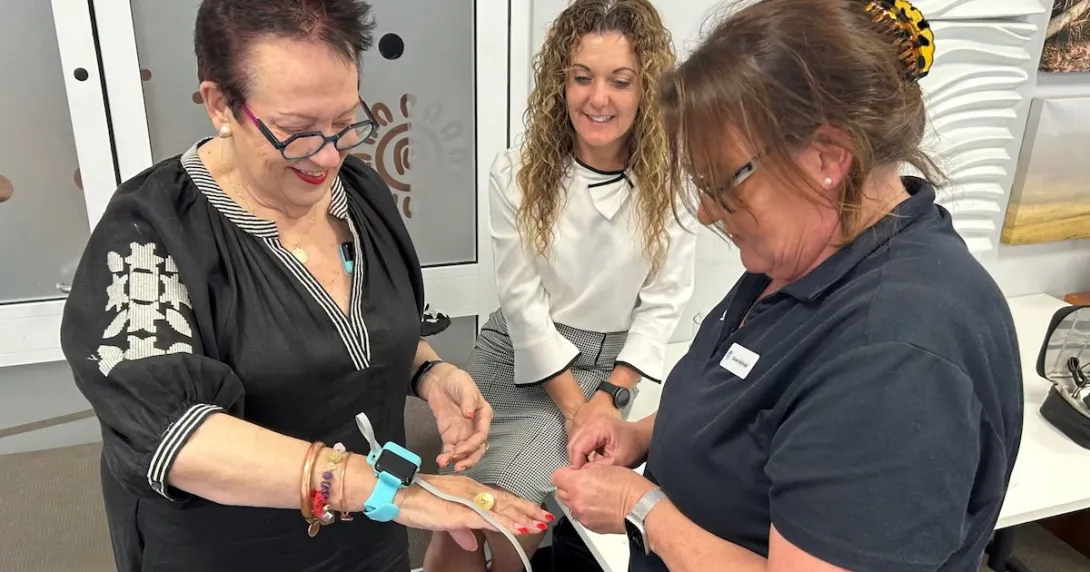
SNSWLHD chief executive Margaret Bennett and nursing director Summa Stephens testing the Respiree remote health monitoring device before a Philips Australia representative.
Photo courtesy of the Southern New South Wales Local Health District
The Southern New South Wales Local Health District has started introducing hospital-level, digitally enabled care at home.
This month, the health district began rolling out the Hospital in the Home care model across the Bega Valley, Eurobodalla, Goulburn and Queanbeyan regions, with the Snowy Monaro and Yass Valley regions to follow.
Delivered by a dedicated medical officer, nurse practitioners and a multidisciplinary team, the service supports a range of clinical conditions that can be safely managed outside the hospital, including cellulitis, pneumonia, deep vein thrombosis and urinary tract infections.
According to SNSWLHD, HITH is designed to support paediatric, chronic and complex, palliative, and aged care patients.
WHAT'S NEW
Instead of just spot-checking patients, which they do in earlier remote monitoring programmes, patients are hooked up with a wearable cardio-respiratory device, so clinicians can remotely and continuously monitor their vital signs, such as breathing rate, oxygen levels, heart rate and blood pressure, in near-real time.
Underpinning HITH is a remote patient monitoring system, provided by Singaporean startup Respiree via Philips Australia. It consists of a wearable Internet of Things-powered device, a clinical command centre dashboard, and mobile applications for clinicians and patients. The entire system is also powered by AI algorithms that flag patient deterioration.
"Respiree is a clinically validated solution with high levels of precision on alerts and alarms, reducing the likelihood of false alarms 10-fold. Clinical decision support tools are embedded to assist with the management of escalation," said Helen Callum, clinical consultant at Philips ANZ.
Callum explained to Healthcare IT News that alerts are escalated to both clinical teams and the patient, with escalation customisable depending on the patient cohort.
"Clinical teams have access to a triage dashboard, which will escalate risk depending on metrics and alerts triggered."
"Obviously, the response approach will vary depending on access to the next steps," she said. "With the introduction of a higher level of monitoring, the expectation will be to pick up deterioration earlier and enact the 'right time treatment plan'."
Additionally, HITH also provides options for home oxygen and transport support for hospital-related appointments.
WHY IT MATTERS
The aim for HITH, SNSWLHD said, is to "improve patient recovery, reduce length of hospital stay, and support better outcomes through flexible, safe and appropriate community-based care."
"This model ensures patients in our district receive equitable, timely and high-quality care across southern NSW," said SNSWLHD chief executive Margaret Bennett.
Summa Stephens, director of Nursing and Midwifery, Community and District Services at SNSWLHD, explained that "[p]atients recover better when they’re in a familiar environment."
"[T]his service allows us to deliver hospital-level treatment while keeping them connected to home and family."
Bennett also noted that the continuous, remote access to vital sign data allows clinicians to "intervene earlier and more precisely," resulting in fewer avoidable admissions and keeping hospital beds available for more acute cases.
Beyond clinical outcomes, having consolidated access to patient data can also reduce administrative burden. The Philips Future Health Index 2025 report found that three in four Australian healthcare professionals lose patient-facing time due to incomplete or inaccessible data, with one in five spending more than 45 minutes per shift – equivalent to about 23 working days a year – on such inefficiencies.
THE LARGER TREND
The HITH programme aligns with the five-year NSW Virtual Care Strategy to provide hospital-in-the-home services. Since 2021, NSW has been scaling virtual care as an alternative care pathway to arrest overcrowding at emergency departments and ambulance ramping, which have worsened over the past several years.
Most recently, it provided telehealth access to correctional settings, introduced the Virtual Rural Generalist Service, which was first introduced in northern NSW, to southern NSW, and started expanding the urgent virtual health service for children statewide.