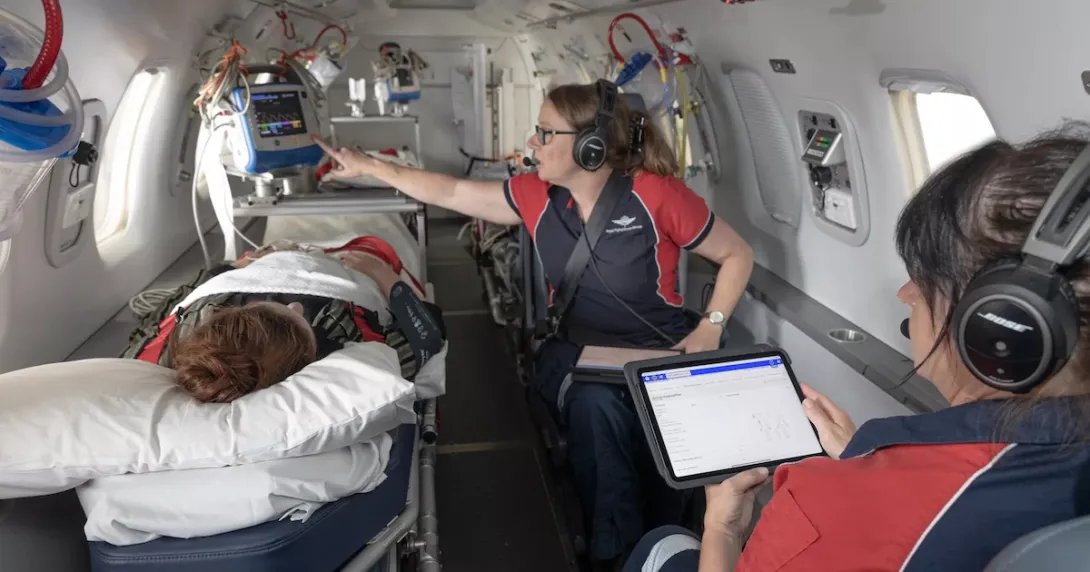
Photo courtesy of the Royal Flying Doctor Service
Royal Flying Doctor Service, a charitable aeromedical services provider in Australia, is working to introduce AI as part of ongoing enhancements to its award-winning EMR system.
The RFDS EHR, launched in 2023, allows doctors, nurses, and paramedics to record critical patient data on mobile devices, whether on the ground or in the air, and share it in near real time.
Built on the Oracle platform, the system also functions offline, incorporates safety alerts for allergies and early deterioration, and displays clinical guidelines related to patient risk factors and medication dosages.
"The RFDS EHR has enabled our crews to spend more time with the patients rather than on paperwork," Tony Vaughan, RFDS chief executive in South Australia and Northern Territory, said in a statement.
"Since launching in 2023, the RFDS EHR has enhanced the quality of medical documentation, clinical governance, data analytics, patient handover, and in-flight clinical care – eliminating the risks associated with manual patient data handovers by making real-time data available to all clinicians involved in a patient’s journey."
In an interview with Healthcare IT News, RFDS SA/NT CIO Ryan Klose, who led the RFDS EHR project, shared that the organisation is "already prototyping" AI-driven enhancements, including image, voice and video-based data entry, to further streamline documentation and support clinicians.
"More advanced analytics and device integration capabilities are also on the roadmap," he added, as RFDS works to evolve the EMR system into a "truly intelligent aeromedical care platform."
WHY IT MATTERS
RFDS SA/NT airlifts more than 10,900 patients for life-saving care and specialist medical treatment each year.
According to Klose, the RFDS EHR was developed to meet the need for reliable, rapid sharing of clinical data with multiple stakeholders – from responders to receiving hospitals – while operating seamlessly in conditions of good, poor, or no connectivity. Previously, responders recorded all information on paper, a process that was time-consuming and vulnerable to errors.
It integrates well with platforms and services, such as My Health Record, SA Ambulance Service, and NT Health's Central Australian Retrieval Service, enabled by Oracle's interoperability engine that uses a suite of secure, compliant APIs.
Since implementation, RFDS clinicians are now recording patient observations and updates in near–real time across the entire episode of care.
"Early data shows clinicians saving around 50% of their administration time thanks to single-entry documentation and automated data ingestion," Klose noted.
Klose also confirmed the potential to expand the RFDS EHR across Australia and abroad. "The RFDS EHR was deliberately built with scalability and sharing in mind," he said.
THE LARGER CONTEXT
Recently, the RFDS SA/NT's use of the EHR system has been recognised as an "Exemplar Practice" under the National Safety and Quality Health Service (NSQHS) Standards. "This is an outstanding example of how digitally enabled care can be harnessed to improve patient safety and quality of care, even in the most challenging and remote environments," said Anne Duggan, CEO and conjoint professor of the Australian Commission on Safety and Quality in Health Care, developer of the NSQHS Standards.
Early this year, RFDS SA/NT also obtained accreditation from the European Aeromedical Institute, becoming one of the only two aeromedical organisations in Australia that receive the approval.
Last year, RFDS unveiled what could be the first unmanned 24/7 virtual medical emergency centre in Australia's outback.