Photo courtesy of Healthdirect Australia
Healthdirect, Australia's national virtual health service provider, has recently introduced a patient consultation summary generation application in its video call platform, with plans to explore AI augmentation.
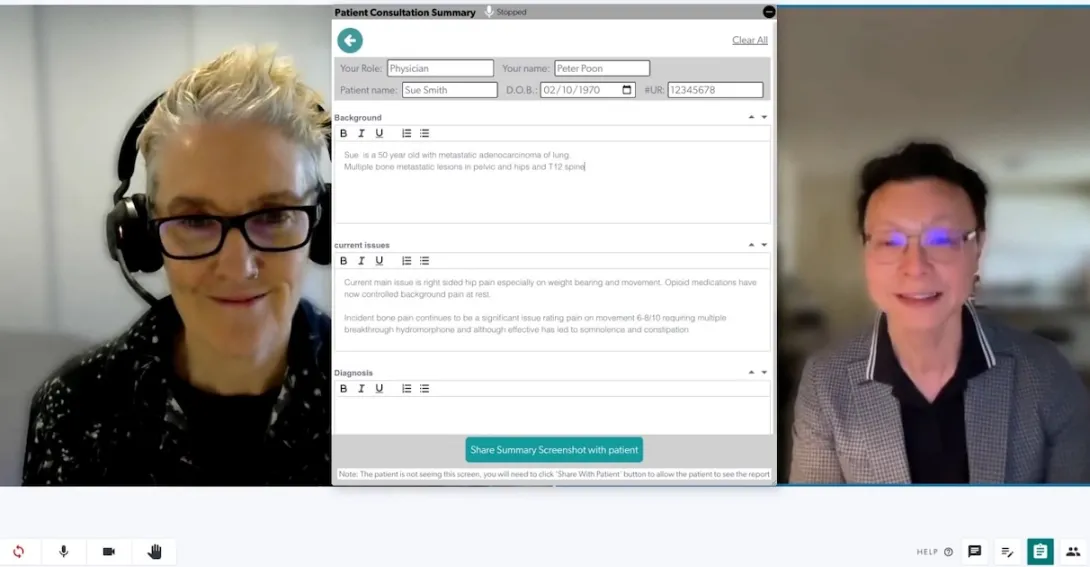
The new Patient Consult Summary (PCS) software application on Healthdirect Video Call – a service that facilitates over 150,000 virtual consultations monthly – allows healthcare practitioners to prepare and share a concise summary of information discussed during their consultation with patients.
It was developed through a multi-institutional collaboration among Monash University, Healthdirect Australia, the Department of Health Victoria, Monash Health, and the University of Melbourne, coordinated by the Digital Health Cooperative Research Centre.
HOW IT WORKS
"The PCS app provides a simple way for clinicians to write up consultation summaries by typing in, audio transcribing (speech-to-text), and/or copying information over from other clinical notes in the same video call window," PCS project lead and Monash University IT professor Rashina Hoda explained in an interview with Healthcare IT News.
The app, she said, also features text formatting options and high-fidelity support for copying over test results, relevant figures, tables, and more. "There are pre-made templates that can be loaded, and new ones can be created and saved by the clinicians for easy reuse."
The PCS integrates with the Healthdirect knowledge graph – a mapping of common and complex medical terminologies to clear, easy-to-understand definitions from Healthdirect Australia and other credible sources – to highlight medical jargon within the summary and provide plain-English explanation and definition when hovering over it on the screen. These terms and their definitions are then added to the appendix of the patient consult summary, which patients can refer to even after the call, according to Prof Hoda.
A summary is immediately available to patients before the end of the video call, unlike in the current practice, where no summary is provided or is only provided via post in 1-2 weeks, the PCS project lead noted.
The app went through a series of experience-based co-design studies, iterative software prototyping, and evaluation studies done in both virtual and real-world settings.
A feasibility study trialled the app in more than 28 consultations across palliative care, supportive care, and oncology clinics at Monash Health between December 2024 and June 2025.
"Early feedback from clinicians and patients has been very positive," the PCS project clinical lead and Monash University associate professor Peter Poon said in a separate interview.
"Patients reported that receiving an immediate written summary helped them better understand their consultation and remember next steps in their care. Clinicians also saw clear value for patients, although some noted that integrating the tool into their workflow may take time."
The feasibility study involved 13 clinicians and 17 patients.
WHY IT MATTERS
The PCS project aims to boost patients' and their carers' health literacy and communication while supporting clinicians by referring to standard definitions as needed. The team cited global evidence showing that after-visit summaries enhance patient understanding and self-management.
The project team, said Prof Hoda, has worked on the app since December 2021, right before AI scribes and the large language models that power them were released and became popular.
"Our focus was on building an add-on that provides a patient consultation summary and medical terminology explanation surfaced organically from our co-design work with real-world patients, carers, clinicians, and telehealth managers," explained Prof Hoda when asked about their decision to develop a purpose-built application within Healthdirect rather than adapting an existing commercial solution.
The team, however, did explore the possibility of switching to an AI-based summarisation solution. "[We] hit a few roadblocks around AI maturity on the one hand and clinical safety compliance on the other," she admitted. "For example, in that early period of LLMs, running an entire patient consultation – typically 15-25 mins – through an LLM was extremely resource-intensive."
"Critically, there were genuine concerns around the privacy and security of the sensitive health data and identifiable information exchange occurring during these consultations," she emphasised.
Still, the PCS team is open to exploring an AI-assisted version of the summary generation tool. The app's internal software architecture already allows for such an enhancement. "This would be designed as an optional configuration, enabled or disabled by health services, so clinicians and patients can choose between a simple version and an AI‑assisted version," Prof Hoda maintained.
The app's "strong" usability and acceptance, according to A/Prof Poon, supported the decision to scale the app on the Healthdirect Video Call platform nationwide.
The application has been made available on Healthdirect Video Call since December 2025, following an early-release trial and testing with seven health services across Victoria.
THE LARGER TREND
Over the years, Healthdirect has scaled the implementation of digital tools to enable operational efficiency. This includes integrating an AI-powered CDSS into its helpline, which has reportedly helped keep over 300,000 people out of emergency departments.
_
Editor’s note: An earlier version of this story wrote “Digital scribe integrated in Australia's Healthdirect telehealth” in the headline. It has since been revised to reflect accuracy.