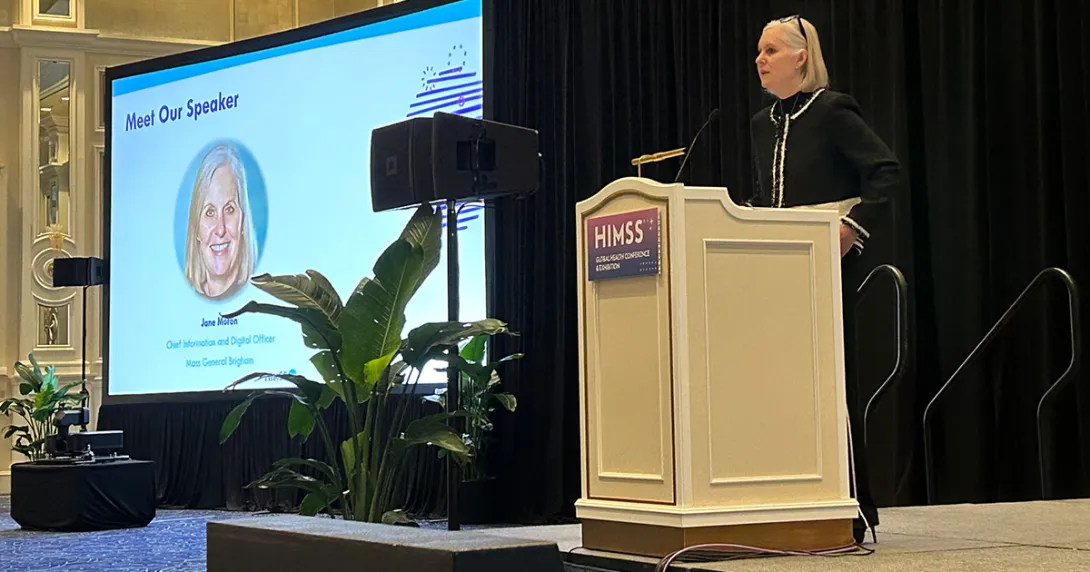
Jane Moran, chief information and digital officer of Mass General Brigham, at HIMSS26 on Monday
Photo: HIMSS Media
LAS VEGAS – Artificial intelligence is advancing more rapidly by the day, "but in healthcare, we're approaching it with caution because of the high stakes involved," said Jane Moran, chief information and digital officer at Mass General Brigham, during her Monday morning keynote at the HIMSS26 AI in Healthcare Forum here.
"We need to take care of our patients, our researchers and our employees," said Moran. "AI in healthcare is moving from pilots to early-stage skills. Most healthcare organizations are approaching it this way, and I think that's an encouraging signal. We're not just pushing things into mass production within 90 days. Adoption needs to be cautious. We need to consider clinical safety, cybersecurity, privacy and regulatory concerns."
But caution and ambition are not mutually exclusive. And at Boston-based Mass General Brigham, IT leaders are very ambitious as they work to deploy AI and machine learning across nearly every department of the sprawling Harvard-affiliated health system and encourage its nearly 80,000 team members – spread out across more than 15 hospitals, including two world-class academic medical centers – to take advantage of the benefits of automation.
Taking a broad-based approach to AI deployment – across clinical, operational, financial and research settings – is a tall task, of course. But Moran said MGB is working carefully, steadily and deliberately as it manages the challenges of building basic AI literacy, retooling workflows, managing vendors and, critically, putting in place governance structures to prioritize safety, transparency and human-centeredness.
'Learning from experiments'
At MGB, "we've been working on AI for years and years and years," said Moran. But like at other health systems nationwide, over the past couple years, "it's just really exploded. During 2024, we carried out a lot of proofs of concepts of pilots. It was like a thousand flowers blooming."
But across all that activity, in all those different use cases, AI innovation has been "governed by one principle: responsible use," she said. "It has to be ethical, equitable, productivity-focused and quality-driven – with human oversight and support."
Safely and effectively scaling AI "depends on people and process as much as actual models and the technology," said Moran. "It's about building a sustainable, human-centered AI capability that drives meaningful outcomes across the enterprise."
Toward that end, the health system has embraced a philosophy of "learning from experiments," she said. But as with any properly calibrated experiment, care must be taken to protect against risks and unwanted consequences.
"We need to account for patient safety, bias in data, unintended disparities in decision-making – and all the cyber risks involved," said Moran. "AI tools increase exposure to sensitive data and broaden the attack surface. And that makes us very nervous about releasing AI tools without proper controls. And of course, there are governance risks around accountability, oversight and validation frameworks."
Data governance table stakes are essential. And so are employee engagement and change management strategies.
When moving from pilots to enterprise-level deployment, "you need the right technology foundations in place," she said. "We also have to educate our workforce, ensure high-quality data, achieve regulatory alignment and drive operational integration."
Clinical enthusiasm, with guardrails in place
For instance, said Moran, "one project where we took an enterprise-wide approach was ambient documentation, led by our chief health information officer. We started with a single clinical use case: using AI to create a patient visit note.
"We brought this capability to a small group of clinicians and were amazed by the response. Clinicians loved it, and requests grew rapidly," she said. "Our pilot eventually had over a thousand people enrolled."
At the same time, "we recognized we needed training for clinicians, and we also became aware that many staff were already using AI tools on their own – tools that were not always compliant. We needed enterprise-wide guidance, governance and education."
As recently as 2024, MGB still relied on its existing technology governance framework for AI, Moran explained. But by 2025, "we recognized the need for a formal AI governance process."
Researchers at the health system were using AI across multiple disciplines – "for cancer and Alzheimer's research, lung cancer imaging and much more" – but many staff were using public-facing consumer AI tools for their research.
So Mass General Brigham stood up a "secure, multi-model prompt platform we call the AI Zone," said Moran. "It's a platform we built internally to give employees access to approved large language models, AI assistants and agents."
The platform "gives our entire employee population a safe, secure way to use AI – including with protected health information, personally identifiable information, and sensitive business and clinical data."
In recent years, "we've since leaned heavily into training programs, including an accreditation program for clinicians: Anyone who wants to use AI in our organization must go through training," said Moran. "We're now exploring making certain training mandatory for specific roles. None of this is regulatory-mandated, but it's the wise and responsible thing to do."
'What problem are you trying to solve?'
Moran said she's often asked about MGB's AI strategy. "For us, our AI strategy is our business strategy," she said. "It's really about the responsible use of AI to address the challenges within our own organization – as part of a holistic technology strategy.
"We get asked all the time: Can we just have a little AI on the side? And it takes me back to a fundamental question in technology: What problem are you trying to solve? Because some problems may not be solved by AI. That's where we have to lean in and figure out what matters most."
At MGB, across the whole of the organizations, "we're deploying AI deliberately and with focus," she explained. "There's a lot we've said no to over the past few months. We're focused on just four areas: clinical care, patient access, research and employee productivity."
Moreover, "each use case is tied to measurable impact," she added. "Improving outcomes, accelerating innovation, strengthening operational performance and enabling our workforce to focus on higher-value work."
When judiciously deployed, "AI supports decision-making and enhances diagnostics, but it always augments rather than replaces professional judgment," said Moran. "Human accountability remains central. In research, it's accelerating discovery, improving data analysis and shortening the path from insight to impact."
Ultimately, "this is not just about adopting AI," Moran said. "This is about solving real business problems, not just putting technology out into the wild."
Mike Miliard is executive editor of Healthcare IT News
Email the writer: mmiliard@himss.org
Healthcare IT News is a HIMSS publication.