
Erin McCann
Healthcare IT News analyzed the personal political contributions from the 2011-2012 election cycle of more than 200 top executives at some of the nation's largest hospitals and healthcare systems. The results may surprise you.
Twitter, the much beloved social networking site, is set to take on disease outbreaks, after the collaborative efforts of three informaticists yielded a new Web-based application tool available to public health officials.
Out of sight, out of mind, the familiar proverb goes. The people of Haiti know this; they live this. After the 2010 earthquake that decimated the country, killing some 316,000 Haitians and leaving some one million homeless, an influx of outside aid poured into the country. Today, much of that promised money has yet to materialize, and most aid groups have vacated. Haiti still remains the poorest and most disease-ravaged country in the Western Hemisphere.
What parties are doing (or should be doing) to protect patient privacy in a digital age.
Since 2005, some 60 million Americans have had their private health information compromised or disclosed electronically - a fact that has privacy experts, political players and consumers alike demanding reform.
With his repeated vows to repeal the PPACA, a President Romney might be more cheerleader than funder for health IT, including the meaningful use program, which some experts said could become an attractive target for cuts because there is money promised but not yet paid.
Mitt Romney is no stranger to health information technology advocacy. But despite his earlier initiatives as governor of Massachusetts, many experts say health IT policies and their funding could be at risk if he were elected president.
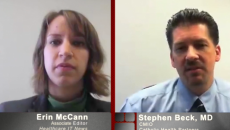
Healthcare IT News Associate Editor Erin McCann talks with Stephen Beck, MD, CMIO of Catholic Health Partners in Cincinnati, Ohio.
Instead of declaring the winners and losers of last night's vice presidential debate, we look at what wasn't discussed: Rep. Paul Ryan's Congressional record on health information technology.
Imagine a clinical database containing medical histories, diseases and demographic data taken from millions of patients across the U.S. Imagine data analytics that could help eliminate healthcare disparities and socioeconomic inequalities, could help pinpoint certain diseases in particular populations, reduce morbidity numbers, and rather than improve healthcare for a single patient, could potentially improve the healthcare of millions across a geographic area.