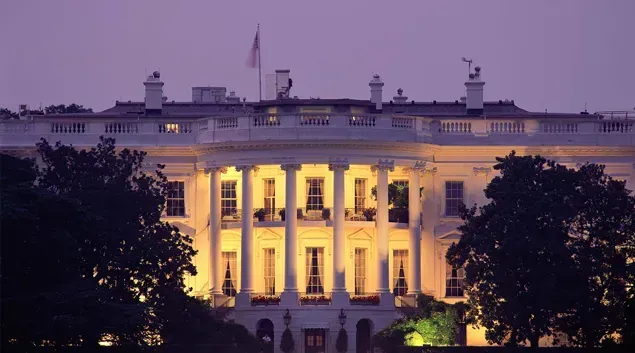
Photo: Walter Bibikow/Getty Images
This past Friday, the White House said it would hold off on releasing a controversial draft executive order that would have created a mechanism under the attorney general to sue states over their own artificial intelligence laws, such as those requiring AI technologies to meet bias mitigation requirements.
Lawmakers, state leaders and consumer groups have been pushing back on federal efforts to curtail state AI regulations.
On Monday, meanwhile, the Trump Administration announced a new federal effort, known as The Genesis Mission, to use federal datasets to develop and train AI foundational models on a new platform that would be used to address at least 20 of the nation's greatest challenges.
Aiming to 'win' global AI race
The Genesis Mission aims "to accelerate the application of AI for transformative scientific discovery focused on pressing national challenges," to "win" the global AI race, the White House explained in a new EO released Monday.
The mission combines scientific research from national laboratories with private-sector companies, universities, and existing research infrastructure, data repositories, production plants and national security sites.
But to achieve "dramatic acceleration in AI development and utilization," the order specifies the creation of the American Science and Security AI platform, implemented and paid for by the U.S. Department of Energy.
The platform must be operational within 270 days of the order by serving at least one identified national challenge.
A list of 20 challenges that "span priority domains," including advanced manufacturing, biotechnology, quantum information science, semiconductors and microelectronics and more, is due in 60 days under the new EO.
The initiative is to be led by the assistant to the president for science and technology, a role currently held by Michael Kratsios, formerly the managing director at the Silicon Valley tech company Scale AI, U.S. chief technology officer from 2017 to 2021 and undersecretary of defense for research and engineering from 2020 to 2021.
The U.S. energy secretary, currently Chris Wright, former CEO of a commercial shale gas technology developer now owned by Halliburton, may choose a senior political appointee to oversee day-to-day operations, the White House said.
"The Genesis Mission will dramatically accelerate scientific discovery, strengthen national security, secure energy dominance, enhance workforce productivity and multiply the return on taxpayer investment into research and development, thereby furthering America's technological dominance and global strategic leadership," the White House said in the new order.
AI dominance vs. safety
Earlier this month, the administration had floated a new draft order to prevent states from regulating AI without a comprehensive federal framework to immediately replace protection from algorithmic discrimination, fraud, deepfakes and other potential harms.
The circulated draft, Eliminating State Law Obstruction of National AI Policy, immediately drew strong reactions from lawmakers and leaders about the balance of power.
Many, even Trump's fellow Republicans, were critical of the move, calling the proposal federal government overreach. For instance, GOP Florida Gov. Ron DeSantis, slammed the action in a social media post last week.
"Stripping states of jurisdiction to regulate AI is a subsidy to Big Tech and will prevent states from protecting against online censorship of political speech, predatory applications that target children, violations of intellectual property rights and data center intrusions on power/water resources," DeSantis said.
The White House has not commented on why it shelved the draft EO, according to Reuters.
In the absence of much in the way of federal AI regulation, individual states have been left to take the lead on establishing some AI guardrails. As we reported earlier this month, the National Conference of State Legislators is currently tracking around 1,000 state bills nationwide.
Some of them, such as California's Transparency in Frontier Artificial Intelligence Act, that take a "trust but verify" approach to model development, have already been signed into law.
But the Trump Administration has previously aired its concerns that state AI regulations could impede U.S. competitiveness against economic rivals. The draft EO had specifically defined state-level guardrails on AI addressing bias mitigation as cumbersome, or "woke AI."
Meanwhile, AI industry giants, including Google, OpenAI and others, have also said that they favor a federal standard to reduce their compliance costs as well as the administrative complexities of varying state laws.
OpenAI asked California Gov. Gavin Newsom to harmonize with emerging global standards it had signed onto in an Aug. 11 letter signed by Christopher Lehane, the company's chief global affairs officer.
"We encourage the state to consider frontier model developers compliant with its state requirements when they sign onto a parallel regulatory framework like the [EU AI Act Code of Practice] or enter into a safety-oriented agreement with a relevant U.S. federal government agency," Lehane advised.
New roles for NDAA
The Senate previously voted 99-1 for an amendment that eliminated a 10-year proposal to block states from regulating AI in the "One Big Beautiful Bill Act," which was signed into law by President Donald Trump on July 4.
At the time, a bipartisan group of state leaders said it would harm their abilities to protect their citizens from fraud, deepfakes and other AI-driven intrusions.
However, the ability for the federal government to preempt state AI laws could show up instead in the National Defense Authorization Act, currently being worked on at press time and due for a vote before the end of the year, based on statements attributed to House Majority Leader Steve Scalise, R-Louisiana.
Trump said last week that he would support adding such a provision to the NDAA for FY 2026, Reuters noted.
The NDAA directs DOE, which happens to be newly charged with implementing Genesis Mission and the American Science and Security AI Platform, in several areas that aim to safeguard the U.S. supply chain.
A unified NDAA might be completed by Congress and put before lawmakers during the second week of December, Rep. Rob Wittman, R-Va., a member of the House Armed Services Committee, told the Federal News Network last week.
Andrea Fox is senior editor of Healthcare IT News.
Email: afox@himss.org
Healthcare IT News is a HIMSS Media publication.


