Photo: WellSpan Health
WellSpan Health, a large health system serving central Pennsylvania and northern Maryland, has announced it is scaling a clinical AI operating system across all nine of its hospitals and more than 250 care locations.
Further, WellSpan will activate 21 new AI-powered care pathways – on top of six already in use – across seven service lines.
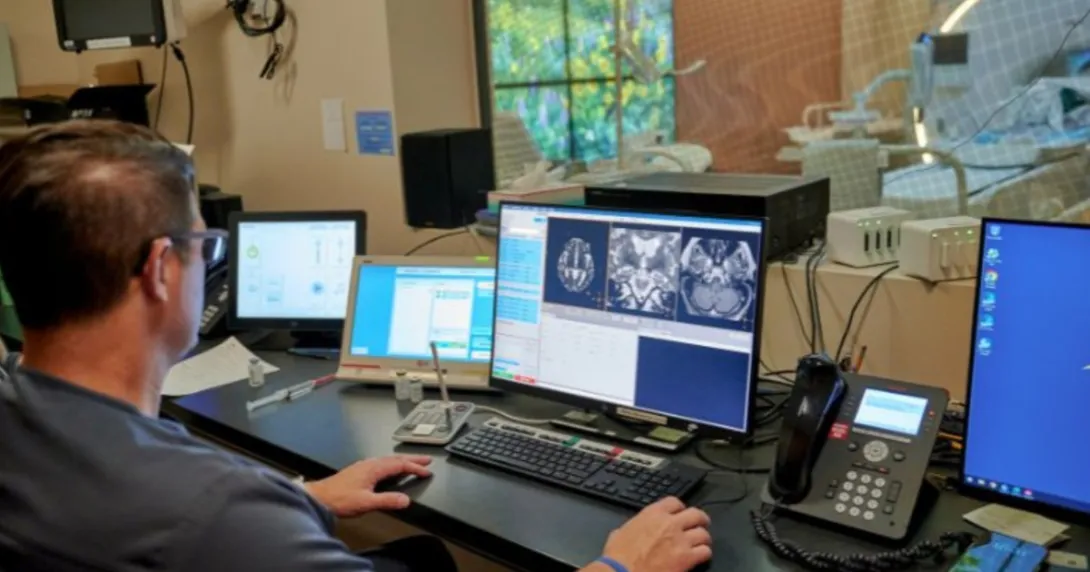
The health system uses vendor Aidoc's clinical AI OS, dubbed aiOS. It decided to expand its deployment of the technology after achieving very positive results on its initial limited use in radiology. The clinical AI platform runs, orchestrates and governs clinical AI across the WellSpan platform for radiologic services.
Life-saving studies in three minutes
In the past year, WellSpan used only six modules (similar to care pathways, for example, a brain aneurysm module) of the platform to analyze more than 200,000 advanced imaging studies including brain CAT scans.
Of that 200,000, the AI OS modules identified more than 10,000 potentially critical findings including pulmonary embolism and brain aneurysms, Dr. Tony Aquilina, chief physician executive at WellSpan Health, told Healthcare IT News.
"More than 96% of those findings – this is very important – were available to the radiologist for their review within three minutes," he reported. "Remember, these are life-saving studies. Within three minutes, the radiologist had the ability to address the issue.
"With Aidoc, we've seen a 65.5% reduction in the wait time for analysis and prioritization of outpatient cases with these critical findings," he added. "This means for patients who have these urgent findings, their needs are prioritized and treated faster by our teams. For example, the vendor's brain aneurysm module alone has allowed us to escalate an additional 22 cases every month of brain aneurysm, compared with our previous run rates."
WellSpan Health radiologists have embraced the AI OS as an essential part of their workflow – 80% of the radiologists engage the technology every day. For one thing, the six modules have delivered more than 650 hours of read time efficiency gains, Aquilina said.
900 hours of delays are gone
"That's 650 hours of our radiologists' time," he noted. "And that's in one year. This frees up valuable clinical resources, enabling our teams to focus more on patient care and less on administrative delays. And by leveraging Aidoc, we've eliminated more than 900 hours of unnecessary delays in delivering the care, delivering the critical diagnosis to the patient.
"That ensures urgent findings reach the right clinician without delay, whether it's in the ER or an outpatient setting," he continued. "We're overwhelmed by the actual results we've achieved just in the past year with just six modules."
Because of these extremely significant results, WellSpan Health now is expanding its use of the AI OS from six to 27 modules – and throughout all of its hospitals.
"What this means is we'll continue to reduce bottlenecks in urgent diagnostic workflows and unlock measurable turnaround time improvements by accelerating standardized high-quality care across our health system," Aquilina said. "With full implementation across the health system, these gains are obviously expected to scale significantly.
"Regarding radiology, this is a time when there are acute radiology staffing shortages everywhere," he added. "So, the efficiencies we're gaining are vital for sustaining high-volume, high-demand, high-quality diagnostic services without increasing the burnout of our radiologists and our entire staff. Patients across the entire health system will benefit, experiencing faster, more accurate diagnosis, and improved health outcomes."
But can AI be trusted?
However, it is widely known that artificial intelligence can be wrong. It can hallucinate. Can it be trusted for such a big clinical job throughout an entire health system? Aquilina said yes.
"Every scan is also read by a radiologist," he explained. "This technology supplements and supports current clinical practice. It doesn't replace it. Our innovation strategy is rooted in aligning people, process and technology with strong value propositions like the one that Aidoc brings. And we measure everything – everything we do, we're looking at measurable results and scalable systems.
"We measure, and what we know from what we've measured in just one year is the outcomes are just incredible and incredibly better with two 'systems' rather than just one – two systems meaning AI plus people," he continued.
"Every process should be designed with the patient and the team member in mind. It's the deep partnership between our clinical innovative teams and the new competencies that we're developing that enable us to deploy AI safely to serve our communities."
Follow Bill's health IT coverage on LinkedIn: Bill Siwicki
Email him: bsiwicki@himss.org
Healthcare IT News is a HIMSS Media publication.
WATCH NOW: How to launch an AI project, per the VA AI chief


