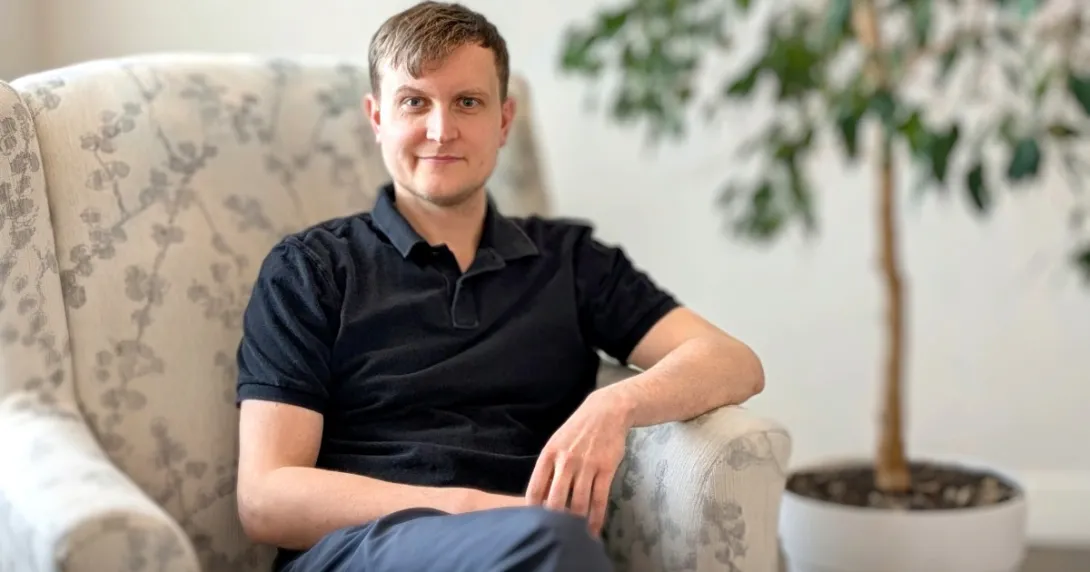
Ryan Saunders, cofounder and CTO of PocketRN
PocketRN, a provider organization serving many older adults with chronic conditions, faced a challenge: scaling a relationship-based virtual nursing model without losing the human quality of care that makes the model effective.
THE CHALLENGE
PocketRN's patients include many people in rural areas who may rely on caregivers or family members to join visits remotely. That meant the organization had to support secure, compliant telehealth encounters for patients with varying levels of technical comfort, inconsistent connectivity and older devices – while also keeping nurses focused on the patient rather than the screen.
"At the same time, our growing nurse team needed a way to simplify administrative work without compromising documentation or care quality," said Ryan Saunders, PocketRN's cofounder and CTO. "Note-taking and charting pulled clinicians' attention away from patients during visits."
Kelli Acosta, RN, the organization's clinical education lead, described it this way: "It was harder to maintain eye contact because nurses were typing throughout the encounter, which slowed the visit and made it harder to be fully present. We were trying to solve for scale, compliance and operational efficiency – but also for a more humane clinical interaction."
When tackling these problems, Saunders asked what mix of tools could support virtual nursing by closing access gaps, involving families and caregivers in the care experience, and scaling over time as the organization rapidly expanded the virtual care model?
PROPOSAL
It was around this time Saunders was invited to a Zoom Clinical Webinar where he learned about Zoom Workplace for Clinicians and more specifically the Zoom Clinical AI Notetaking feature in development. The offering stood out to him because it combined video, communication and AI documentation in one environment rather than forcing an organization to stitch together separate tools or interfaces.
"The idea was clinicians could conduct visits, capture the conversation and generate draft documentation within the same workflow – reducing friction for nurses and lowering the implementation burden for the organization," he explained.
"More specifically, the proposed system included AI-powered transcription, automated clinical note generation, seamless EHR integration, customizable templates across specialties and multilingual support," he continued. "For our use case, that meant nurses could rely on ambient capture technology to produce AI-generated appointment notes, instead of manually documenting the entire encounter in real time."
In theory, this would reduce paperwork, improve consistency between charts and other documentation, and free nurses to spend more attention on patient education, questions and relationship-building during the visit.
"Most importantly, we already are deeply embedded with Zoom," Saunders noted. "Since its initial ideation, the PocketRN platform has used the Zoom Meeting API to create virtual visits between our nurses and our patients. Incorporating the Zoom Workplace for Clinicians was a natural fit because the user experience was already familiar. After comparing other similar AI note-taking offerings, we decided Zoom's offering was worth our time and joined the beta program."
MEETING THE CHALLENGE
PocketRN uses Zoom Workplace for Clinicians with Zoom Clinical Notes directly inside its virtual care workflow. During telehealth visits, nurses use the platform to schedule the visits, which in turn creates the Zoom meetings via an API call.
"While the nurses conduct the patient encounters, Zoom captures the conversation and generates structured clinical notes," Saunders explained. "Those notes then are reviewed, edited and finalized by the nurse as soon as the meeting ends.
"The primary users are our nurses, though the broader Zoom environment was used across the company, including teams beyond clinical operations," he continued. "In practice, nurses use the documentation features during and between visits to reduce after-hours charting, complete notes faster and stay more focused on the patient. We also successfully use the AI summaries for nursing orientation."
RESULTS
One of the clearest results was a major reduction in documentation burden. Overall documentation time decreased by about 60%, from nearly 20 minutes to less than 10 minutes per note, Saunders reported. Comprehensive assessment meetings, required for patient enrollment, decreased by 15 minutes per visit – allowing nurses to complete documentation between visits rather than after hours.
"The ambient capture and AI-generated draft notes reduced manual typing, shortened write-up time and improved documentation quality while allowing nurses to stay more engaged during the visit itself," he said.
"A second major outcome was measurable labor and cost savings," he continued. "The AI note-taking now saves our nursing team about 33 hours daily and lowers administrative overhead by about $27,720 each month. Those savings came from automating note generation and reducing the administrative work attached to each encounter."
Instead of spending that reclaimed time on manual charting, nurses reinvest it into direct patient support, care-plan coordination, caregiver education and collaboration with partner organizations.
"As we continue to grow our nursing team, these savings compound, helping PocketRN successfully fulfill our mission by allowing us to grow efficiently," Saunders said.
"Finally, 92% of nurses reported a positive experience with matching, reviewing, note-taking and joining calls," he added. "Nursing orientation time dropped from more than four weeks to two weeks, a 50% improvement. AI summaries and the Zoom task features were instrumental in keeping the revamped orientation on track."
Zoom Workplace for Clinicians improved both day-to-day clinician satisfaction and the speed-to-productivity for new nurses, he concluded.
Follow Bill's health IT coverage on LinkedIn: Bill Siwicki
Email him: bsiwicki@himss.org
Healthcare IT News is a HIMSS Media publication.
WATCH NOW: HIMSS Global Conference attendance creates 'chosen family' relationships


