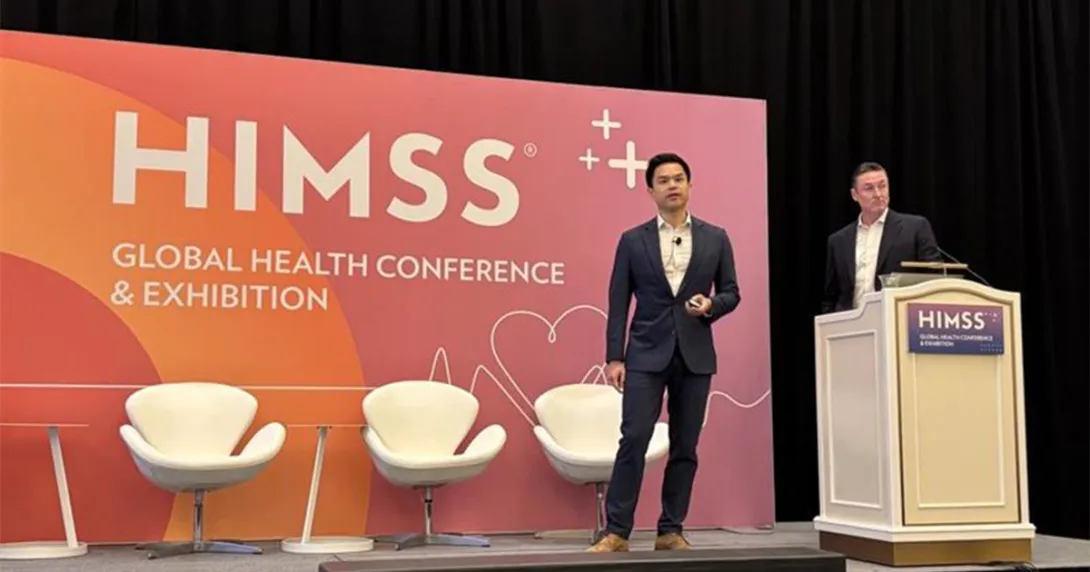
From left, Pelu Tran, CEO of Ferrum Health, and Dr. Jason Wiesner, chair of Sutter Health's imaging service line, present at HIMSS26 in Las Vegas.
Photo: Andrea Fox/HIMSS
LAS VEGAS – Despite all the AI hype, health systems struggle to operationalize artificial intelligence effectively and sustainably due to internal misalignments, regulatory complexities and fragmented data. Most AI tools fail, and the costs are high.
"There aren't many case studies that have been actually published that we can all reflect on, certainly at a scale that Sutter Health has deployed, where you can point to the real value of AI, the benefits, the learnings. Certainly, nothing related to the newer frontier models," said Dr. Jason Wiesner, chair of the California health system's imaging service line.
His case study session here last week at the 2026 HIMSS Global Health Conference & Exhibition, "From Pilot to Practice: Building Scalable Artificial Intelligence Governance in Healthcare," explored Sutter Health's recipe for moving beyond an AI pilot to enterprisewide AI governance.
By using a common infrastructure that plugs directly into the existing electronic health records, imaging archives and dictation tools, Sutter Health created a standardized artificial intelligence framework that allows the organization to deploy, monitor and swap various algorithms without the technical burden of building new siloed connections for every individual vendor.
The health system's AI approach focused on validating efficacy using the provider's own real-world data and patient population and establishing meticulous frameworks for deployment decisions, performance monitoring and evolving policies.
Improving patient outcomes
As chair of the radiology department, Wiesner said he wanted to focus on how to transform cancer detection.
"We find a patient who has an abnormality, whether that's a pulmonary nodule or a breast lesion that looks suspicious, as we'll describe in these case studies, we need to make sure we track those patients so they get into care as soon as possible," he said.
The health system's success in developing early cancer detection for both breast and lung cancers improved patient outcomes through a combination of locally validated AI and deliberate, policy-driven frameworks with must-haves, a common infrastructure to efficiently scale enterprisewide, a governance committee and continuous key performance indicator tracking, he said.
Previously, only 31% of lung cancer patients at Sutter Health were diagnosed at an early stage before the addition of AI detection. By late 2025, that figure rose to 71% diagnosed and identified pulmonary nodules at Stage 1 or 2 with access to a cure pathway.
"These are curable lung cancers," Wiesner said.
"Once we started to see some of these early results in lung cancer detection back in 2020, 2021, we realized we were on to something, and that really started another turn of the flywheel and got us to think about other areas of cancer care where we can make radiologists better with AI."
After rigorous evaluation, detection rates with AI across breast cancer screenings – Sutter Health's second use case – increased to 3.4 cancers per 1,000 in those care centers – about a 30% improvement.
"I'm grateful to say at this point that many more than 1,000 patients have been impacted since our launch," said Wiesner.
Ensuring patient safety
"We are already hearing a lot of stories around models gone awry and tools that are harming patient care, leading to impacts in the opposite direction for productivity or ROI," said Pelu Tran, CEO of Ferrum Health.
"And the reasons for these failures are things that are known to us," he said.
Between 1,200 and 1,300 clinical AI tools cleared by the U.S. Food and Drug Administration and on the market have not been clinically tested, the speakers said.
"I really do think we're maybe one or two bad headlines away from some real reckoning in the space," said Tran.
Previously, he told Healthcare IT News in a conversation about AI as an evolving ecosystem that clinical AI "requires an incredible number of use cases to really be able to effectively impact patient care."
Confusion about AI strategy is leading to decisions at provider organizations where the loudest person may get their AI purchasing request to the top of the list.
"This is not how application purchasing should work," Tran said.
In the breast cancer AI detection market, there are more than 100 vendors in this area, "all with strong white papers and good strong marketing talking about the benefits," Wiesner noted.
Sutter Health's patient population extends from Silicon Valley to the Central Valley of California, and "includes a segment of just about every type of human in the world," he said.
"Which AI tool works best without bias equitably across that population?"
"Unlike a medical device or a drug, AI models are incredibly variable based upon the underlying demographics of the population they run on," said Tran. "And so, the only way to ensure a model's performance and safety is to actually see it with your own eyes on your own patients."
Sutter Health evaluated more than 10,000 patient cases to benchmark AI findings against their own radiologists' interpretations to ensure algorithms perform accurately across diverse demographics, Wiesner said.
Of note, all patient data fed into algorithms is contained in a Databricks system and is not used to train foundational models outside of it.
As Sutter Health validated outcomes using the tools at two initial care sites, it created momentum to deploy the cancer detection algorithms across the system in a period of 12 months, he said.
Scaling multiple algorithms
The health system's governance board chose a common AI infrastructure using Ferrum Health's AI platform.
"A common platform that allows you to scale multiple algorithms using that infrastructure is what we found successful, and it gives us efficiency," Wiesner said. "This is critical to us."
"You can't integrate with 10, 15, 20 different point solution companies, separate vendors, and integrate them into your health system in a scalable and safe way," he added. The integration of multiple individual point solutions is a "non-starter."
Signing a multi-year contract with an AI vendor "is insane," said Tran.
The space is moving too fast – cheaper options that perform better are going to be available "on the scale of quarters, not years," he said.
With a single infrastructure in place, providers can compare models and swap them as needed.
In order to ensure safe, ethical and scalable AI deployment, healthcare organizations must continue to analyze the impact of model adoption and performance, the speakers said.
Sutter Health's centralized AI governance and infrastructure enables "clinical observability," allowing the system to monitor KPIs and safety metrics across 26 hospitals from a single vantage point, Wiesner and Tran said.
"This seems like a lot of work to set up, but in my experience, and I think this is a key takeaway for me, is you have to go slow in order to go fast." -Dr. Jason Wiesner, Sutter Health
"If you set up the governance correctly, governance committee, KPIs, regular reporting, everybody in the company starts speaking a similar language, and it allows you to scale subsequent AI tools more efficiently."
"As we are inundated with the growing number of AI models – not just predictive or pixel-based, but increasingly frontier and agentic – it's important to put in place the right frameworks for AI governance, if you want to be able to make it to the finish line," Tran explained.
Wiesner and Tran said the core three guardrails are:
1. A unified way to onboard models in any environment – on-prem, cloud, etc.
2. A unified deployment architecture.
3. Unified validation and governance.
Existing provider systems like EHRs are going to stay in place, Tran said. Maintaining the guardrails can avoid breaking those systems when integrating a new model.
"There's no way your organizations are going to sign 1,000 different contracts with 1,000 different vendors and handle 1,000 different integrations," he said. "It might fly for your first two, three, five, 10 applications, but guess what? Each one of those applications needs to be maintained and needs to be updated."
Andrea Fox is senior editor of Healthcare IT News.
Email: afox@himss.org
Healthcare IT News is a HIMSS Media publication.


