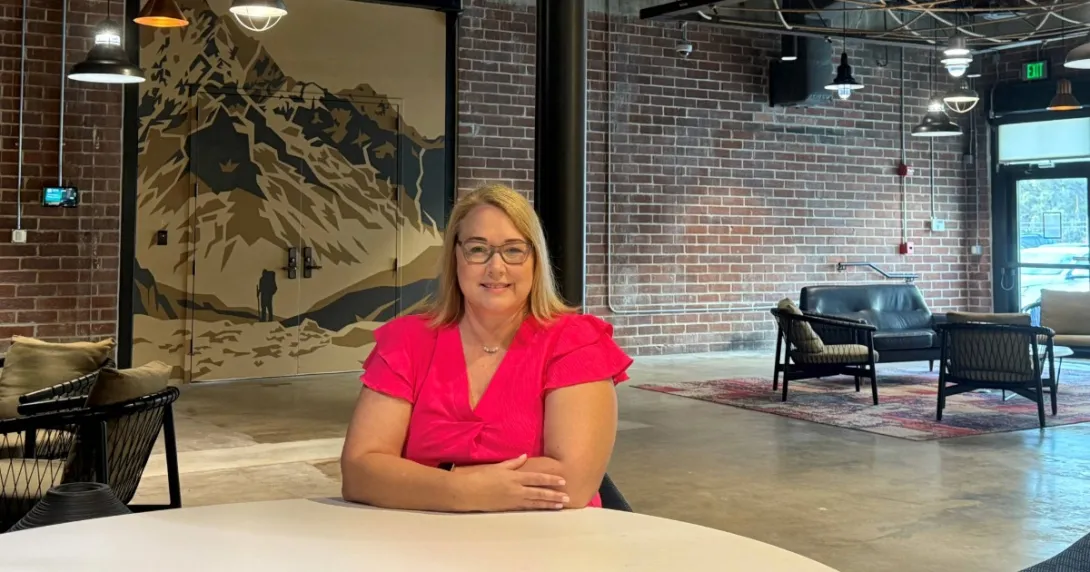
Amy Bender, manager of inpatient informatics at Tampa General Hospital
Photo: Tampa General Hospital
Tampa General Hospital's call center managed a dynamic environment with high call volumes and frequent recurring inquiries, presenting opportunities to enhance efficiency and customer experience.
THE CHALLENGE
A substantial share of incoming calls centered on routine, transactional requests – such as appointment confirmations, prescription refills, insurance verification and facility directions.
While these interactions were essential, they did not require specialized expertise and consumed a disproportionate amount of agent capacity. This dynamic created persistent backlogs, extended wait times and elevated call abandonment rates. This ultimately eroded patient satisfaction and trust.
"Our team found that by strengthening call triage and prioritization, we could significantly improve patient access and streamline care delivery," said Amy Bender, manager of inpatient informatics at Tampa General Hospital.
"Experience center agents were frequently engaged in low-value tasks rather than focusing on cases requiring empathy, critical thinking or clinical coordination," she explained.
"As a result, urgent or complex inquiries were often delayed, introducing potential risks to patient care," said Bender. "The constant pressure to manage overwhelming queues fostered a reactive environment, contributing to agent stress, burnout and high turnover. In short, the call center needed scalability and technology to deliver consistent, high-quality patient experience."
PROPOSAL
The proposed technology – a conversational AI platform from vendor Hyro – aimed to transform the call center by introducing an AI-driven conversational agent as the primary point of interaction for incoming calls.
This agent was designed to absorb the overwhelming volume of routine, transactional requests – such as appointment confirmations, hours of service and location inquiries, prescription refills, and billing questions, among others – that previously consumed human resources.
"Using advanced natural language understanding and intent recognition, the AI agent could greet callers, determine their needs, and either resolve the request autonomously or route the call to the appropriate department," Bender explained. "This approach was intended to reduce call abandonment, shorten wait times, and allow human agents to concentrate on complex, high-value interactions requiring empathy and clinical judgment.
"A key component of the proposal was scalability and accessibility," she added. "The AI agent was expected to handle thousands of simultaneous interactions without compromising service quality, ensuring consistent performance during peak periods or unexpected surges. Multilingual capabilities were built to serve a diverse patient population effectively."
The proposal emphasized data-driven insights and continuous improvement. Every interaction would generate analytics on call drivers, patient behavior and operational bottlenecks. These insights would inform staffing strategies, training programs and process optimization – creating a feedback loop designed to continuously enhance efficiency and patient experience.
MEETING THE CHALLENGE
The Tampa General IT team and experience center operations team along with the Hyro team successfully rolled out the platform within a 90-day timeframe. The final product is an AI agent called "Aimee" who introduces herself as a digital host.
"The implementation of Aimee was designed to transform patient interactions at the first point of contact," Bender explained. "This agent was deployed as the initial interface for inbound calls, replacing traditional menus with conversational routing. When a patient called, the AI agent greeted them and identified their intent using natural language processing.
"The system is actively used by both patients and internal staff," she continued. "Patients communicate with Aimee using voice, and call center representatives experience fewer misrouted calls and more efficient workflows."
Instead of spending time on repetitive tasks, human agents can focus on high-value interactions – such as clinical coordination or sensitive conversations – where empathy and expertise were critical. This shift not only improved patient experience but also alleviated staff burnout by removing the burden of low-complexity calls, she added.
"The rollout strategy was structured in phases for smooth adoption," she noted. "The initial phase focused on call routing and triage, ensuring every incoming call was answered, intent was identified and the caller was directed appropriately. Subsequent phases will expand functionality to include appointment scheduling and management, enabling patients to book, cancel or reschedule.
"To deliver these benefits, the AI agent has integrated with core operational systems, including Epic and telephony systems, such as Cisco and SpinSci," she continued. "This interoperability allows the agent to authenticate callers, retrieve real-time data and complete transactions without manual intervention."
RESULTS
Tampa General began deploying Aimee in phases starting Sept. 24. One of the most significant improvements since then has been the dramatic reduction in call abandonment rates across affected scheduling queues. There has been a 56% drop in ambulatory queue abandonment and a 35% improvement in specialty queues.
"This was made possible because the AI agent acted as the first point of contact, efficiently triaging and resolving routine requests or routing callers to the correct department," Bender reported. "The streamlined process reduced wait times and prevented callers from dropping off due to long holds, as the technology's ability to handle high volumes simultaneously eliminated bottlenecks and created a smoother patient experience.
"Another key metric was the reduction in average caller wait time," she continued. "In the ambulatory scheduling queues, the average wait time saw a 58% decrease. For specialty clinics, wait times fell by 29%. This enhancement was facilitated by the AI agent's ability to automate routine inquiries and efficiently direct more complex calls."
By ensuring patients are routed to the appropriate queue and department, Aimee optimizes agent availability in the experience center and decreases overall wait times, she added.
"Further, the deployment led to a measurable increase in productivity, as reflected in the number of appointments scheduled," she said. "The average daily total appointments scheduled by the experience center observed a 17% increase.
"With the AI agent managing and resolving routine requests, human agents were freed up to focus on more complex appointment management and patient coordination," she continued. "This allowed staff to handle a greater volume of scheduling tasks, supporting both operational efficiency and improved patient access to care."
Lower abandonment rates, shorter wait times and increased appointment scheduling demonstrate how the integration of Aimee directly addressed call center core challenges and delivered measurable improvements in both patient experience and operational performance, she concluded.
Follow Bill's health IT coverage on LinkedIn: Bill Siwicki
Email him: bsiwicki@himss.org
Healthcare IT News is a HIMSS Media publication.
WATCH NOW: Managing government policy and regulation in healthcare AI adoption


