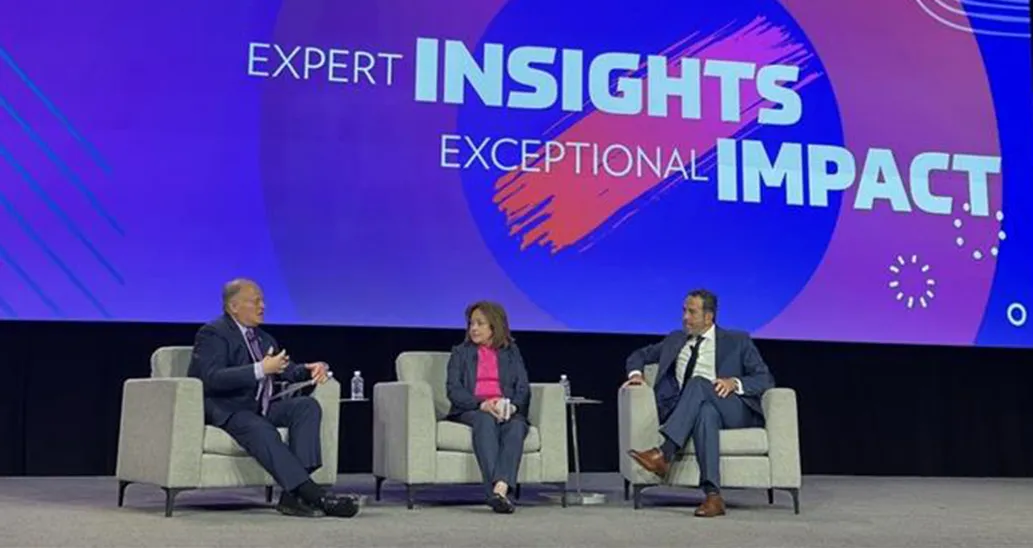
From left, HIMSS CEO Hal Wolf, Colorado Lt. Governor Dianne Primavera and Louisiana Department of Health Secretary Bruce Greenstein at HIMSS26 in Las Vegas.
Photo: Andrea Fox/HIMSS
LAS VEGAS – "We are the Department of Health for Louisianans, not just the 'Department of Medicaid,'" said Bruce Greenstein, the Louisiana Department of Health secretary, on Tuesday in a Views from the Top session, aimed at aligning healthcare policy, funding and public-private partnerships, at HIMSS26 here.
"How can we decomplicate the system?"
Greenstein and Colorado Lieutenant Governor Dianne Primavera described how their states are improving healthcare by modernizing information exchange, bolstering rural health systems and advancing innovation.
Primavera, recognized for healthcare access and affordability advocacy with the 2026 HIMSS Changemaker Lifetime Achievement Award earlier in the day, credited collaboration in Colorado for leading patients to more complete access to their health data and helping providers better address social determinants.
"When we take our backgrounds and our experiences and collaborate amongst one another, we become the catalyst of innovation, not just innovation for innovation's sake – innovation because we've seen the impact our work has on human lives," she said.
The state coordinates health IT funding, strategy and policy through its Office of eHealth Innovation and Office of Saving People Money on Healthcare. Recently, OHAI released its first patient-centered roadmap, built through outreach with 67 organizations.
To reach constituents from urban Denver to remote mountain towns, the office held listening sessions in eight languages, Primavera explained. While the policy focuses on data governance, the practical goal is to give individuals full access to and control over their health data.
"A cornerstone of this effort is how we handle consent management," she said, noting that a pilot program for a new consent repository in the state will launch soon.
"To the experts in this room, that's responsible data sharing and data governance in action through policy," she said. "But to a mother in rural Colorado, it means she finally has the keys to her family's health records."
Primavera also said the Colorado Social Health Information Exchange, or CoSHIE, is bridging the gap between medical care and agencies that address social factors that impact health, including housing, food security and transportation.
"We aren't just modernizing systems, we're modernizing the way the government shows up for its people because we know that health doesn't just happen in a doctor's office," she said.
CoSHIE shifts coordination from the patient to technology by enabling a doctor to see if a patient accessed a referral to social services. It also eliminates additional requests to complete redundant consent forms and allows patients to revoke their consent at any time, the lieutenant governor explained.
"The system works by taking the fragmented data silos and connecting them together," said Primavera. "By connecting data, we're better able to reduce patient trauma."
Through the federal Rural Health Transformation Program, Colorado is looking to artificial intelligence to help bridge the digital divide, but as a practical tool to reduce rural doctors' administrative burdens.
With it, "they can spend more time with patients and provide the best whole person care."
"The crossroads of healthcare and technology have the potential to change our world for the better," she said. "As you build the next generation of AI-driven care and work diligently to modernize your health systems, don't just focus on the how; focus on the who."
Greenstein said Louisiana's seven strategies under its RHTP program focus on balancing innovation with governance, equity and sustainability.
Under one key strategy, the state is establishing a fund where rural health providers can apply for allocations to buy electronic health records.
"We have deals that we're doing right now where we're negotiating the best price, and then making those prices on the EHRs available to the health systems," he said. "And then we'll also assist in the implementation and then ongoing of support."
Bringing causes together with policy to address them is another focus.
For example, the department is aligning federal chronic disease policies under the U.S. Centers for Disease Control with its subsidized nutrition programs. "To us, it's critical that we bring the things that cause chronic disease together with the policy for addressing chronic disease," he said.
Greenstein said he also persuaded other states to create a Rural Tech Catalyst Fund.
"It's really a venture capital fund that we put together that will make investments in novel technologies or services that are technology-driven," he said, noting his department will offer webinars and host a mini-summit to develop the fund.
The idea is to offer financial incentives to subsidize strategies and technologies that increase access to healthcare and specialities, in particular, in rural areas until they are sustainable. One example is a clinician credit program – sign-on and retention bonuses – that are designed to attract medical professionals to work in underserved rural areas.
"This is an easy way to start to think about morphing what has created headwinds in market dynamics for us to really be able to take care of the patients in those rural areas," he said.
Louisiana will also pay hospitals for meeting specific quality performance measures under a value-based payment model.
While Medicaid payments were "given away" in the past, "Now, we set the bar pretty high," using measures like HEDIS, Greenstein said.
"The work that's being done in clinics and in hospitals is being recorded and rewarded," he said.
Andrea Fox is senior editor of Healthcare IT News.
Email: afox@himss.org
Healthcare IT News is a HIMSS Media publication.


