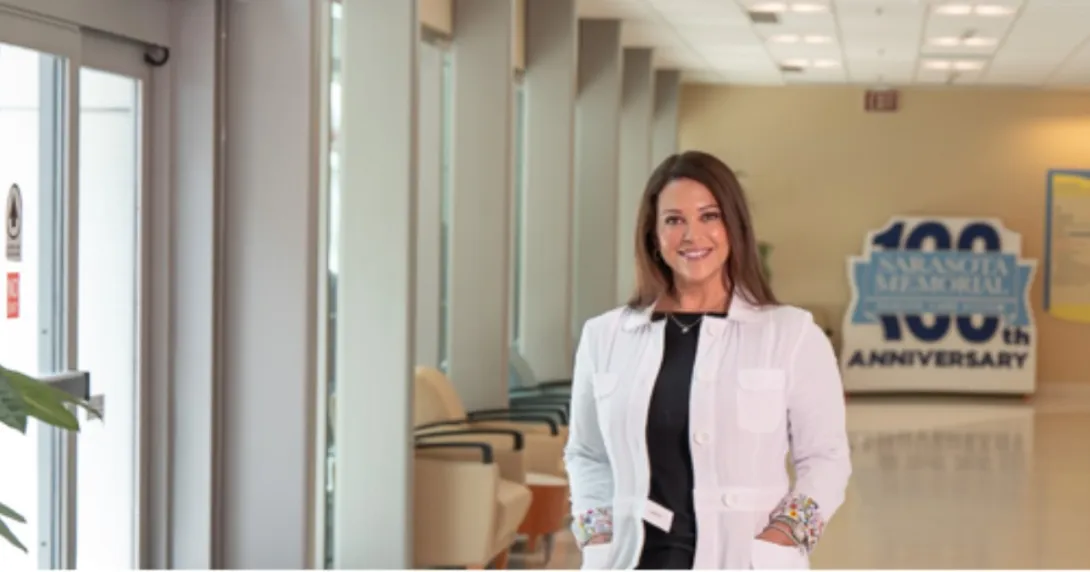
Susan Grimwood, DNP, APRN, executive director of logistics and patient throughput at Sarasota Memorial Health Care System
Photo: Sarasota Memorial Health Care System
Sarasota Memorial Health Care System is one of the largest employers in Sarasota County with nearly 11,000 staff members, 1,500 physicians and 750,000 annual patient registrations.
As its patient volume grew, the health system struggled to manage capacity and throughput due to inconsistent discharge management, siloed information across nursing units and care teams, and limited access to real-time patient status.
THE CHALLENGE
Discharge has long been one of the most persistent challenges in hospital operations. Teams struggled with a highly reactive process.
"We often had to wait until a physician initiated the discharge order before mobilizing downstream tasks like care coordination, environmental services, transport and bed management," said Susan Grimwood, DNP, APRN, executive director of logistics and patient throughput at Sarasota Memorial. "This meant we were constantly playing catch-up.
"Even when everyone was working hard, bottlenecks formed because multiple discharges would stack up late in the day, leaving us with units that turned over too slowly and emergency patients waiting far too long for an inpatient bed," she continued.
Another core challenge was visibility. Frontline staff had no clear, data-driven way to anticipate how many patients were likely to discharge on a given day, or at what times.
"This uncertainty made staffing, scheduling and bed planning guesswork," she explained. "When volumes spiked unexpectedly, we would scramble and frequently resort to costly workarounds like calling in extra staff or extending shifts, which not only cost us money, but also took a toll on the staff.
"Poor planning meant staff were overutilized unnecessarily, which also led to burnout," she added. "The lack of predictability, not only impacted patient flow, but also staff morale."
PROPOSAL
Grimwood and her team looked at an artificial intelligence-powered system called iQueue for Inpatient Flow from health IT vendor LeanTaaS. They concluded the technology would allow them to forecast discharges at both the unit and hospital level, which they found compelling.
"Instead of waiting for discharges to be initiated, we could forecast them in advance, which would allow us to plan and operate more efficiently," Grimwood explained. "It promised to analyze a wide range of patient and operational data, including length of stay patterns, clinical factors, census trends and historical discharge activity. This would give us a reliable, real-time view of expected discharges for the coming hours and days.
"The vision was that the system could shift us from a reactive to a proactive approach," she continued. "If we knew early in the morning which patients were most likely to go home later in the day, we could line up case management, notify environmental services and coordinate transport ahead of time."
The technology also offered integration with Sarasota Memorial's existing dashboards, so managers could see discharge predictions alongside admissions and transfers to give staff a fuller picture of hospital capacity in real time.
MEETING THE CHALLENGE
Once implemented, the predictive discharge tool became a shared reference point for multiple teams. Nursing leaders and case managers used it to identify high-likelihood discharges first thing in the morning. Physicians could cross-check the list and prioritize rounding or documentation on patients flagged as likely to leave that day.
Environmental services used the predicted timing to pre-plan room turnovers, which reduced downtime between occupancies. Bed management incorporated the data into their throughput meetings, making more confident decisions about when they could safely accept patients from the ED or transfer centers.
"iQueue integrated into our existing EHR and operational dashboards, so staff didn't need to learn a completely new system," Grimwood noted. "The forecasts were refreshed in real time and displayed in the same environment they already used for census and staffing updates. That seamlessness was critical for adoption.
"Over time, the predictions became embedded into daily huddles, unit-level planning and even executive oversight – transforming how we coordinated discharges across the hospital," she added.
RESULTS
Sarasota Memorial has seen results across emergency department boarding hours, length of stay and the discharge process.
"By predicting earlier which beds would be available, we were able to move patients out of the ED faster," Grimwood reported. "Within six months, we observed a 32% drop in ED boarding hours, even as our ED visit volume increased by 22%. This not only relieved pressure on our emergency department but also improved patient satisfaction.
"We also trimmed bottlenecks that had previously extended inpatient stays with earlier discharges each day," she continued. "Our average length of stay decreased by over half a day – 13 hours – which was especially impactful during our highest census periods."
That reduction translated into better throughput and improved capacity without adding physical beds.
"We measured a 10% decrease in the time between discharge order and actual patient departure while experiencing a 23% increase in average daily census," she said. "That may sound incremental, but in aggregate, it meant we could reliably open beds earlier in the day, smoothing patient flow throughout the hospital."
ADVICE FOR OTHERS
Predictive discharge tools are not a standalone technology but an enabler of culture change, Grimwood said.
"The models are only as powerful as the workflows and people who use them," she continued. "Hospitals need to ensure that case managers, nurses, physicians and support services are aligned on how to act on the predictions – and that they trust the forecasts enough to adjust their routines. Embedding the tool into daily huddles and standard workflows was critical for us.
"I would also stress the importance of starting with clear goals and measurable outcomes," she advised. "Whether it's reducing ED boarding, shortening length of stay or improving staff efficiency, you need to define success upfront and hold yourself and your partners accountable to it."
Technology can deliver remarkable insights, but the real value comes when operationalizing those insights consistently, she added.
"In our experience, once staff saw the tangible impact on patient flow and workload, adoption snowballed and the tool became indispensable," she concluded.
Follow Bill's health IT coverage on LinkedIn: Bill Siwicki
Email him: bsiwicki@himss.org
Healthcare IT News is a HIMSS Media publication.
WATCH NOW: Wisdom on nurses and IT from a health system's nurse CIO


