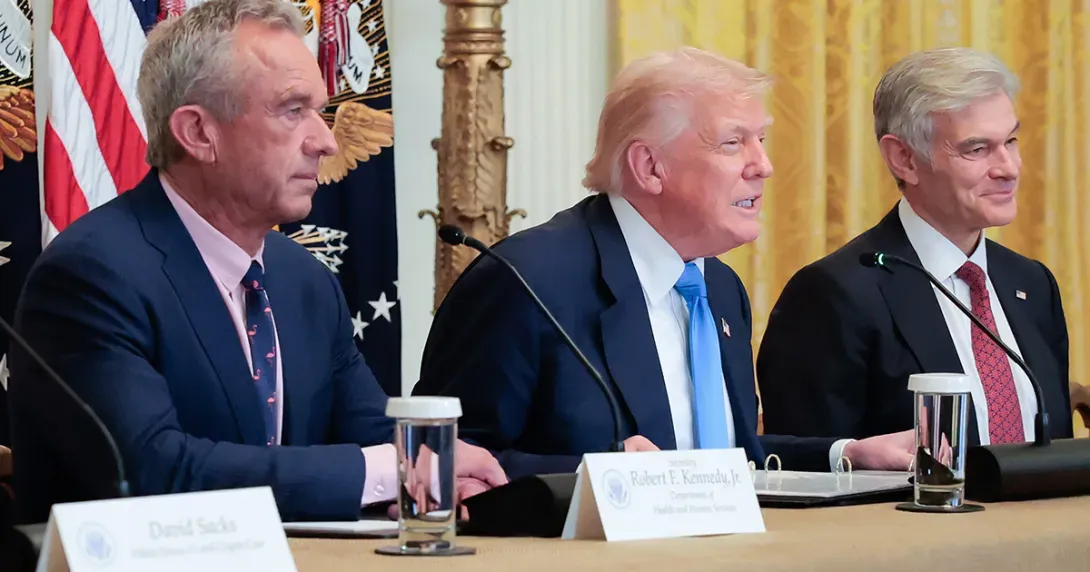
From left, HHS Secretary Robert F. Kennedy Jr., President Donald Trump and CMS Administrator Dr. Mehmet Oz appear at the Make Health Tech Great Again event on July 30, 2025.
Photo: Anna Moneymaker/Getty Images
At a rural health roundtable Friday at the White House, President Donald Trump focused on an array of issues affecting healthcare costs in the United States, from his new "Great Healthcare Plan" proposal, efforts to reduce drug costs and more.
In a federal shift away from volume-based reimbursements toward innovation-focused grants, the Rural Health Transformation Program is the chief mechanism aimed at ensuring rural residents have long-term access to quality care that urban residents do, said Centers for Medicare and Medicaid Services Administrator Dr. Mehmet Oz.
WHY IT MATTERS
"The Rural Health Transformation Fund is the largest investment ever in American history in our rural communities," Oz said at the event, ahead of multiple state and tribal leaders who shared their perspective. "We don't want rural America left behind anymore."
CMS announced the first round of awards in the five-year RHTP last month. The awards range from $147,250,806 for New Jersey to $281,319,361 for Texas, and are based in part on the size of each state's rural population.
The funding, earmarked in the Working Families Tax Cut Act in 2025, is not being distributed blindly, Oz noted. Fraud has run rampant in Minnesota and California, he said.
The RHTP investment will carry out a "true state-federal partnership," said Oz. States competed and had "amazing ideas," he added.
They'll have project managers and others in a new Office of Rural Health Transformation that will help all states implement their funded proposals and also ensure long-term oversight to ensure transparency and accountability.
"It's not just paying the bills; it's not just picking up the pieces; it's actually transforming, using technology we have widely available in urban areas," he said.
A fact sheet on the Historic Investment in Rural Health released by the White House Friday addressed how "funds can be used to help these facilities make investments necessary to better meet the needs of the communities they serve and become more sustainable over the long term."
"When legacy programs link funding to reimbursements for services provided, they do not promote long-term sustainability as the overall volume of services provided in these facilities remains low," the White House said in the fact sheet.
"In other words, these programs do not actually provide hospitals with investments that would help them sustain themselves."
"Your zip code actually is your destiny," Oz said. "But we can make a dent in this because the high rates of chronic disease and other ailments that plague our rural areas are often driven because they don't have access to care."
Oz added that CMS has been working with states to "right-size rural healthcare" by creating teams to focus on sustainable access and other programs and getting money into governors' hands within six months. The funding opportunity was announced in September.
Using the example of Butler General Hospital in Butler, Pennsylvania, the city where President Donald Trump was shot on July 13, 2024, he described how the funding could change access to care through technology and innovation.
Rural hospitals like Butler will be able to build telemedicine and telerobotic capabilities to reach experts like neurosurgeons that they do not have in-house through hub-and-spoke models that engage them with well-resourced health systems in major metropolitan and academic areas, he said.
North Carolina is one state working to coordinate resource sharing with major health systems.
Oz said funding for rural pipelines would address rural care workforce shortages, including a new medical school planned for rural Delaware and a high school-to-healthcare career development program in Michigan.
"Growing up in a rural community, I saw firsthand how difficult it can be for families to access healthcare," Dr. Valerie Fuller, president of the American Association of Nurse Practitioners, said in a statement emailed to Healthcare IT News.
"Programs like the [RHTP] recognize the importance of strengthening the healthcare workforce and supporting providers who are already delivering care in rural communities."
Oz also named additional rural tech initiatives:
- Texas and Hawaii are making targeted investments in statewide telehealth.
- Alaska plans to deploy unmanned pharmaceutical distribution kiosks and medication drone delivery.
- Alabama has funding for robots performing ultrasounds on expecting mothers in counties that lack OB-GYN care.
"They'll save lives for decades there," long after the RHTP funds are exhausted, he said.
THE LARGER TREND
The 2025 One Big Beautiful Bill Act, passed in July along with the Working Families Tax Cut Act, included Medicaid changes that are expected to increase uncompensated care and potentially put small and rural hospitals in an even more precarious position.
A Congressional Budget Office analysis released in June showed that the OBBB would cut $930 billion from Medicaid and increase on-budget deficits after 2034.
Despite $50 billion distributed to states over five years, some experts question whether states can sustain the RHTP's goals.
There are financial caps and limitations on "specific technology-related expenditures and overall funding distribution," Valerie Rogers, senior government relations director at HIMSS (parent company of Healthcare IT News), noted in November.
Meanwhile, many security experts are concerned about rural hospital cybersecurity risks. One interviewed this week for an upcoming episode of HIMSSTV expressed concern over a lack of RHTP funding for improving their vulnerable security postures.
Three years ago, St. Margaret's Health in Illinois cited a cyberattack as partly to blame for closing all operations.
Since 2010, 182 rural hospitals have closed or converted, according to a Chartis Rural Health State of the State report released last year. The consultancy estimated at the time that 432 were vulnerable to closure.
ON THE RECORD
"Distinct from these other programs, the Rural Health Transformation Program is designed to promote innovation in payment and flexibility," the White House said in the fact sheet. "These funds can be used to help these facilities make investments necessary to better meet the needs of the communities they serve and become more sustainable over the long term."
Andrea Fox is senior editor of Healthcare IT News.
Email: afox@himss.org
Healthcare IT News is a HIMSS Media publication.