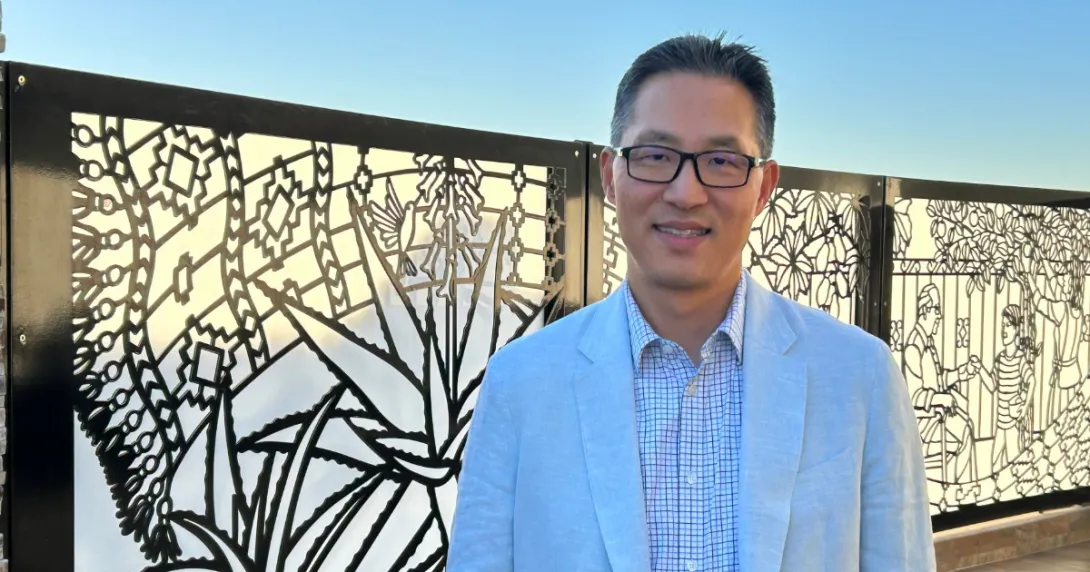
Dr. Eric Lee, medical director of clinical informatics at Commerce, California-based AltaMed
Photo: AltaMed
Dr. Eric Lee is medical director of clinical informatics at Commerce, California-based AltaMed, one of the largest federally qualified health centers in the U.S., serving more than 400,000 patients across more than 60 sites. He provides strategic and operational leadership on digital health transformation, EHR governance, data strategy, patient engagement and health IT innovation.
A big part of his days today is a technology that cannot be avoided in the realm of health IT.
"Since the advent of EHRs and meeting Meaningful Use, I have not seen more discussion on a topic within health IT until generative artificial intelligence took a significant leap into our consciousness in recent years," Lee said. "There is a plethora of proposed use cases, ranging from speculative to proven and everything in between. And with that, there are more emails and messages to sift through – or as the saying goes, 'separate the chaff from the wheat.'"
First on the healthcare AI list
The most successful AI use case in healthcare has been ambient scribe technology – simply because daily documentation of visits has been an increasingly onerous requirement capturing what is a personal and private interaction between a provider and patient, he observed.
"While most people would say the next most popular use case is applying AI to draft denial/appeal letters for referrals or specialty/high-cost medications requiring prior authorization, this has become an unfortunate case of payer AI versus provider AI – and from a clinical perspective, there is not much that is appropriate, unfortunately, about this process.
"Applying AI to lower-risk situations is increasing," he added. "Using this to help patients schedule, reschedule or cancel appointments is a useful way to help them among many others. But what people need to once again realize is that applying AI to this will not be accurate, efficient or productive if data governance has not taken shape with a clean data foundation. The patient experience will be impacted by AI slop."
AltaMed is using AI in several different ways, with ambient AI scribes being the most heavily utilized application. Ambient AI scribes at AltaMed have been extremely successful, but getting there required many steps, reinforcing the adage, Lee said, that in order to go fast, you must go slow.
Piloting every feature
"Navigating the plethora of ambient AI scribe options in the industry was the first task," he recalled. "Given AltaMed's slim margins for error, the clinical informatics team pilots virtually every feature or tool introduced or integrated with the EHR first so we can train and manage expectations when it is live for all.
"Our clinical informatics team applied our principles and piloted several options until we reached a point where we had a firm understanding of the risks and benefits," he continued. "For the first time in years in looking at this technology, we believed that the benefits finally outweighed the risks."
The best technology is intuitive and requires minimal to no training, he added.
"We know from many others who are live with this technology that this was the case," he said, "but how many organizations are live with a deep integration of this into the EHR across all standard note templates and Express Lanes to increase adoption, usability and preserve workflow?
"There were many conversations with multiple leaders across months before this could be implemented," he continued. "Does this technology really work? Does it auto-recognize other languages? How do you ensure this technology will be used responsibly and ethically? Where are the recordings stored and for how long?"
Responsible use agreement
AltaMed took some foundational steps including establishing interdisciplinary AI governance, approving and subsequently educating providers about AI policies and procedures, and developing and adopting a responsible use agreement for all providers. The organization required every provider to review and sign the following responsible use agreement before receiving access to the integrated AI scribe, and in doing so, was able to reinforce what the providers needed to know from Day One:
- Always ask for consent to record.
- Understand this is solely designed to assist with documentation and does not provide medical advice/diagnosis/treatment recommendations.
- Always review and edit created documentation for accuracy.
- Do not include umbrella statements excusing and/or attributing potential inaccuracies or typographical errors to generative AI.
- Document that the encounter was co-created with generative AI and attest to carefully reviewing the note prior to signing.
"We have been live for over half a year, with almost three-quarters of our providers having enrolled into this program," Lee reported. "More than half enrolled are high utilizers, using this greater than 70% of their visits. Another third are using this between 30%-70% of the time.
"On average, our providers are saving about 20 minutes daily with documentation, and more than 95% of our providers are editing the notes created," he continued. "Apart from the usual data about time savings, wellness and cognitive burden, we have been collecting data on what our providers think of how accurate ambient AI scribes are with other languages."
A deeper look at ROI
AltaMed is working with the California Healthcare Foundation's innovation team to dive deeper into measuring ROI for ambient AI scribes so other FQHCs and community health centers can benefit from this core technology, he added.
"AltaMed is live with draft responses to patient messages using augmented response technology for nurses within our centralized message management team, which handles around two-thirds of all messages directed to our providers," Lee concluded. "This has been well received by our nurses, and early findings include decreased cognitive burden for our nurses on this team as well."
Follow Bill's health IT coverage on LinkedIn: Bill Siwicki
Email him: bsiwicki@himss.org
Healthcare IT News is a HIMSS Media publication.
WATCH NOW: How can an IT exec become a Chief AI Officer – and then work with the C-suite


