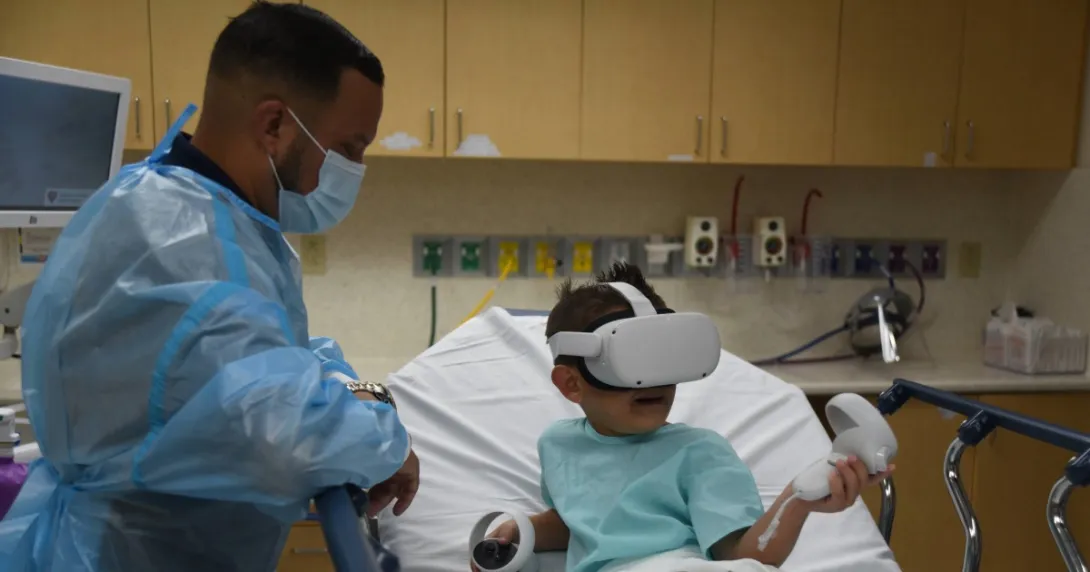
A patient at Nicklaus Children's Health System uses virtual reality technology
Photo: Nicklaus Children's Health System
Virtual reality is beginning to impact real-life scenarios in healthcare. Nicklaus Children's Health System in South Florida is using VR technology to ease children's anxiety before and during a procedure, reduce pain significantly in children during extended hospital stays, and train employees during challenging scenarios. It will be used in operating rooms before the end of this year.
THE CHALLENGE
"In our surgical unit, we were encountering ongoing challenges with ensuring consistent patient engagement and delivering effective therapeutic interventions, particularly around pain management and mental health," explained Dr. Christina Potter, IT digital technologies manager at Nicklaus Children's.
"Traditional approaches, though often effective, tended to be resource-heavy, difficult to scale, or lacked the immersive, engaging elements needed to support improved patient outcomes," she added.
PROPOSAL
VR presented a patient-centered approach that allowed staff to create calming, immersive environments to support patients without requiring continuous clinical involvement.
"The idea was to use VR as a tool to help reduce anxiety and pain by engaging patients in a more meaningful way, creating a sense of presence that could redirect focus from the at-times scary hospital setting and enhance the overall experience of care," Potter said.
MEETING THE CHALLENGE
Nicklaus Children's implemented VR headsets across several departments, including same-day surgery, minor procedures and pain management.
The digital innovation team collaborated with clinical staff to identify and train superusers – called innovation ambassadors – who would lead the hands-on implementation. These ambassadors were trained to understand both the technology and which patient populations would benefit most.
"Patients used headsets for a variety of experiences, from guided meditation and mindfulness to immersive, distraction-based games," Potter noted. "In partnership with our pain management team, VR is now being used as a non-pharmaceutical alternative in many cases.
"To support ongoing success, we also implemented a mobile device management system that tracks usage in real time," she continued. "This allows our team to monitor engagement, evaluate impact, and continuously refine the content we offer based on actual patient needs and usage trends."
RESULTS
Pain reduction and decreased opioid use have been a big win.
"Patients using VR reported on average a 60% decrease in pain scores during and immediately after sessions," Potter said. "This has directly contributed to a meaningful reduction in opioid use from our pain management team, supporting safer recovery and higher patient satisfaction."
Another success has been reduced patient and family anxiety.
"We've seen anxiety levels drop by an average of 60% in patients and 50% in parents, which we believe is influenced by the sense of relief parents feel when they see their child calm and relaxed," she reported. "The impact has been even more significant for our neurodiverse patients, with those on the autism spectrum showing a 75% reduction in anxiety."
And there has been scalable growth across the hospital.
"What started as a small pilot in two units with three innovation ambassadors has grown into a health system-wide initiative," she said. "We now operate across 14 units, with nearly 70 trained ambassadors and close to 40 VR headsets in active rotation.
"In addition to patient use, we've expanded into staff training, developing our own VR-based clinical education modules," she added. "Much of this growth has been driven by frontline staff, who have seen the benefits firsthand and continuously bring new ideas forward."
ADVICE FOR OTHERS
Potter said for peers interested in VR to begin with a focused use case and establish clear metrics to measure success.
"Engaging with care teams early is essential, identifying superusers who are enthusiastic and willing to lead," she concluded. "Their involvement has been central to our success. Also, be prepared to iterate. Not all VR hardware or content is the same, and different clinical applications may require different platforms. Start small, stay flexible and scale based on what works."
Follow Bill's health IT coverage on LinkedIn: Bill Siwicki
Email him: bsiwicki@himss.org
Healthcare IT News is a HIMSS Media publication.
WATCH NOW: How healthcare AI can take lessons from national security leaders


