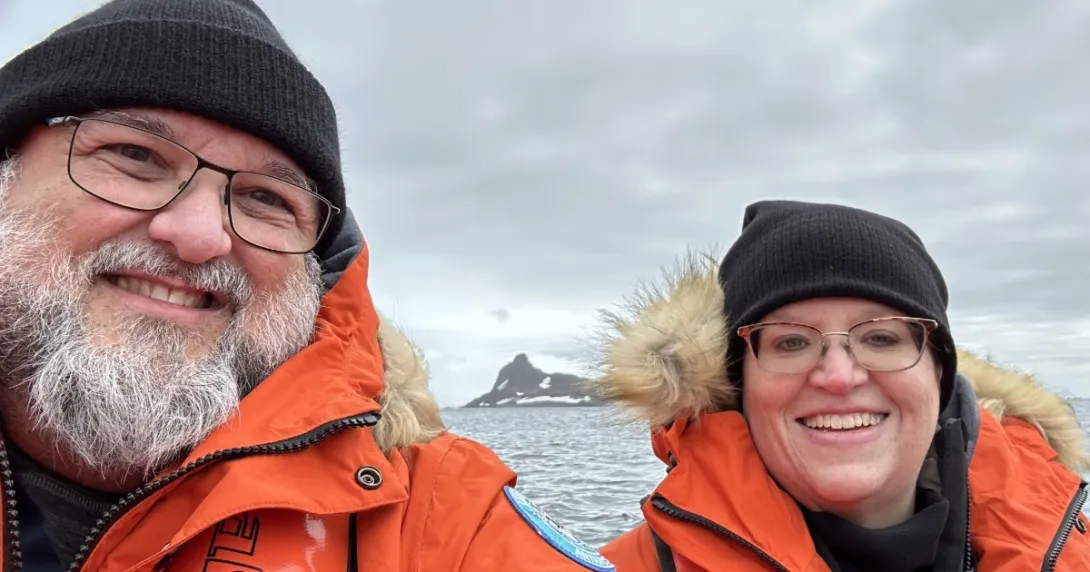
Dr. Julie Wood, senior medical director, clinician engagement, at Linus Health, and her husband John
Photo: Dr. Julie Wood
Linus Health, an AI-powered brain health company that has made breakthroughs in the early detection via digital health technologies of cognitive impairment and personalized intervention, recently appointed Dr. Julie Wood as its new senior medical director for clinician engagement.
Wood, who previously served as senior vice president for science and clinical strategy at the Academy of Family Physicians, has more than two decades of clinical, public health and primary care leadership experience, along with extensive expertise in clinician education, quality improvement and large-scale practice transformation. She has been a practicing family physician for nearly 20 years.
Healthcare IT News sat down with Wood to discuss the role AI in helping primary care physicians identify and treat cognitive impairment earlier, scaling specialist capabilities to get patients treatment sooner, and why this technology and use case is so meaningful to her as a primary care physician.
Q. Please explain the role AI can play in helping primary care physicians identify and treat cognitive impairment earlier, before it becomes full-blown dementia. Is it possible for AI-powered technology to identify Alzheimer's disease before it even presents clinically?
A. From a primary care perspective, the biggest shift right now is that we are moving from reacting to obvious cognitive decline to having the opportunity to identify it long before noticeable symptoms appear.
AI-driven digital screenings and assessments can help by picking up very subtle patterns in how people think, process information, speak and perform everyday tasks that are hard to capture in a short office visit or with traditional pen-and-paper tests. Having quantifiable data to support those observations can make earlier conversations feel more grounded and actionable.
There is now substantial research showing that AI-enabled cognitive assessments can surface signals associated with Alzheimer's pathology likely years before patients or families detect any changes. Recent peer-reviewed studies have shown that brief digital assessments, when analyzed using AI, are associated with underlying amyloid and tau changes in the brain, even in people who appear cognitively normal.
That is incredibly important because it changes our approach from reactive to preventive care, when interventions can yield the greatest benefit. We can also be more thoughtful about who needs closer follow-up or additional testing, whether it is a referral to a neurologist or one of the blood-biomarker tests for Alzheimer's disease that have been developed.
For primary care, this matters because timing changes everything. Earlier identification creates space for planning, education, and meaningful conversations with patients and families. It allows us to approach brain health the way we already manage heart health or diabetes risk, as something we can monitor and address over time, rather than something we only confront once function has clearly declined.
Q. How can this scale specialist capabilities and get patients treatment sooner than they would otherwise?
A. Throughout my family medicine career, one of the most challenging aspects has always been access to brain health specialists. Even when a physician recognizes a concern early, referrals to neurology or memory specialists can take many months.
AI-supported tools help by enabling primary care teams to do more of the initial workup up-front, using objective data to clarify who is most likely to benefit from specialist evaluation. This helps reduce unnecessary delays for patients who need next-level care more urgently.
When patients reach specialty care with clearer information and a more complete picture of their cognitive status, the entire process becomes more efficient. Specialists can focus their time on patients who need advanced diagnostics or treatment decisions, rather than starting from square one.
That helps move patients through the system faster and reduces the frustration families often feel during long periods of uncertainty. It also supports better collaboration between primary care and specialty teams.
This approach also has a real impact on communities with limited access to specialty care. Rural areas and underserved urban settings – both of which I have practiced in during my career – often face the longest delays. Supporting primary care teams with better tools helps extend specialist expertise into those settings and brings patients closer to appropriate care without requiring repeated visits or extended travel.
That kind of scalability is essential as demand continues to grow and workforce shortages persist. There is also an important opportunity for primary care and sub-specialty care to have bidirectional communication and collaboration as patients are diagnosed and to provide ongoing quality care.
Q. Why is this so meaningful to you as a primary care physician yourself? Could you have imagined this ten or even five years ago?
A. As a family physician, I have always cared deeply about supporting patients and families through their brain health concerns. At the same time, I also know how difficult it can be to do this well in a busy primary care setting.
These conversations take time, are emotionally complex, and often surface alongside other competing priorities during a short visit. Primary care clinicians have always cared deeply about brain health, even when the tools available made it challenging to address cognitive concerns in a proactive and comprehensive way. That tension between wanting to do the right thing and having limited time and resources is very real.
What feels especially meaningful now is the opportunity to shift these conversations earlier and frame them around prevention and whole-person health. Primary care already does this well for heart disease, diabetes and cancer screening; brain health deserves the same approach.
Earlier assessment allows clinicians to talk with patients about risk factors, lifestyle changes, monitoring and long-term planning in a way that feels supportive rather than crisis-driven. That is very much aligned with how family physicians think about preventive care across the lifespan.
I could not have imagined this level of capability even five or ten years ago. When I was practicing, cognitive screening often relied on paper-based tools that usually required follow-up visits, offered limited insight and were challenging to fit into everyday workflows.
Short AI-driven digital screenings that could easily be worked into a routine appointment were not part of how we thought about prevention or early detection. The fact that we now have evidence-based digital tools that support earlier conversations about brain health long before dementia is present – when we can still do something about them – represents a meaningful shift for primary care and for patients who want to stay healthy over the long term.
Follow Bill's health IT coverage on LinkedIn: Bill Siwicki
Email him: bsiwicki@himss.org
Healthcare IT News is a HIMSS Media publication.
WATCH NOW: How can an IT exec become a chief AI officer – and then work with the C-suite


