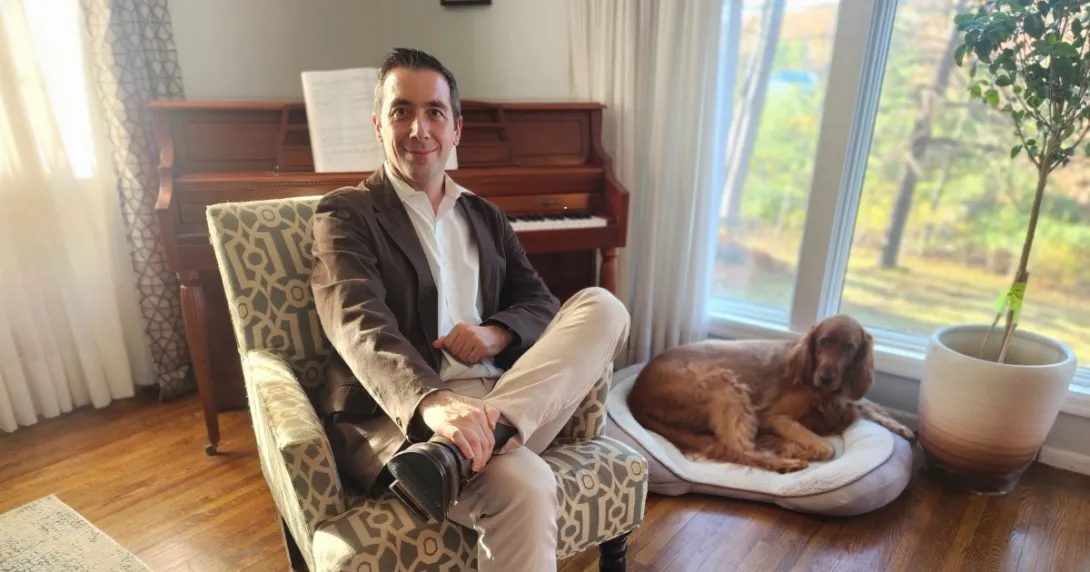
Charlie and his best friend Joe Lengfellner, senior director of clinical research information technology at Memorial Sloan Kettering Cancer Center
Photo: Joe Lengfellner
Memorial Sloan Kettering Cancer Center's mission is to end cancer. To get there, the famed organization must keep improving clinical care and research, including clinical trials. It has as many as 1,800 clinical trials open at any given time.
THE CHALLENGE
Clinical research at this scale runs on data. However, too much of the crucial information the organization needs for trials is locked up in unstructured data, such as free-text notes, imaging narratives, outside records and other sources that don't natively interoperate.
"To find patient matches for our clinical trials, we have more than 400 research coordinators that spend countless hours combing through patient histories – staging details, biomarkers and prior therapies to locate aligned patients," explained Joe Lengfellner, senior director of clinical research information technology at the center and lead of its Clinical Research Innovation Consortium.
"They then reenter relevant fields into systems that often don't talk to each other," he continued. "Even elements that are structured – like labs and vitals – rarely move cleanly from the EHR into clinical trial sponsor systems. Copy-and-paste has become an unfortunate but common bridge today."
The result is friction: slower screening, avoidable data errors, and missed opportunities to place the right person in the right clinical trial at the right time.
Complexity is acceptable when it serves the science, Lengfellner noted.
"Overall, oncology clinical trials are becoming increasingly complex in all directions," he said. "Oncology protocols continue to expand their inclusion and exclusion criteria, and large Phase 3 studies can involve millions of data points, magnifying the burden on teams tasked with screening and data operations.
"Once more, modern documentation tools like artificial intelligence scribe reduce clinician burden but generate still more unstructured content downstream, ensuring the unstructured problem will grow, not shrink," he continued. "Without a fundamentally better way to transform this information – to structure the unstructured data – it's hard to scale clinical trial access, activate studies efficiently, or keep pace with our institutional mission to improve cancer care through research."
Finally, the human toll is real, he added.
"Research coordinators don't enter the field to push data between systems – they want proximity to patients, clinicians and the science," Lengfellner said. "The status quo constrains trial throughput and adds cost, while also limiting how many patients can be considered for our clinical trials."
PROPOSAL
The provider organization ran a structured evaluation led by its Clinical Research Innovation Consortium in partnership with the center's iHub to target major clinical trial pain points – some of which included patient matching, unstructured-to-structured extraction, and EHR-to-sponsor system data movement.
"In mid-2024, we launched a head-to-head competition across multiple vendors and approaches, knowing many earlier systems hadn't delivered," Lengfellner recalled. "In terms of working to improve patient matching, Triomics stood out with an oncology-tuned platform that reads unstructured clinical data at scale, extracts trial-relevant facts and continuously reconciles those against clinical trial criteria.
"The performance bar was evidence, not promises," he continued. "We required a retrospective analysis across multiple completed trials and disease areas with a challenge: Use the AI technology to recover every patient our teams had already found through manual screening, and surface additional appropriate candidates if we missed any."
Triomics met the challenge, matching the center's manual identifications and finding more "needles in the haystack" clinical trial candidates – and did so with an explicit human-in-the-loop design. Coordinators can confirm or correct suggested matches and extractions, the system learns, and center staff measure impact on screening precision/recall and hours of manualized work returned to staff.
As part of the center's collaboration with the vendor, the center now is rolling out the artificial intelligence tech in a methodical way with a goal toward faster, more consistent matching and less manual data review and movement.
MEETING THE CHALLENGE
The Triomics AI platform is connected to Memorial Sloan Kettering Cancer Center's Epic EHR and research data environments. Nightly pipelines ingest notes, labs, reports and visit schedules from Epic. Models align patient-level features against clinical trial inclusion/exclusion criteria to surface high-confidence candidates.
Researchers and treating clinicians receive timely alerts, especially for patients with upcoming visits, while coordinators work in a console to validate matches, correct extractions, and place almost-match patients on watchlists the system tracks over time.
"It's a human-in-the-loop approach where clinicians retain final eligibility decisions, and research coordinators remain central to quality control and longitudinal follow-up," Lengfellner explained. "If the collaboration is successful, our plan is to scale the system in phases.
"With the retrospective analysis now done, we will move into a controlled pilot across varied oncology subspecialties, then broader rollout across more than 1,800 open studies as performance gates are met," he added.
RESULTS
As part of the collaboration, in the initial retrospective evaluation, the center asked the vendor to "prove it."
"We shared historical data across multiple completed clinical trials and challenged the system to recover every eligible patient our teams had already identified and to surface any we might have missed," Lengfellner said. "The vendor matched all of our manually identified candidates and found additional appropriate patients beyond that.
"The analysis was unambiguous: The approach works as intended and can widen access by reducing false negatives in screening," he reported.
Operationally, manual screening can take a coordinator a couple of hours for a single patient. By contrast, the platform processes hundreds of charts overnight.
"As we scale, this will free research coordinators to focus on higher-value work such as engaging patients, coordinating logistics and overseeing data quality," he explained. "We expect greater efficiency, fewer missed opportunities and more people enrolled in our clinical trials – with measurable improvements to throughput and data hygiene across the portfolio.
"We expect a step-change in screening efficiency: faster identification of eligible patients and fewer missed opportunities due to buried criteria in unstructured data," he continued.
Success is more patients in the clinical trials – powered by measurably better data operations end to end, he added.
ADVICE FOR OTHERS
Start with a pragmatic approach and be evidence-driven, Lengfellner advised his peers looking at similar AI technology.
"Before any broad deployment, run a retrospective analysis that compares the AI platform's performance against grounded truth from completed studies," he explained. "Set metrics for your rollout to be sure you are meeting them before broadly deploying the technology enterprise-wide.
"Build a human-in-the-loop workflow from day one so clinicians and research coordinators can correct errors, track near-misses over time, and teach the system where clinical nuance lives," he added.
Above all, keep people at the center by using the technology to reduce administrative burden and elevate expert work, he said. "Doing so will help unlock both operational wins and improve access to research for patients."
Follow Bill's health IT coverage on LinkedIn: Bill Siwicki
Email him: bsiwicki@himss.org
Healthcare IT News is a HIMSS Media publication.


