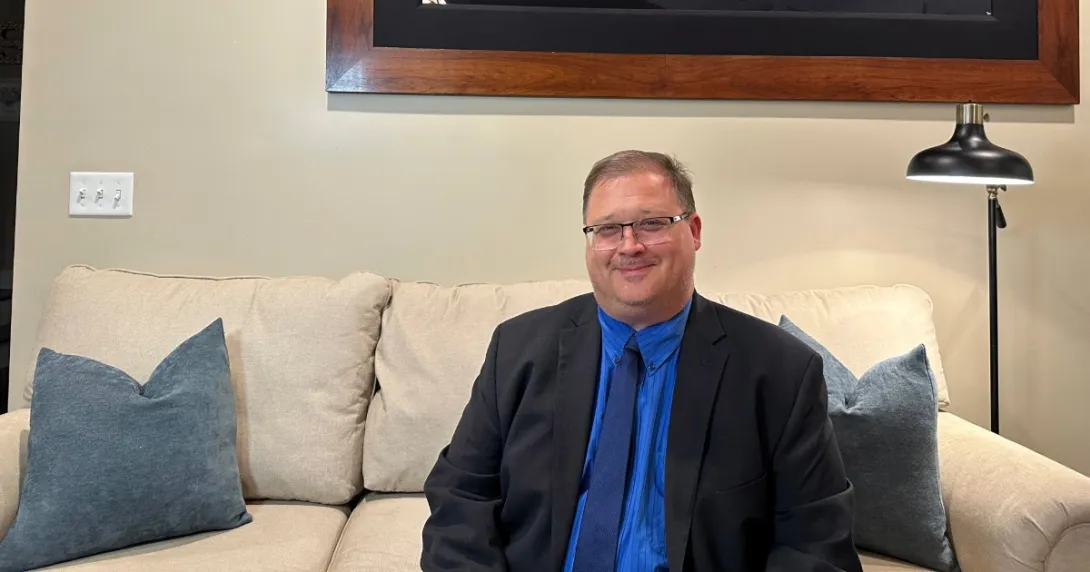
Dr. Chadwick Smith, chief population health officer at Marshall Health Network
Photo: Dr. Chadwick Smith
Marshall Health Network serves 1.4 million residents across West Virginia, southern Ohio and eastern Kentucky – predominantly rural communities where access to specialty care requires significant travel.
THE CHALLENGE
The health system faced a significant challenge supporting sustainable weight management within its employee population using traditional care models alone. Obesity and weight-related conditions were contributing to higher rates of chronic disease, musculoskeletal issues and cardiometabolic risk – all of which directly impacted employee health, productivity and long-term healthcare costs.
However, access to consistent, structured weight-management support was limited by time constraints, competing work responsibilities and the episodic nature of in-person care.
"From a clinical and operational standpoint, we lacked continuous visibility into employee progress between visits," said Dr. Chadwick Smith, chief population health officer at Marshall Health Network. "Weight management efforts often relied on infrequent appointments, self-directed lifestyle changes and delayed feedback loops.
"This made it difficult to provide timely coaching, adjust care plans, or identify when an employee was struggling or disengaging," he continued. "As a result, many well-intentioned interventions failed to achieve durable results, leading to frustration for both employees and care teams."
These challenges were further compounded by workforce and benefit-design pressures. As a self-insured employer, the health system increasingly is accountable for downstream costs associated with obesity-related conditions – yet it did not have a scalable way to proactively engage employees or support behavior change over time.
"We recognized that without a more continuous, accessible model of care, we would continue to see suboptimal outcomes, rising costs, and missed opportunities to improve the overall health and well-being of our workforce," Smith explained.
PROPOSAL
The proposed solution centered on a remote care platform designed to support structured, longitudinal weight management, initially focused on the employee population but intentionally built for broader scalability.
"The model combined clinical oversight, behavioral support and regular digital engagement to extend care beyond traditional visits," he noted. "By reducing reliance on in-person encounters, the approach was designed to improve access and continuity while fitting into the realities of work schedules and daily life.
"A core element of the proposal was the ability to create consistent touchpoints and real-time visibility into participant progress between encounters," he continued. "Employees – and, over time, broader patient populations – would receive personalized guidance, education and accountability through virtual interactions, while care teams would have access to timely data to identify risks, adjust care plans and intervene earlier when engagement or progress began to decline."
This structure was intended to shift weight management from an episodic, self-directed effort to a proactive and supported care journey.
"Importantly, this was positioned not only as an employee benefit, but as a scalable population health strategy with particular relevance for rural communities," Smith said. "West Virginia and the surrounding region face some of the highest obesity rates in the country, compounded by transportation barriers, limited specialty access and workforce constraints.
"The remote model was designed to overcome these challenges by delivering consistent, clinically supported weight-management care regardless of geography, creating a pathway to expand impact beyond employees and into the broader rural populations we serve," he added.
MEETING THE CHALLENGE
Marshall Health Network implemented the remote care technology as a structured weight-management program embedded within its employee health and population health strategies. Employees voluntarily enrolled and were supported by a multidisciplinary care team led by care managers, with clinical oversight to ensure appropriate management and escalation when needed.
The platform enabled ongoing virtual engagement, allowing participants to receive education, goal-setting support and regular follow-up without requiring frequent in-person visits.
"A key differentiator of how we used the technology was the intentional pairing of pharmacologic therapy with effective clinical and care-management support," Smith said. "Historically, weight loss efforts had often been driven primarily by medication alone, with limited structure around long-term engagement or behavior change.
"This model allowed our system to integrate pharmacologic management into a broader, more holistic program that emphasized accountability, education and sustained lifestyle modification alongside medication use," he continued.
Care managers used vendor Primefocus Health's platform to monitor participation, engagement and progress over time, enabling more timely outreach and individualized support. The platform provides continuous care between visits with specialty-specific workflows, early warning systems for care teams and integrated monitoring.
"Rather than relying on episodic encounters, the program emphasized continuous touchpoints and proactive management," Smith noted.
"While the technology was not directly integrated into the electronic health record, workflows were designed to align with existing clinical and employee health processes, ensuring the program functioned as a coordinated extension of our care model rather than a standalone system."
RESULTS
Through collaboration with the vendor, Marshall Health Network has achieved meaningful early results that demonstrate the value of a more holistic, technology-enabled approach to weight management in a rural setting.
"Active participants in the program are completing assigned care tasks at a 77% bi-weekly rate – well above the 45-60% adherence rates typically reported in remote patient monitoring programs," Smith said. "This level of sustained engagement reflects a shift toward shared accountability, where participants and clinicians function as active partners in care rather than relying on episodic or medication-only interventions.
"The platform has fundamentally changed the care experience by eliminating long gaps between clinical touchpoints and replacing them with continuous engagement and feedback," he continued. "Through app-based patient-reported outcomes, weight monitoring, and structured education, participants remain actively involved in their care while clinicians gain timely insight into progress and challenges."
This shared visibility allows care teams to tailor support, reinforce behavior change and adjust treatment strategies in real time – strengthening the partnership between patients and clinicians.
"Marshall Health clinicians report improved confidence in prioritizing patient outreach based on automated threshold alerts rather than scheduled intervals alone, enabling them to manage larger patient cohorts without proportional increases in staffing," Smith said.
"From a health system perspective, this model creates return on investment by ensuring weight-management efforts are comprehensive and durable rather than exclusively dependent on pharmacology," he continued. "By pairing medication therapy with consistent clinical oversight, education, and care management support, the program addresses the behavioral and lifestyle components necessary for long-term success."
This integrated approach improves outcomes, supports financial sustainability, and positions the organization to scale a model of care that delivers lasting value for both participants and the health system, he concluded.
Follow Bill's health IT coverage on LinkedIn: Bill Siwicki
Email him: bsiwicki@himss.org
Healthcare IT News is a HIMSS Media publication.
WATCH NOW: Virtual health produces outcome differences


