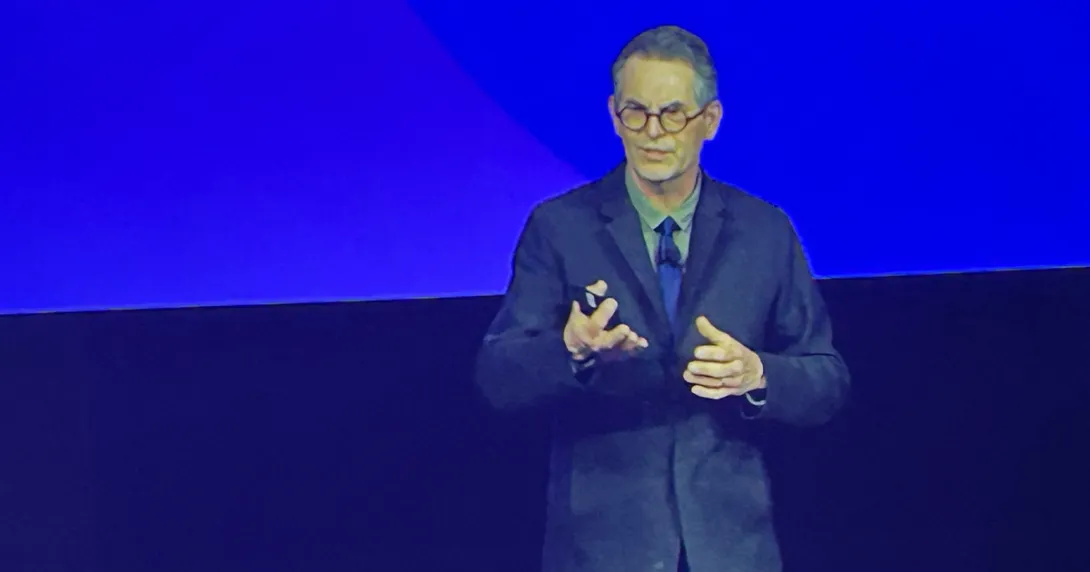
Mayo Clinic Platform President Dr. John Halamka at HIMSS26
Photo: HIMSS Media
LAS VEGAS – "You won't see the term 'AI' in my slides," said Mayo Clinic Platform President Dr. John Halamka during the HIMSS26 opening keynote here on Tuesday.
"I did that purposefully, because having done this for 40 years, what you know is the technologies will change, but the engineering principles will stay the same," Halamka explained.
"I'm hoping today to give you those principles so you can go back to your organizations and build whatever you need to build, buy whatever you need to buy, partner with whomever you need to solve your business problem."
Indeed, for all the constant buzz about artificial intelligence these days – "predictive, generative, agentic, new analytics and visualization tools" – Halamka says that when he speaks with HIMSS26 attendees about what's top of mind, it's generally "not AI implementations that you're thinking about."
Instead, "you're thinking about business and problems to solve. Your margins are thin. Your staff is burned out, especially in rural areas. It's hard to hire and retain specialists and nurses.
"So when we think about how we're going to solve these problems," he added, "I think the first thing to do, as many of you are engineers, is to numerate where we are and where we want to be."
In terms of places where you'd like to be, few can compare with the world-class Mayo Clinic. And Halamka spent much of his talk highlighting some of the leading-edge innovations coming from Rochester, Minnesota, and beyond.
"In 2019, Dr. Gianrico Farrugia, CEO of Mayo, had a vision," he said. "Don't we want a healthcare system that is more continuous, helping us through our care journeys from birth to death?
"We're not in this for technology's sake," said Halamka. "All of us in this room are patients. Don't we want faster cures? Don't we want more rapid discovery? Don't we want easier care navigation? Don't we want to connect the knowledge sources and people more easily than we have today?"
Mayo Clinic approaches this vision and mission on every level – from workforce to technology to physical infrastructure.
When the health system builds out its new buildings, for instance, "they're put together in a modular fashion," said Halamka. "Sometimes you need an OR, sometimes you need an ER, sometimes you need a virtual care building. You can change it as the system around you demands new services."
As for technology, Mayo is a longtime leader, of course.
One of its big ongoing projects is a massive dataset – structured and unstructured – of more than 10 million records, dating back decades. It's an effort to enable the use "the entire corpus of data of the past, everything from text to images to wearable data to genomes, to help us with the care journeys of the future," said Halamka.
Building that resource, and ensuring that every single piece of data, no matter how old, is effectively deidentified, is a tall order, to say the least.
"It really does require rethinking your architecture," said Halamka. "So sure, you'll have your systems of record, your EHR, your ERP, but how do you wrap those in a mechanism that's standard-based, scalable and future-proof?"
But all the technology and advanced clinical decision support in the world will not replace the human factor, the core of care delivery has to be about.
"I've been in 21 countries in the last six months," he said. "I can tell you this is true across the world: Most care, even in 2026, is late stage, invasive, impersonal, hard to navigate and expensive."
At Mayo Clinic, "we want to transform healthcare by capturing knowledge around the world and bringing people and tools and data together in novel ways," said Halamka.
And yes, AI may just be a tool. But right now it's a very powerful tool.
"I am just turning 64, and I care about colonoscopies; some of you in the audience will as well," he said. "Do you know that it is really hard to prepare for a colonoscopy? It's no fun. And that means that your prep isn't always perfect, which means the visualization is not always perfect, which means even the best endoscopist will miss 15% of small polyps."
However, "the AI that overreads all of our endoscopy misses 3% of small polyps," he added. "So I'll ask you a rhetorical question: Should you have a colonoscopy without AI if it's five times better than the best human?"
He put it another way: "What is malpractice? Malpractice is a deviation from the standard of care. Should not AI oversight of all colonoscopy be the standard of care if it's five times better than humans? Probably, sure. And it's probably coming soon."
Halamka is not the only one at HIMSS26 this week to suggest that AI-augmented care is becoming so advanced that it may soon be unethical for hospitals not to use it.
"I have supraventricular tachycardia," he said. "My heart rate can go from 50 to 170. Irritating, but not life-threatening."
But Halamka's colleague, a cardiologist at Mayo, said: "'You know, you may have structural heart disease, vascular disease, cardiomyopathy. But we have 14 AI algorithms that we can run remotely from your living room. So just take a watch, a wearable, a device that you buy on Amazon, and send us your ECG. We'll run through 14 algorithms, and we'll tell you your ejection fraction and the health of your heart muscle or your valves and your circulation.'
"We did it. And the answer is, I don't have any structural issues. I just have a node that conducts poorly. So I take diltiazem every day, and the SVT is gone. All done from my living room. And isn't that the care all of us are going to want?
"Again, this may soon become our standard of care," said Halamka. "And it doesn't mean we're going to need fewer radiation oncologists. It means we are able to treat more patients in more locations than ever before.
"I'm hoping you've seen today that just a few years of work at Mayo Clinic shows the art of the possible," he said. "So go break down some barriers and make sure the patients of tomorrow get the care that we want and they need."
Mike Miliard is executive editor of Healthcare IT News.
Email the writer: mmiliard@himss.org
Healthcare IT News is a HIMSS publication.


