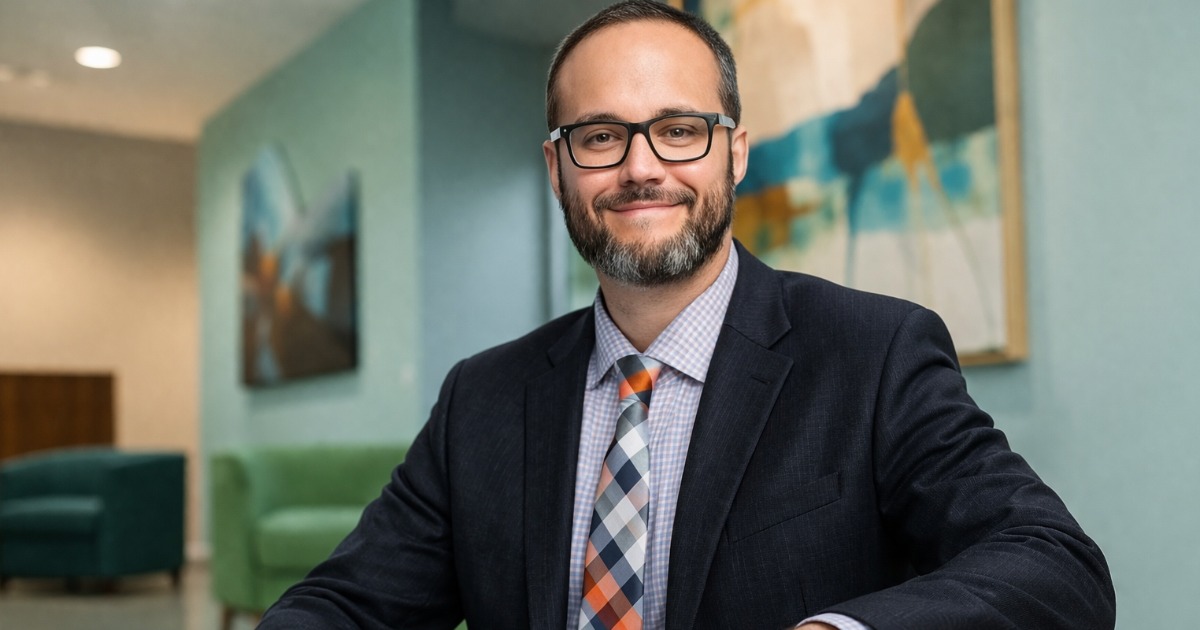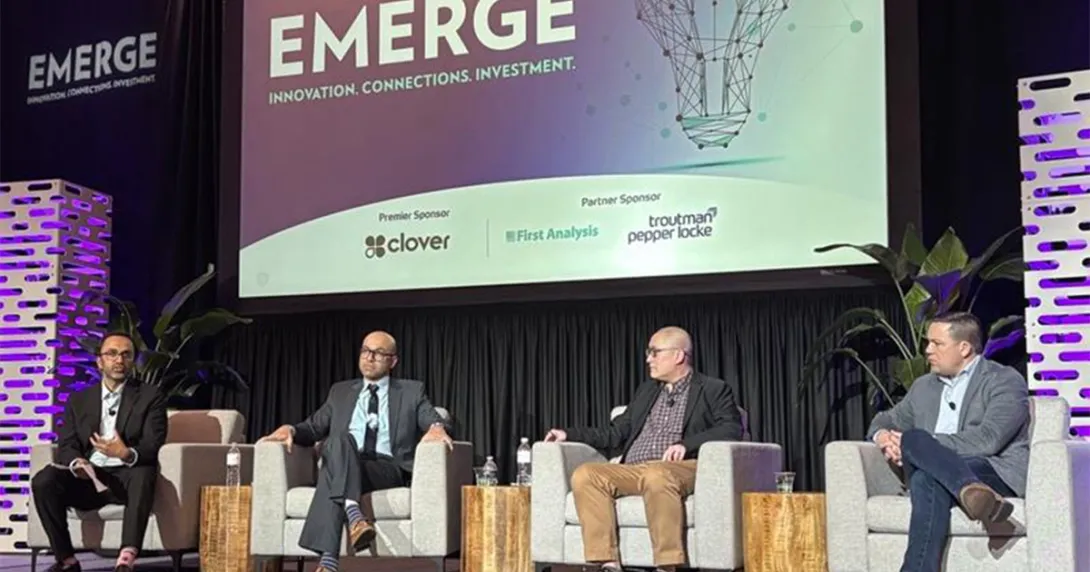
From left, Omkar Kulkarni of Children's Hospital Los Angeles, Dr. Haider Warraich of ARPA-H, Haipeng Mark Zhang of U.S. Veterans Affairs and Stephen Konya of the Assistant Secretary for Technology Policy at HIMSS26 in Las Vegas
Photo: Andrea Fox/Healthcare IT News
LAS VEGAS – The keynote panel session at the HIMSS26 Emerge Experience, "From Pilot to Scale: Building Public-Private Flywheels for AI, Interoperability and Real-World Impact," here on Wednesday examined how health IT companies and providers can use federal interoperability resources and accelerate partnerships to guide health IT startups, investors, health systems and payers.
Panel moderator Omkar Kulkarni, vice president and chief innovation and transformation officer at Children's Hospital Los Angeles, spearheads the largest pediatric accelerator program, called Kids X.
"I spent the last decade and a half trying to bring together communities, bring together startups, bring together providers, payers, and early technology companies and late-stage technology companies, with the goal of adoption," he said.
Inspired by his experience, Kulkarni brought the following federal government tech leaders together for a Q&A to discuss how they see partnerships playing out in the year ahead. Some comments are abridged.
Stephen Konya, chief of innovation and strategic partnerships for the U.S. Department of Health and Human Services' Office of the Assistant Secretary for Technology Policy, helps to shape national health IT and digital health innovation while building public-private partnerships. He has led and co-founded federal innovative initiatives, including Cancer X, the FHIR at Scale Task Force and the Pandemic X Accelerator program.
Haipeng Mark Zhang, the acting Assistant Under Secretary for Health for the Discovery, Education and Affiliate Networks in the U.S. Department of Veterans Affairs, oversees the VA's national research, innovation and clinical training programs, driving collaboration with external partners. Before this role, Zhang led the VA's Office of Health Care Innovation and Learning, where he helped scale solutions to improve care for veterans, families and caregivers.
Dr. Haider Warraich, program manager of the Advanced Research Projects Agency for Health (ARPA-H), leads clinical agentic AI research. Previously, he served at the U.S. Food and Drug Administration as a senior clinical advisor focused on chronic disease and artificial intelligence.
Q. At the VA, what are the things that you look for when you're looking for solutions or products that meet the VA's requirements?
Zhang: The VA is just like any other health organization – we're looking for products that do the work, particularly where it comes to taking care of veterans.
Veterans have some very unique needs that we're also very interested in, such as things like PTSD and suicide prevention. But frankly, at a high level, the things we're always looking for are solutions that actually work, and ideally, can work within a federal environment.
Q. Tell us more about Mission Daybreak and how that ties into some of the things that you look for and the criteria you described.
Zhang: Mission Daybreak is a top clinical priority for VA, launched in 2022, centered around reducing veteran suicide. It brings veterans, families, innovators, advocates, [veteran service organizations] and VA staff together to accelerate and integrate suicide prevention innovations.
It really began as a grand challenge, and it received at that time more than 1,300 concept submissions. We awarded $20 million to 40 teams developing promising solutions. That work has continued.
In 2024, we published a broad agency announcement, or a BAA, to source and fund early-stage research, development, prototyping and piloting. And through that BAA, we've actually partnered with seven companies that applied through this process, and we're continuing to do it.
There's two pieces of this BAA – it's a two-submission process. So step one, there's a concept paper submission, which is three pages. It's very high-level. And once reviewed and requested, step two is a detailed technical proposal up to 30 pages.
Q. Programs like Cancer X, Pandemic X have a focus seeking to find key stakeholders. How do these things come about, and how do you think about constructing these types of programs that are focused on a specific area of interest?
Konya: Well, it comes from a lot of areas. If you've seen one of these initiatives, you've seen one of them, because they're all custom-built with the community that you're trying to innovate with. They're going to help shape what the needs are and what it looks like in each time.
The idea for Kids X didn't come from within the administration at the time. It came from an external stakeholder. It started with a question, and then you [Kulkarni] did all the heavy lifting and pulling together 34 children's hospitals to work together on a National Innovation Accelerator.
It gave us a more easily defined community to go to and try to educate and partner with. It's a matter of getting all the different types of stakeholders inside government together. It's not just one agency – it's all the agencies involved in that topic. Can we pull the pediatrics teams from VA, for instance, and get them involved?
And then outside of government, it's looking at all the different stakeholders who have been in the game as well, including patients, patient advocates, which obviously, there should always be a core of.
Then, bringing in investors, startups, providers, payers if you can, associations and more. Really, be as broad as you can think or as you can possibly imagine, and then bring them all together in a one call to action.
Find out how you can design with their input in a way that everyone can stand to benefit from. It's challenging, and it takes a lot of work. But once you find that common ground between them, then you start to see the magic happen.
Q. Let's talk more about that magic. So public-private partnerships are a big part of what you've driven for three years. What makes a good public-private partnership?
Konya: Well, in my opinion, in the initial design process, you're coming up with the scope of work or whatever it may be that everybody can rally around and say, 'Hey, this is a wall that we're on, and it's clearly defined.' It's got low barriers to no barriers for anybody to participate. Not just those that are currently identified, but those you may not find until later.
Make sure you always have easy on-ramps for people to come join in later and it's a "big tent" opportunity and room for everyone to come under.
The second key ingredient is design in a way that it's self-sustaining beyond even the initial organizations that launched it. So if the government were central, how does the catalyst pull it all together when government is unable to participate or unable to continue to fund it five years later? How can it continue to survive beyond that?
It's the same thing for any of the external or non-federal stakeholders. If you have a large healthcare system that helped launch it, like Children's Hospital of LA, how can it be designed in a way where if you have a change in leadership and in funding and whatever it may be, and you have to drop out, how can it continue on? Even without CHLA, how do they switch leadership to help continue changing the work?
You want these to be self-sustaining communities, and it takes a lot of effort early on to think through that structure so that we can continue to be of value as long as it's needed.
Q. Speaking of public-private partnerships, I think of ARPA-H. How do you describe it in the simplest terms? Where is the program leaning right now? Is there an area or a tool of focus?
Warraich: The story of ARPA-H actually starts way before. It actually starts in the '60s when Sputnik was launched. This was a moment of great shock in the United States because this was a strategic surprise that we had never planned for. In response to that, there was an agency that was formed that's called DARPA, the Defense and Advanced Research Projects Agency.
DARPA has had this historical, legendary run of inventing some of the most consequential technologies in history, like the internet, GPS, teletechnology, etc.
Three years ago, the idea was, what if there was a DARPA for healthcare? What if there were an organization within the U.S. federal government that had the license to be able to fund transformative events in health?
Our agency director, Alicia Jackson, who's also actually a former DARPA program manager, she joined a few months ago, and some of the things that she's outlined as her key priorities include defeating devastating disease and winning the biotech race. She's really focused on longevity and how to make that a real science, and how to get what we're learning about longevity into actual clinical care. Then, when it comes to really figuring out how we can, in fact, unlock the potential of AI and healthcare.
Q. As we think about AI and healthcare, many organizations start by doing a pilot or validation study. At the VA, how do you think about designing a pilot for one VA? How do you scale to the entire VA?
Zhang: That's a really great question. The VA is a massive organization. We do pilots at medical centers through one innovator, and we also think about systemic projects where we definitely do a top-down approach. What's very impressive and exciting about VA is part of what the Office of Healthcare Innovation and Learning does, whether it's supporting the innovator in the ecosystem, in the facilities, or creating a safe sandbox to test these things.
For example, we ran an innovation sprint, a tech sprint, where we had essentially competitors come from the field, and we put them into the National Simulation Center to run through simulated experiences to test the quality of the ambient dictation tools before we made the decision to pilot them in our facilities. That's an example of how we think about doing a top-down, national-scale pilot – we're thinking about it through the full stack. But, we also support – through our Innovation Network and our regional innovation centers – small, discrete pilots across the field.
For folks interested, I would highly suggest checking into Pathfinder.VA.gov, which is our intake engine for industry and companies and collaborators who want to work for VA. There's no guarantee, just to be very clear, that you're going to get a pilot, but I will guarantee that someone will read the application and think about it. If there's someone in the field interested in our innovation ecosystem and raises their hand, our goal with Pathfinder is to try to make that connection.
Q. As you think about startup companies, or people who may apply to programs like Pathfinder, what is a misconception as it relates to the adoption of a technology, the decision associated with adopting a technology or giving it a shot in a pilot?
Zhang: I saw this also when I was working in an academic medical center doing digital innovation. A lot of times, in my experience, I've seen companies, early-stage startups, technology solutions that are very interested, excited, engaged with one organization or another because they think that that affiliation is ultimately going to create more business being aligned with XYZ Institute or whatnot.
And there's a disconnect between what's possible and the timeline, with, frankly, the runways of the companies.
The thing I would say is you may have an amazing technology, but you also want to really think and do your homework about whether you're ready and how to engage. Specifically, when you think about engaging with any federal entity, doing the homework and knowing whether your solution needs to be FedRAMPed or what other additional considerations you have to think about before you have a pathway to scale is going to be really important.
Also, what can we both get out of a discovery relationship that's valuable for you, but also valuable for our organization and veterans? Think about what is in it for us, certainly, but what's in it for you.
Warraich: The mission of ARPA-H is to take big swings, and it's really about how we can leverage our resources as the greatest country in the world to be able to really defeat some of the greatest challenges that we face in our field.
As an example, we have programs that include how we transplant eyes, which is essentially neurotransplantation. We have another program in which we're essentially creating an interoperable data exchange that harmonizes multimodal clinical genomic data across 200 hospitals in this entire country.
Oftentimes, you need something to de-risk the process to get to that base. I think that's the space where I think ARPA-H really can focus on that, but the vision has to be there. That's the role that we're playing this year.
The metrics are publications and consistency, keeping your lab funded, etc. I think that those incentives have basically created a system in which you just want to keep things afloat. You don't want to take big swings, and there's no real incentive. Frankly, there was no avenue for where you can go to be able to get that type of work funded. Since I've been in ARPA-H, the most common is incremental, not transformative. Sometimes ... the best thing we can do is push people to think about things and think about problems that they never felt like they had a license to do.
But when you look at high-capability, high-impact technologies, which would fall under a regulatory framework at the FDA, there's not a single FDA-authorized generative AI technology of any sort.
The idea for this program is how can we support teams that want to develop a patient-facing technology that can do everything a doctor can on the phone, which includes making a diagnosis, performing triage, providing treatment and then closing the loop all of it autonomously.
We're focused on a hard problem. We're focused on patients with heart failure. Because we feel, if you can prove that it works for heart failure, then you can actually show the entire use that it can work for any other client.
The other thing that we're doing is there's this false dichotomy between you can either be safe or you can be innovative. And I think you can be both. For the purposes of this program, the other technology that we want teams to develop is what we're calling a supervisory agent. This would be a disease-agnostic technology that would be essentially co-deployed to the cardiovascular system that can really optimize human oversight. Because we know that a system that is fully reliant on human oversight is just not on scale.
I think all of those reasons highlight the importance of both transformative, moonshot-type innovation, but also that of making an economic improvement.
Q. As we think about a "big swing" in interoperability, how we can get from where we are now to where we all want to get to? What are those big swings going to look like, and what are the types of things we all can do to help get to that point?
Konya: We're here at HIMSS – interoperability is like the core of everything going on. This is the Emerge track, which obviously is supposed to be focused more on innovation.
But I think you can't have a conversation about innovation without talking about the data that fuels that innovation. We know it's a critical piece of it. It's the lifeblood of many of these new innovative technologies and tools.
Without the good data being available and interoperable, the quality is not going to be there.
They're not going to be effective. Luckily for you, the federal government has been working this for 20-plus years on coordinating health IT adoption and the interoperability piece of it. While we still know there's a lot more work to be done, otherwise this conference wouldn't exist as far as promoting all the things that need to happen from that.
But we have come a long way, too. In the mid-2000s, it was still pretty much all paper, manila folders and filing cabinets. And how do you build a digital tool to take advantage of all that information when it's all locked up in buying cabinets? Now the bulk of it is in a digital format, and it's almost an issue of having too much data, not knowing what to do with it all, being able to look with it, or not having great quality data being matched with other data that is of the quality.
At that intersection of the work we're doing to support interoperability, we work with startups, investors and innovation programs at hospitals and others to understand where there are still needs and friction points – a lack of data standards, interoperability and governance around probably using these things.
Ultimately, if we can start to address those things, it makes it easier to take either the big swings or the incremental ones. I don't think it needs to be an either/or. I think the incremental needs to always be there. It's a consistent approach.
That's the stuff that I get excited about – figuring out how to support both the incremental innovators every day, as well as how you can continue to work and support those who are making the big swings. And sometimes it means doing it through a partnership.
Andrea Fox is senior editor of Healthcare IT News.
Email: afox@himss.org
Healthcare IT News is a HIMSS Media publication.