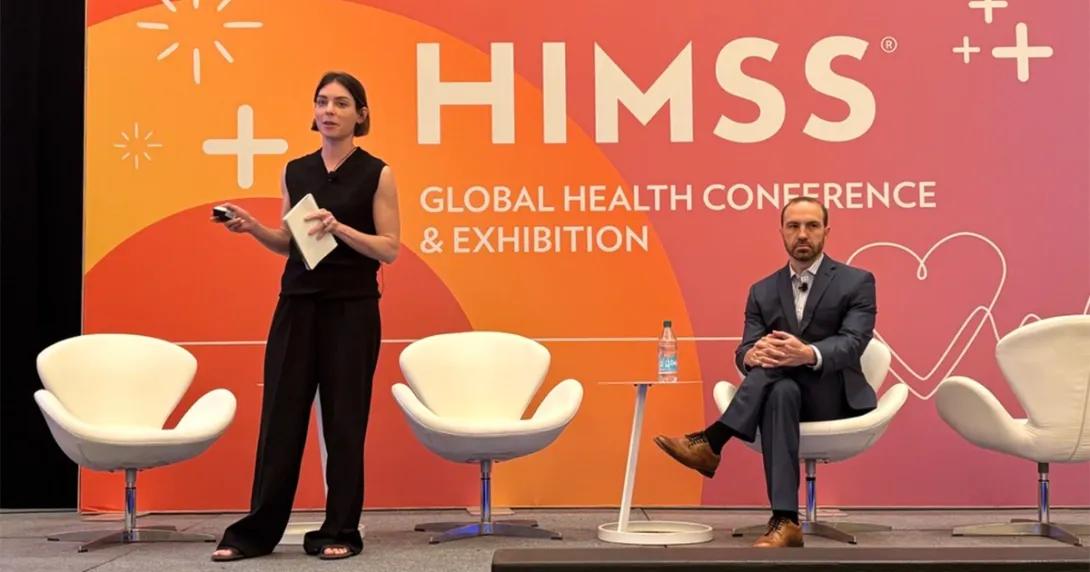
From left, Jessica Saleska, lead AI implementation researcher at Washington University School of Medicine, and Dr. Nathan Moore, BJC Healthcare medical director, present at HIMSS26 in Las Vegas.
Photo: HIMSS Media
LAS VEGAS – To enhance end-of-life care and reduce manual workflows, BJC Healthcare, an Accountable Care Organization serving patients in Missouri and Southern Illinois, partnered with Washington University's School of Medicine in St. Louis, Missouri, to develop artificial intelligence-based automations.
The HIMSS26 session "Multi-Artificial Intelligence Agents for Enhancing Clinical Decision Support in End-of-life Care" that took place here on Tuesday explored how an augmented large language model that relies on deep learning can intervene in persistent workflow challenges and initiate person-to-person alert messages that trigger human caregivers to take action.
"Those of you who work in the clinical space are probably aware we have a really odd approach to end-of-life," said Nathan Moore, BJC's medical director. "In the U.S., we perform a lot of, some would call it, 'futile care.'"
"We're providing care that's not really benefiting the patient," he said. "It's also quite expensive to our society and health systems, and oftentimes, it's not what the patients actually want."
Moore said that while 75% of Americans prefer to die at home, less than 33% do.
In value-based care, the use of AI holds great potential to improve care quality, workflow efficiencies and care coordination challenges, such as end-of-life planning.
Moore, who is also the author of "The Health Care Handbook: A Clear and Concise Guide to the U.S. Healthcare System," said his health system averages about 50,000 admissions per year, and 1-2% of these patients may be high-risk.
"There are clinical prediction calculators for everything in medicine," he said. "But not mortality."
Advanced care planning (ACP) conversations are difficult, with patients often being volleyed between primary care and specialists to have them.
"That's what we, at our health system, tried to do a better job of," Moore said.
The resulting inpatient workflow to trigger ACPs maintains human decision-making, however.
"Think about mimicking what's really being done with humans in the real world," said Jessica Saleska, the lead AI implementation researcher at the university and Moore's co-presenter at the HIMSS26 session.
While multi-agent architectures can be challenged by information overload, a new CDS integration at the health system implemented in the last year has improved operational efficiencies, clinical accuracy and continuity of care for high-risk patients.
Saleska and her team built a machine learning AI model that pulls structured data out of the ACO's electronic health records, which reviews patient data and notes, decides if the patient might be near the end of life and sends a message to a human administrator.
While the workflow is a multi-human model loaded with manual steps, they did not automate person-to-person messaging and the ultimate choice to recommend a high-risk patient for advanced care planning.
The workflow then passes from the model "to a critic and then to a goal judge and then a reflection agent," Saleska explained.
They also initiated a feedback loop – a Learning Reviewer Agent that learns from the human messaging in the workflow. The agent's results are also kept outside of the medical chart.
"It's been a compromise that's working to date," said Moore.
To customize the model, they used supervised learning with more than four years of programmatic data to help predict how reviewers and doctors would respond.
After preliminary evaluation, the health system launched the model-driven workflow in "shadow mode," a silent evaluation of a model's performance before actual deployment.
There were also technical challenges around EHR regulations and cloud environments (the trained agent is using OpenAI's GPT, but in a data bricks environment), as well as managing change among clinical staff.
Moore said he was initially concerned that the automation would deteriorate the physician alert response rate, which was greater than 90%, but it did not.
The ACP rate in outpatient settings increased by more than 25%, while the time for ACP billing was reduced by more than 20%, said Moore.
"We're now able to provide this intervention for more patients," he added. "We like to target our interventions at every point along the continuum that matches the acuity of the patient."
With the model able to identify patients who need additional discussions, "we're now notifying the primary care providers at the time of their hospital follow-up visit."
Andrea Fox is senior editor of Healthcare IT News.
Email: afox@himss.org
Healthcare IT News is a HIMSS Media publication.


