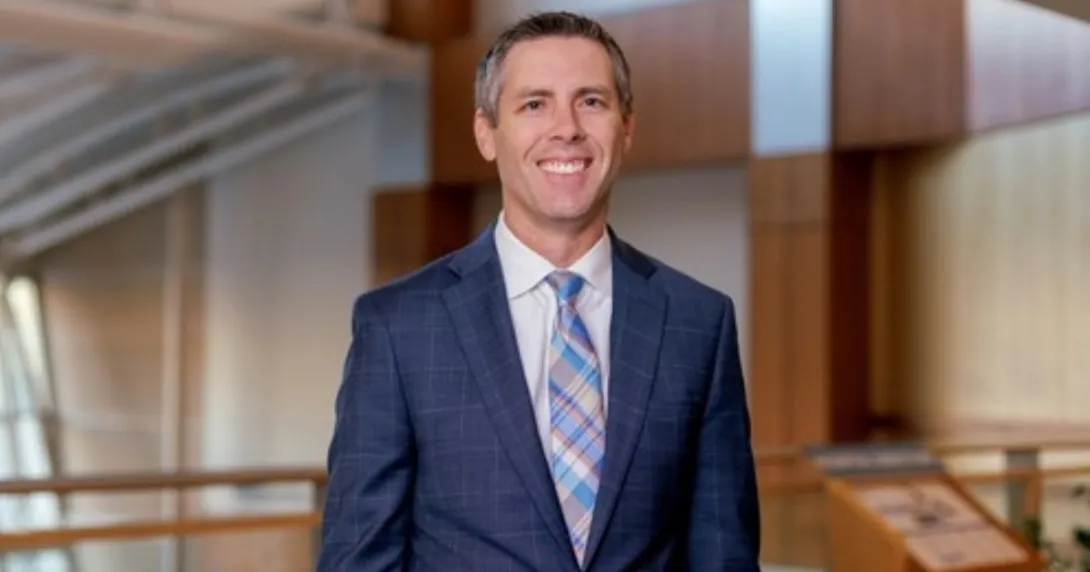
Dr. Kory Anderson, medical director of inpatient care and clinical documentation integrity at Intermountain Health
Photo: Intermountain Health
Intermountain Health was confident in the high quality of care it delivered to patients. But it faced a significant challenge in ensuring that its clinical documentation fully and accurately reflected the quality and complexity of care.
THE CHALLENGE
There was a noticeable gap, in other words, between the acuity of patients' conditions and the story told by their medical records. This disconnect had real consequences – not just for billing and reimbursement, but for accurately representing quality of work and pointing to true opportunities for improvement.
In addition, the medical record is a communication tool between providers across the care continuum and is the patient's story, and staff felt they were not adequately telling the patient's story.
"Education of our medical staff around documentation and risk adjustment was a focus for our team, but there are so many things providers are asked to remember in the day-to-day of seeing and caring for very sick patients," said Dr. Kory Anderson, medical director of inpatient care and clinical documentation integrity at Intermountain Health. "We would see transient improvements in documentation after education sessions, but we failed to see sustained improvement over time as providers were drawn to other more pressing needs or issues.
"In addition to education, the existing query process for improving documentation was often inefficient and frustrating for our physicians," he continued. "It relied on a retrospective query system, where clinical documentation integrity specialists would review a chart after the fact and send questions back to the physician for clarification."
For a busy hospitalist like Anderson, these queries would arrive days later, forcing him to recall specific details about a patient he might have seen earlier in the week. For him, it felt like an administrative chore that added to an already heavy workload and took time away from direct patient care.
"This manual, after-the-fact process created a constant back-and-forth that was burdensome for everyone," he said. "It was a source of frustration for physicians, who felt they were being asked to do extra work, and it limited the ability of our CDI specialists to focus on more complex cases.
"We knew there had to be a better way – perhaps proactively and upstream – to capture the complete patient story in a way that supported our physicians instead of adding to their burdens," he added. "Our goal was to find a method that would help us document the true acuity of our patients right from the start, making the entire process more efficient and accurate."
PROPOSAL
So Intermountain decided to fundamentally change the approach to clinical documentation by using a health IT platform from vendor Solventum.
"The core idea was to shift from a purely retrospective, query-based model to incorporating a component of a proactive, real-time system embedded directly within our existing electronic medical record workflow," Anderson explained. "At the time, we used Cerner, and the vision was for this new tool to integrate seamlessly, becoming a natural part of the physician's documentation process rather than a separate, disruptive task.
"The technology was designed to use artificial intelligence to analyze a physician's clinical note as it was being written," he continued. "Instead of waiting for a CDI specialist to review the chart later, the system would identify opportunities for greater specificity or clarification, or propose a possible missing diagnosis in the moment."
The system would present these opportunities to the physician as simple, interactive "nudges" or suggestions directly on their screen. For example, if a physician documented "heart failure," the tool might prompt them to specify whether it was "acute" or "chronic" and "systolic or diastolic, or both." This would allow the physician to add the necessary detail at the time of note creation, while the patient's case was still fresh in their mind.
"The promise was twofold," Anderson noted. "First, it would empower physicians to create a more complete and accurate record from the outset, reducing the need for frustrating retrospective queries. This was key to gaining physician buy-in. Second, it would elevate the role of our CDI specialists.
"By automating the more straightforward clarification requests, the platform was intended to free up our CDI team to concentrate on more complex cases, perform deeper analysis, and serve as educators and partners to our clinical staff," he added. "The ultimate goal was to create a more collaborative and efficient ecosystem that helped us accurately reflect the quality of care we provide and document the complete patient story."
MEETING THE CHALLENGE
Intermountain integrated the Solventum platform directly into its Cerner EMR. This integration was crucial because it means physicians do not have to log into a separate application – the tool works within the environment they already use every day for patient care documentation. The primary users are inpatient physicians, APPs and residents.
"When a physician is typing a clinical note, the AI works in the background, analyzing the text in real time," Anderson said. "If it detects a place where more specific information could be documented, for instance, clarifying the type of condition or linking a symptom to a diagnosis, it generates a nudge. This appears as a small, nonintrusive suggestion on the physician's screen.
"The physician can review the nudge and, with a simple click, accept the suggestion to add the more specific terminology directly into their note," he continued. "The process is immediate and interactive, turning documentation into an opportunity for clarification rather than a retroactive chore."
Intermountain took a physician-led approach to help ensure success and drive adoption.
"We established a governance structure with physician leaders at the forefront and recruited a team of physician informaticists," he explained. "These are practicing physicians who became super-users and champions of the tool. They were responsible for training their peers, answering questions and helping customize the system to fit our clinical needs.
"This peer-to-peer model was instrumental in building trust and demonstrating the tool's value from a clinician's perspective," he continued. "It shifted the perception of CDI from an administrative burden to a clinical tool that helps us tell a more accurate patient story."
RESULTS
One of the most significant results has been the financial impact from capturing a more accurate case mix index. By helping physicians document the true severity of illness and complexity of care at the point of service, the technology enabled the organization to achieve a seven-figure increase in appropriate reimbursement within the first year.
"This wasn't about changing the care we provided, but about ensuring our documentation accurately reflected the high-quality care that was already being delivered," Anderson stated. "The real-time nudges made it simple for physicians to add the necessary specificity, which directly translates into a more precise CMI through improved CC/MCC capture and, consequently, more appropriate reimbursement.
"Another key metric is our physician engagement rate, which has reached 94%," he continued. "This number is a powerful indicator of success because it shows our physicians are actively interacting with and see value in the tool. The technology helped us achieve this by making the process intuitive and respectful of a physician's time."
Instead of receiving a query days later, they get an immediate suggestion that can be addressed in seconds, while the patient's details are still top-of-mind, he added.
"This high adoption rate demonstrates a clear physician preference for this interactive, in-workflow approach over the traditional, retrospective query process," he said. "In addition, we were able to track natural compliance with documentation – meaning, we could see where a nudge would have fired, but the physician naturally documented the specificity on their own without being nudged, which showed they were learning from the nudges and improving on their own with time."
Finally, Intermountain has seen a significant "halo effect" on the efficiency and role of clinical documentation integrity specialists.
"While I don't have a specific number for the reduction in queries, the automation of simple clarification requests has freed up our CDI team to operate at the top of their license," he reported. "They now spend less time on routine queries and more time on complex case reviews, physician education and analyzing data to identify broader documentation trends.
"The technology transformed them from query writers into true data-driven partners to our clinical staff, enhancing the collaborative culture between our clinical and administrative teams," he concluded. "We haven't seen a reduction in queries, per se; rather, our CDI team has been able to help make sure some of the less common diagnoses and conditions are reviewed and documented appropriately because low-hanging fruit conditions like CHF and CKD are now being documented proactively with or without a nudge."
Follow Bill's health IT coverage on LinkedIn: Bill Siwicki
Email him: bsiwicki@himss.org
Healthcare IT News is a HIMSS Media publication.
WATCH NOW: Managing government policy and regulation in healthcare AI adoption


