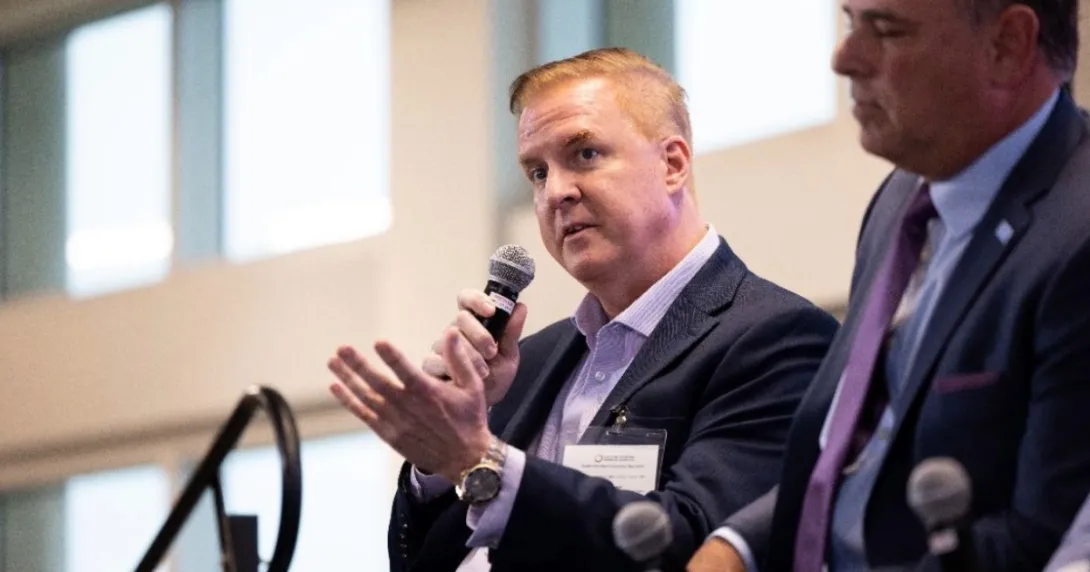
Steven Travers, chief information officer at Broward Health
Photo: Steven Travers
Hospitals and health systems spend a lot of money on the latest and greatest healthcare information technology. But none of that investment matters if frontline staff don't embrace those tools.
Adoption is one of the major health IT issues today, says Steven Travers, chief information officer at Broward Health, a four-hospital health system based in Fort Lauderdale, Florida, that serves the North Broward County area. He earned a PhD in business administration.
"When you look at IT, we do a great job of implementing software and getting it there – for example, we have the Epic EHR and do two upgrades every year," said Travers. "You spend a fair amount of time each year learning new functions. And with all the new pieces there is a lot of AI, but there's many other functions.
"So, the difficulty I see a lot of organizations having is getting the operations people and clinical people to adopt the new technologies IT is putting out," he added. "Because it's coming at them at a very fast pace and in several different areas. It's not just Epic. It might be your Workday system, it might be the UKG for scheduling. Microsoft 365 has all kinds of changes."
It's the amount of change – healthcare organizations are past the difficulty of implementation; the challenge really is around adoption, he added. That's where organizations still struggle, to get engagement from the end users, to get them to learn new information and use new components, and then adopt those before the next set that's coming, he said.
More and more trainers
At Broward Health, when IT staff look at training clinical informatics teams, for example, IT tends to skimp on materials and really expand the IT staff training group compared with the implementation team.
"It's about adding more trainers into the mix so we can get them to be experts at adopting new technology," Travers explained. "And you do that by getting feet on the ground, getting out, seeing people, showing them the new technologies, doing sessions and having availability for them, online sessions so people can see it, record that so you can watch it after hours.
"For me, that's one of the changes we're going through, to really focus on adoption because we've got a ton of technology now that's implemented in our organizations, but we often don't use it to its fullest."
Many times, when staff or vendors bring a new technology to Travers and his team, they find there usually is overlap with tools already in place.
"By not adopting an existing system fully and not learning all of its pieces and using them in your everyday work life, what ends up happening is there's these gaps in knowledge about the system," he said. "Then people look for some of these point systems to fill these gaps, even though your existing system might already cover them."
So truly complete adoption is yet another challenge that must be met, he added.
People and process
Travers recommends to his peers at other hospitals and health systems struggling with the adoption challenge to focus not so much on technology but on people and process.
"Often healthcare organizations spend very little time going through the workflow, going out to the sites, seeing how people actually do their work, and understanding the details behind all that," he noted. "Often organizations bring a technology in that's got a workflow IT staff basically try to just stamp in there.
"Focusing more on people and process is the key because organizations are filled with people and the technology is just one component," he continued. "They've got to want to adopt this new technology. They've got to want to see the reason for why they have to use it. They've got to see it not as something that's going to add more work, but something that's going to help them out with their work to either make it better or more efficient."
For his peers, Travers advised the adoption challenge should really be focused less on technology because a lot of that is getting blended into the background with software-as-a-service and other platforms.
"It's become more what you are doing around people and process to make sure the technology fits what the organization is trying to accomplish through the processes these professionals have," he concluded.
Follow Bill's health IT coverage on LinkedIn: Bill Siwicki
Email him: bsiwicki@himss.org
Healthcare IT News is a HIMSS Media publication.
WATCH NOW: Utilizing computer vision in hospitals


