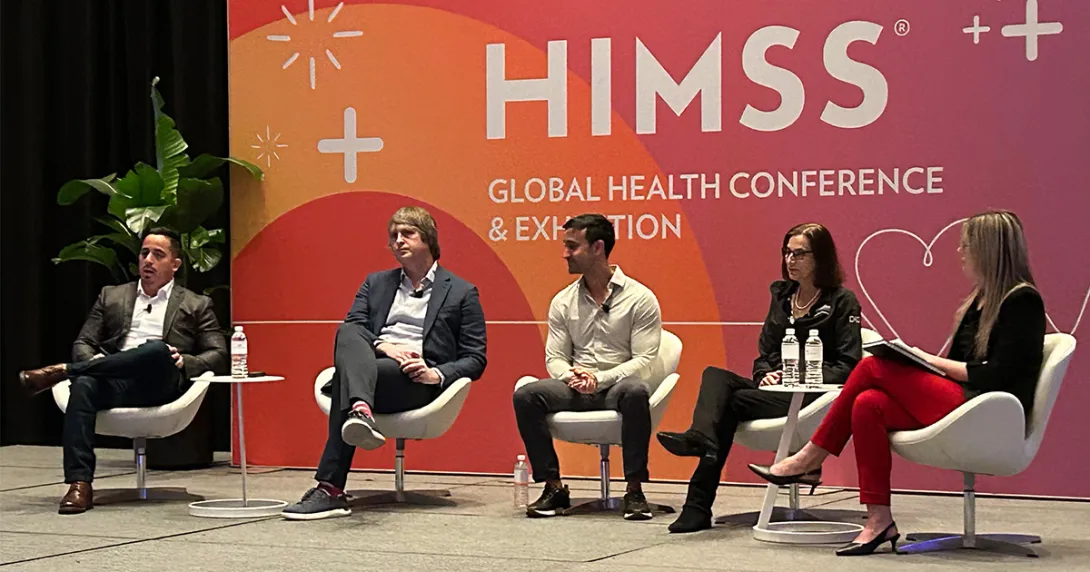
(L-R) Michael Archuleta, Michael Hasselberg, Ian Shakil, Roberta Schwartz and Amy Zolotow at HIMSS26 on Monday.
Photo: HIMSS Media
LAS VEGAS – At the HIMSS26 AI in Healthcare Forum here on Monday, clinical and IT leaders from a variety of U.S. hospitals and health systems compared notes on their own artificial intelligence experiences so far – and assessed where the larger healthcare industry is on the road to AI adoption.
The panel discussion, "From Hype to Reality: Guiding Leadership Through AI Transformation," was moderated by Amy Zolotow, senior fellow at Belmont University's Thomas F. Frist, Jr. College of Medicine.
She spoke with Michael Archuleta, chief information officer of Mt. San Rafael Hospital in Colorado; Michael Hasselberg, chief transformation and digital officer of Nebraska Medicine; Houston Methodist Chief Innovation Officer Roberta Schwartz; and Ian Shakil, chief strategy officer at AI vendor Commure.
Each brought different perspectives to the conversation, and each offered proof that, for all the inescapable hype of AI, for all the big spending – whether driven by under-informed FOMO, or the result of careful deliberation and research – there's little doubt that AI is already well in place and transforming care delivery in fundamental ways large and small.
'We want to create specific results'
For his part, as CIO of a 25-bed critical access hospital, Archuleta made the point that efficacy and utility are fundamental starting points for any AI investments.
"If we bring in specific AI tools that don't have an actual patient-centric initiative associated with it, then it's just noise," he said. "We really want to create specific results, especially in rural America, where every dollar counts."
At Mt. San Rafael, for instance, "we incorporated, specifically, seven algorithms within our organization that have really been life-saving initiatives within our radiology practices."
Hasselberg, meanwhile, works at a large health system with multiple hospitals and clinics and more than 800 beds. With the resources that come with an organization of that size, he has been keenly interested recently in developing AI applications in-house.
"As an academic health system, I truly believe it's never been easier for health systems to develop their own AI tools to solve their own problems," said Hasselberg. "We have access to the same foundation models as all the vendors in this room have. We have the data, we have the problems, and we have the content experts.
"At Nebraska Medicine, we have a small but mighty dev team, and we're developing an AI use case, about one a month," he added. "We scale over 25 AI use cases across the health system and are having a lot of success."
And at Houston Methodist, a longtime innovation leader, AI doesn't always pan out as planned. Zolotow asked Schwartz to "walk us through one AI investment that looked very promising on paper but didn't deliver – talk about the signals that were missed, what changed along the way to have you re-evaluate."
Schwartz said change management challenges can be a big culprit when it comes to AI misfires.
"Technology plus not changing equals more expensive," she said. "Technology plus innovating and transforming the way that you do your business is the thing that ends up saving us the money. Because ultimately, all of us have to do healthcare cheaper, I don't care if you're in a rural environment or in an urban environment."
One challenging deployment at Houston Methodist was a project putting ambient cameras in the operating room, an effort to help monitor equipment and track process efficiency.
Many surgeons were not happy about the new scrutiny, which they saw as an intrusion. "When we started rolling it out and using the data, as well as the voice, I can tell you we had like mayhem," Schwartz said. "It was crazy."
Now, almost two years later, most have come around on the project and are willing to buy into the idea that "it's a tool, not surveillance."
Which goes to show how much AI change can come in just a couple years.
'Change your prior assumptions'
As the session wrapped up, Zolotow asked the panel to each name a single important "shift" that could help other providers move beyond hype and toward lasting AI-enabled transformation.
For her part, Schwartz said Houston Methodist is far past the hype phase already: "At this point in time, AI has moved into every product that we've got," she said.
"I think that this is a year of maturation," she added. "This is a very interesting time. And I think maturing your technologies into these platforms, it's an ideal time for that."
"I was going to say speed, but I think flexibility is very much needed in this year in particular," said Shakil. "What you're going to see come out of Silicon Valley in the next few months is going to change a lot of your prior assumptions from what integrations can work.
"Whatever you thought was normal six months ago will not be normal six months from now," he added. "So be ready to press the refresh button on your priors."
Hasselberg advised healthcare organizations to "cultivate your internal talent. Upskill them, build up their skills in the sense. So we can start being more nimble as health systems and take some of these problems on."
While he's a big fan of homegrown products, "it's not that we don't work with vendors," he said. "We have some great vendor partners. And some of my best vendor partners are those vendors that take a forward deployed engineering model. And then we actually leverage those forward deployed engineers to upskill my own internal talent."
As Archuletta sees it, the momentum is already significant – and, properly harnessed, could lead to great things, regardless of the organization.
"In the end, if AI closes the gaps of what we're trying to accomplish here, the enhancements of better patient care outcomes, I'm all behind it," he said. "Your ZIP code should never determine your overall healthcare outcomes. Period. If we can utilize this technology to really improve on the enhancements of what we do in rural America, I am sold."
Mike Miliard is executive editor of Healthcare IT News.
Email the writer: mmiliard@himss.org
Healthcare IT News is a HIMSS publication.


