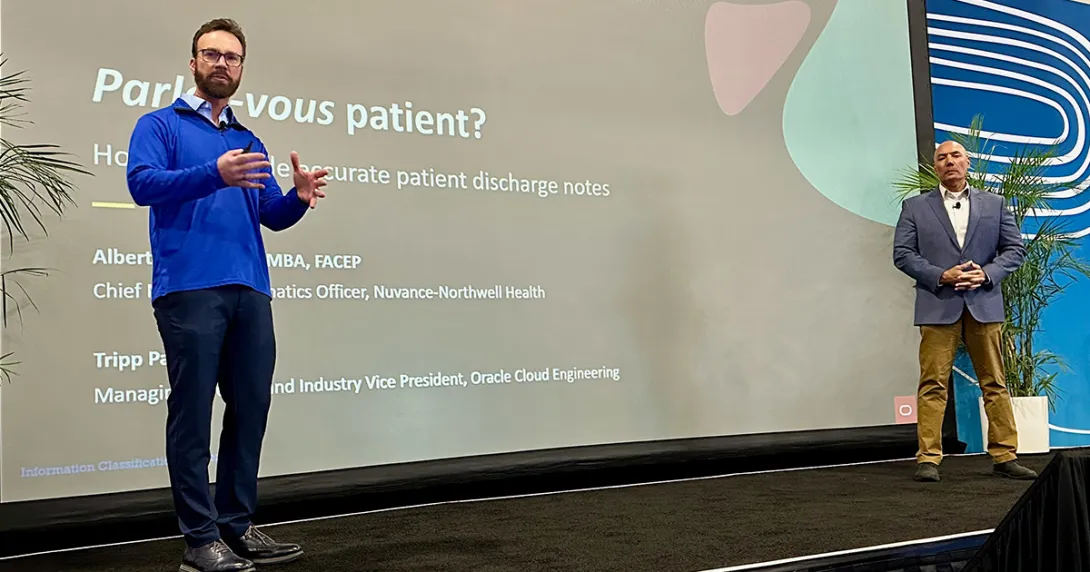
Tripp Partain of Oracle and Albert Villarin of Nuvance-Northwell Health at HIMSS26 on Wednesday
Photo: HIMSS Media
LAS VEGAS – Language barriers remain a persistent challenge in healthcare, often leading to misunderstandings in discharge instructions that can increase medical risk and contribute to avoidable readmissions.
At a HIMSS26 session here on Wednesday, "Parlez-Vous Patient? How to Provide Accurate Patient Discharge Notes," Tripp Partain, senior director of cloud engineering at Oracle, and Dr. Albert Villarin, vice president and chief medical officer at Nuvance-Northwell Health, discussed how new AI-driven translation tools are helping health systems deliver clearer, culturally appropriate discharge information for patients who speak a wide range of languages.
The goal, Partain said, is simple: Ensure that no patient's care instructions are lost in translation.
When language services are delayed or inconsistent, instructions are often rushed through existing workflows, increasing the risk that patients leave the hospital without fully understanding their care plans.
AI translation tools integrated with electronic health records aim to close those gaps by automatically translating discharge instructions into multiple languages while maintaining medical accuracy.
"Language barriers in healthcare systems lead to poor care, increased readmissions and system inefficiency," Partain said.
Traditional translation tools, he noted, are not designed for clinical environments. Medical instructions involve complex terminology, dosage information and standardized codes that require models trained specifically on healthcare data.
Modern translation platforms address that challenge by incorporating clinical terminology and structured data standards such as HL7 and FHIR to ensure medication names, dosage instructions and clinical documentation are translated correctly.
"These systems are trained to understand medication dosages, medical codes and other clinical terminology so the AI model works as it should," Partain said.
For health systems serving linguistically diverse populations, the stakes are especially high. Villarin said Nuvance-Northwell Health's hospitals across the New York region care for patients who collectively speak hundreds of languages.
"Every single language in the world is spoken by someone in this region," Villarin said.
Ensuring patients understand discharge instructions is essential for building trust and improving outcomes, particularly for patients who may already face barriers to accessing care.
"If we can’t communicate with patients, we're in the wrong business," Villarin said. "Patients need us and trust us."
Research has shown that non-English-speaking patients often experience higher readmission rates for conditions such as heart failure and acute myocardial infarction, in part because post-discharge instructions are not fully understood.
Villarin said improving communication at discharge is therefore both a patient safety priority and an operational goal.
"Our roadmap is to embrace the entire ecosystem of the patient, from registration to discharge," he said.
Longer term, the vision is to embed language preference directly into clinical workflows. When patients register, their preferred language would automatically populate the electronic medical record, allowing discharge instructions and other communications to be generated instantly in that language.
"We want the experience to be efficient and positive for both the patient and the provider," Villarin said.
Both he and Partain emphasized that technology is not replacing clinicians but instead strengthening their ability to connect with patients.
By improving communication at every step of the care journey, health systems can reduce risk, improve outcomes and reinforce the trust that underpins effective healthcare.
"We are better clinicians because we are better communicators," said Villarin.
WATCH NOW: How nurses can improve AI deployments
Nathan Eddy is a healthcare and technology freelancer based in Berlin.
Email the writer: nathaneddy@gmail.com
Healthcare IT News is a HIMSS Media publication.


